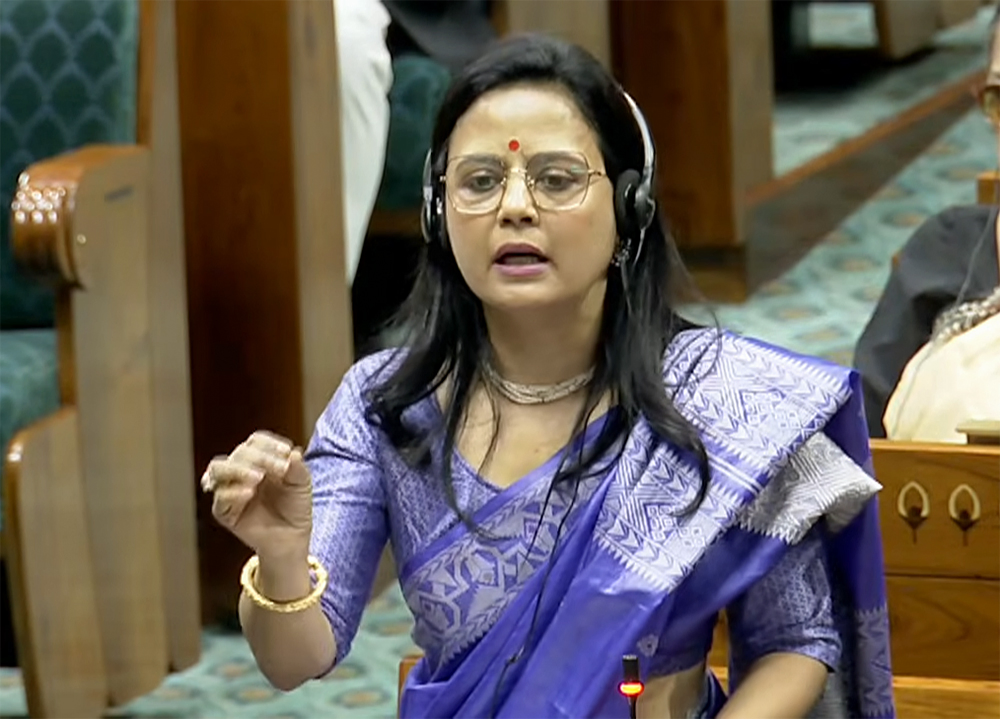
New Delhi, March 13 – The Supreme Court on Friday issued notices on a petition filed by the Lokpal of India challenging the Delhi High Court judgment that had set aside the sanction granted to the Central Bureau of Investigation (CBI) to file a charge sheet against Trinamool Congress MP Mahua Moitra in connection with the alleged "cash-for-query" row.
A Bench of Chief Justice of India (CJI) Surya Kant and Justice Joymalya Bagchi sought responses within three weeks from Moitra, the CBI, and BJP MP Nishikant Dubey, who has accused Moitra of accepting cash and luxury gifts from Dubai-based businessman Darshan Hiranandani in exchange for raising questions in Parliament.
During the hearing, the CJI Kant-led Bench also stayed the Delhi High Court’s direction asking the Lokpal to decide within 60 days whether to grant sanction to the CBI to file a charge sheet against Moitra.
The apex court clarified that, for the time being, the Lokpal cannot direct the CBI to file a charge sheet against the Trinamool leader and that no coercive action would be taken against her in the matter.
The CJI Kant-led Bench observed that it would examine the statutory scheme and the scope of powers vested in the Lokpal under the Lokpal and Lokayuktas Act, 2013. Senior advocate Ranjit Kumar, appearing for the Lokpal, submitted that the anti-corruption body was aggrieved by the interpretation of the Lokpal Act adopted by the Delhi High Court, and clarified that the petition was not directed against any individual.
He argued that the Delhi High Court’s interpretation of Section 20 governing inquiry and investigation had far-reaching consequences for the functioning of the anti-corruption body.
In its petition, the Lokpal sought an authoritative ruling from the apex court on the procedure to be followed by the anti-corruption watchdog while directing investigation and granting sanctions.
The Lokpal argued that the Delhi High Court’s judgment had incorrectly interpreted the statutory framework and failed to consider the interplay between various provisions of the Act.
According to the petition, the legislation is a special law that lays down a distinct procedure for inquiries and investigations against public servants and empowers the Lokpal to order preliminary inquiries, supervise investigations and grant sanctions for filing cases or charge sheets.
“The legislative intent is to proceed against public servants involved in corruption without exception while protecting honest officials from vexatious complaints,” the plea stated.
The anti-corruption body further submitted that if the High Court’s interpretation were allowed to stand, it could enable accused persons to stall corruption prosecutions at the threshold by inviting writ courts to conduct “mini-trials” at the stage of sanction.
The controversy stems from allegations levelled by BJP MP Nishikant Dubey, accusing Moitra of accepting cash and luxury gifts from Dubai-based businessman Darshan Hiranandani in exchange for raising questions in Parliament.
Acting on the complaint, the Lokpal had directed the CBI to conduct a preliminary inquiry and later a full investigation into the allegations. After the probe, the Lokpal passed an order in November 2025 granting sanction to the CBI to file a charge sheet before the competent court. However, in December 2025, the Delhi High Court set aside the Lokpal’s sanction order, holding that Section 20 of the Lokpal Act did not contemplate separate sanctions for filing a charge sheet and initiating prosecution and that the sanction had to be granted in a composite manner.
A Bench of Justices Anil Kshetarpal and Harish Vaidyanathan Shankar had accepted Moitra’s contention that the Lokpal had failed to properly consider the statutory requirement of examining the comments and material submitted by the public servant before granting sanction.
The Delhi High Court had directed the Lokpal to reconsider the issue in accordance with the law and take a fresh decision within a month.
Later, in January, the Delhi High Court granted the Lokpal a final extension of two months to decide the issue, observing that no further extension of time would be entertained.
The Supreme Court will now examine the broader question of the procedure to be followed by the Lokpal during inquiry and investigation, and the extent of judicial review over its decisions.