New Delhi, February 26 – Amid the fierce confrontation and bitter exchange of accusations over the Congress’s charge of a “compromised PM”, the Bharatiya Janata Party (BJP) stepped up its offensive on Thursday, accusing India’s first Prime Minister, Jawaharlal Nehru, of compromising and surrendering India’s interests, integrity, and sovereignty to foreign powers.
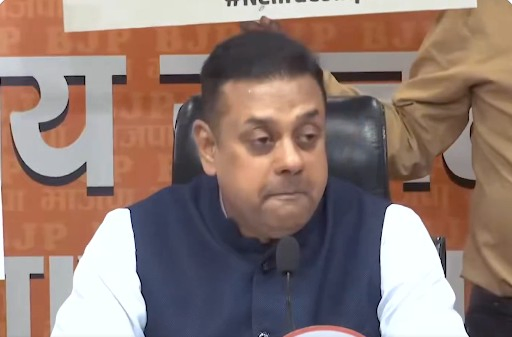
“It’s not Chacha Nehru who compromised, but Chacha himself,” said BJP National Spokesperson Sambit Patra, taking a pointed swipe at the Congress while also posing seven questions on why India “surrendered and capitulated” before foreign powers, including adversaries like China and Pakistan.
Speaking to the press at the party headquarters here, the BJP MP launched a frontal attack on the Congress government under Jawaharlal Nehru, claiming that foreign powers had unrestricted access to the then Secretariat, putting the Prime Minister’s office under foreign influence.
Patra alleged that Nehru was the compromised Prime Minister, and he had surrendered the country and its sovereign interests, hence he deserved to be called “Chacha compromised,” not “Chacha Nehru.”
“The mistakes and misdeeds were not unintentional but were carefully planned to harm India’s interests,” he said.
Patra claimed that the US intelligence agency, the CIA, had deep influence in the then Secretariat under the then Prime Minister Nehru.
“M.A. Mathaai, one of the most senior officers and trusted aides of former PM Nehru, was often dubbed an American agent. In the 1960s, KGB agents of the Russian agency also infiltrated into former PM Nehru’s Secretariat,” he claimed.
“It was said in those decades that any document that foreign dispensations needed were readily available for the US and Russia,” he claimed, and asked as to why India’s interests and sovereignty were compromised under former PM Nehru’s regime?
“Why was India’s security compromised and surrendered to foreign powers?”
Accusing the Nehru dispensation of dismembering India at will, Patra asked why areas of strategic interest were given to nations like China and Pakistan.
“During the 1954 Panchsheel agreement, he gifted Tibet to China. In 1951, China ramped up infrastructure across the border. The then IB Chief had warned in no uncertain terms that India must step up its infrastructure capabilities in the region, but these warnings were repeatedly ignored,” the BJP MP said.
He also added that in 1962, the chain of Army command was put aside, and those with family links to the Nehru family were given charge, which resulted in a humiliating loss for the forces.
Further questioning former PM Nehru’s intent and motive behind such a move, Patra claimed, “In 1958, the Sultan of Oman offered the Gwadar port to India, but the Nehru government rejected this offer. This could have been a strategic asset for India, but it was compromised by India’s first Prime Minister. In 1950 and 1955, the US and Russia offered permanent membership to India in the UN Security Council, but both times, India declined. This was at Nehru’s insistence that India gave up the chance to become a member of the UNSC.”
“An intriguing question comes to mind. Was Nehru bribed by China and Pakistan?” he asked, while demanding that the Congress provide convincing answers to all these charges.
He also claimed that former Prime Minister Nehru brazenly lied in Parliament on September 27, 1955, that India was never offered permanent membership in the UN Security Council.
The seven questions that Patra posed to the Congress over former PM Nehru included: “Why did he (Nehru) give Tibet to China? Why were IB’s warnings ignored and then dismissed as hearsay? Why was the issue of a plebiscite agreed upon in Jammu and Kashmir without public consultation? Why was a piece of land in Bengal given to Pakistan? Why was a village in Punjab given to Pakistan? And, at whose insistence was 300 square miles in Rann of Kutch given to Pakistan?”