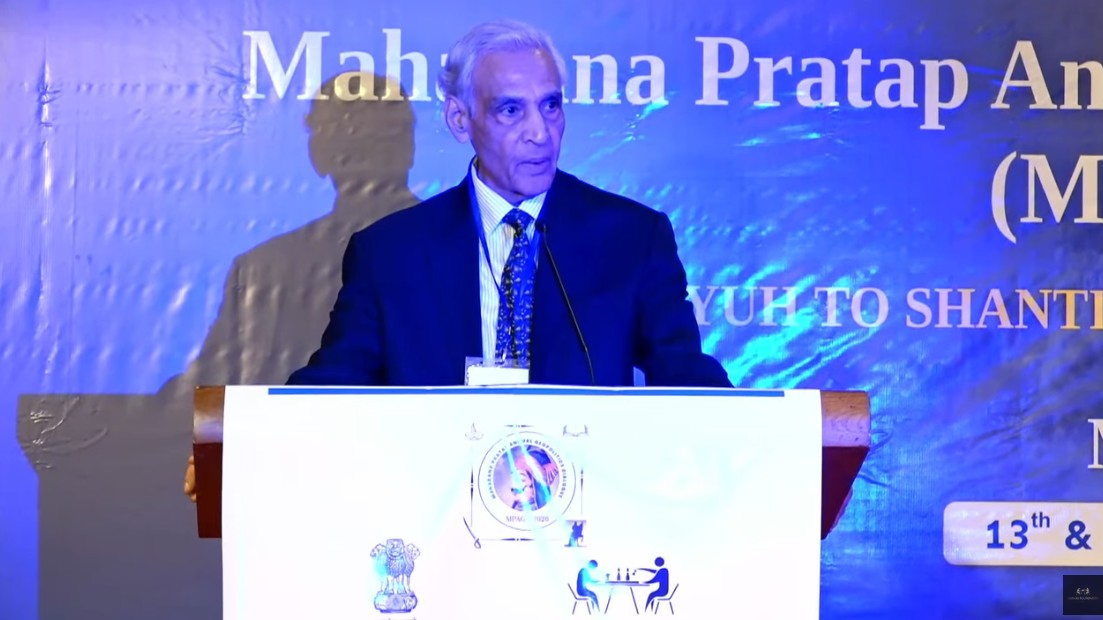
"In a new era of grey-zone conflicts, traditional international institutions are struggling to manage evolving geopolitical tensions," said Daniel Benaim, former Deputy Assistant Secretary of State for Arabian Peninsula Affairs, during his keynote address at the Maharana Pratap Annual Geopolitics Dialogue (MPAGD) 2026 in Udaipur.
Benaim emphasized that the model of international cooperation based on "shared values" is increasingly failing to sustain effective interstate partnerships, while noting that US foreign policy is undergoing a significant transition in response to evolving global realities.
The fifth edition of the Dialogue, organized by the Usanas Foundation in collaboration with the Ministry of External Affairs on March 13-14 in Udaipur, Rajasthan, under the theme "From Conflict to Consensus: Chakravyuh to Shanti Parv," was attended by Bihar Governor Syed Ata Hasnain, who delivered the keynote address after the launch of Dr. Abhinav Pandya's book, "The Jihad Game: Inside Pakistan's Dark War." In his remarks, Lt. Gen. Hasnain outlined three key pillars supporting jihadist networks targeting India-Pakistan-backed ideological infrastructure, institutional capability, and extensive financial and logistical networks – while also offering strategic recommendations to counter these challenges.
Vishvaraj Singh Mewar also spoke at the conference, discussing the continued relevance of Maharana Pratap's legacy in contemporary geopolitics and public policy.
Dr. Anita Jain, Director of the Usanas Foundation, outlined the broader intellectual framework of the Dialogue, while Dr. Abhinav Pandya, Founder and CEO, highlighted how major power rivalries today are shaped by ideological conflicts, technological competition, supply chain dominance, and the transition toward a multipolar world order.
Amb. Anil Trigunayat, former Ambassador to Jordan, Libya, and Malta, and a Distinguished Fellow at VIF, also delivered opening remarks. The conference featured multiple high-level sessions. The session on "The Chessboards of Giants: Great Power Rivalries in the 21st Century" was chaired by Sujan Chinoy, Director General of the Manohar Parrikar Institute for Defence Studies and Analyses (MP-IDSA), and included Dr. C. Raja Mohan, Visiting Research Professor at the Institute of South Asian Studies, National University of Singapore; Amb. Anil Trigunayat; Amb. Mayank Singh, Joint Secretary (Eurasia Division), Ministry of External Affairs; and Dr. Timofey Bordachev, Programme Director, Valdai Discussion Club.
The session on China, chaired by Dr. Jagannath Panda, Head of the Stockholm Centre for South Asian and Indo-Pacific Affairs at ISDP, featured Amb. Vijay Gokhale, former Foreign Secretary of India; Manoj Kewalramani, Chairperson of the Indo-Pacific Research Programme at the Takshashila Institution; and Col. Pavithran Rajan, Advisor at the Centre for National Security Studies.
The session on climate and sustainability, chaired by Erik Grigoryan, Former Minister of Environment of Armenia, featured Rasmus Abildgaard Kristensen, Ambassador of Denmark to India, and Dr. A.A. Mao, Vice Chancellor of Martin Luther Christian University and former Director of the Botanical Survey of India.
On the second day, Brian Michael Jenkins, Senior Advisor to the President of the RAND Corporation, and Tejendra Khanna, Former Lieutenant Governor of Delhi, delivered special addresses. The session on “Disruptors and Proxies,” chaired by Prof. (Dr.) Sreeram Sundar Chaulia, Professor and Dean at the Jindal School of International Affairs and Director General of the Jindal India Institute, featured Daniel Benaim, Dr. Sagit Yehoshua, Research Fellow at the International Institute for Counterterrorism; Peter Knoope, Senior Associate Fellow at the Clingendael Institute; and Dr. Abhinav Pandya.
The session on “Evolving Frontiers of Jihad” included Peter Knoope; Dr. Vinod J. Bahade, Joint Secretary, Counter-Terrorism Division, Ministry of External Affairs; Dr. Michael Barak, Senior Researcher at the Institute for Counter-Terrorism and lecturer at Reichman University; and Vanessa Panes, Intelligence Analyst and Counter-Terrorism Expert.
A key session on “Pakistan’s Terror Factories and Radical Islam in South Asia” was chaired by Ajay Bisaria, former envoy to Pakistan, Canada, Poland and Lithuania, and Distinguished Fellow at ORF.
Bisaria referred to the October 7 attacks on Israel and the Pahalgam attack carried out by The Resistance Front (TRF), linked to Lashkar-e-Taiba, which claimed 26 lives. He reiterated India’s doctrine of zero tolerance towards terrorism and highlighted the growing challenge posed by Salafist influences to Kashmir’s historically syncretic Islam.
Sam Westrop, Director of the Middle East Forum’s counter-extremism project, highlighted evolving terror tactics, including the use of charities and welfare organisations for funding. He discussed networks linked to Jamaat-e-Islami, Deobandi groups, and Salafist movements, and warned of the dangers posed by “soft Islamism.”
Shiv Murari Sahai, a former IPS officer of the J&K cadre and former Additional Secretary in the National Security Council Secretariat, traced the historical spread of Islam in the region and recalled the role of the JKLF in the 1990 exodus of Kashmiri Pandits. He also pointed to China-Pakistan coordination in information warfare and evolving counter-terror cooperation within India.
Subsequent sessions covered geoeconomics, Indo-Pacific strategy, information warfare, and emerging technologies. These included participation from Amb. Anil Wadhwa, Former Secretary (East); Dr. Jagannath Panda; Amb. Ashok Sajjanhar, Former Ambassador of India to Kazakhstan, Sweden and Latvia; Amb. Gautam Bambawale, Former Ambassador of India to Bhutan, Pakistan and China; Major General (Retd.) Sudhakar Jee; Col. Pavithran Rajan; Damdin Tsogtbaatar, Member of the Mongolian Parliament and former Foreign Minister; Nvard Chalikyan, Research Fellow at the Applied Policy Research Institute, Armenia; Amb. Diana Mickevičienė, Ambassador of Lithuania to India; Dr. Gulshan Rai, Former National Cyber Security Coordinator; and Prof. P.M. Soundar Rajan, IISc Bangalore.
The Dialogue concluded with closing remarks by Amb. Ashok Sajjanhar. Bringing together over 30 distinguished speakers from across the world, MPAGD 2026 once again underscored its role as a significant platform for discussions on geopolitics, security, and global transitions -- mapping pathways from conflict to consensus in an increasingly complex international order.