In his 17th budget presented in the Assembly on Friday, Karnataka Chief Minister Siddaramaiah proposed a ban on social media for children under 16, along with numerous other announcements, including upgrading schools, implementing various water projects including the Mekedatu reservoir (which faces opposition from neighboring Tamil Nadu), and infrastructure development for the capital city.
Presenting a budget totaling Rs 4,48,044 crore, Siddaramaiah emphasized that the government's development strategy balances welfare programs with investments in infrastructure and long-term economic transformation. This strategy involves developing a Karnataka-specific economic framework, dubbed the "11G model," to guide the state's growth.
Key budget announcements include filling 56,432 vacant positions across various departments, the "Vasudhamruta" program to promote environmentally friendly farming, the construction of 800 new Karnataka Public Schools, the development of 40 degree colleges and 11 polytechnics, the implementation of the Rohith Vemula Act to prevent caste-based discrimination, student union elections in colleges and universities, the construction of 40 new residential schools, a Rs 5,000 crore plan for Kalyana Karnataka development, and a Rs 7,000 crore allocation for Bengaluru infrastructure.
For the 2026-27 fiscal year, the projected revenue deficit is Rs 22,957 crore, the fiscal deficit is Rs 97,449 crore (2.95% of GSDP), and total liabilities at the end of the year are estimated at Rs 8,24,389 crore (24.94% of GSDP), with a gross borrowing of Rs 1.32 lakh crore.
Siddaramaiah stated that both the fiscal deficit and total liabilities fall within the limits prescribed by the Karnataka Fiscal Responsibility Act, reflecting the state's commitment to responsible fiscal management.
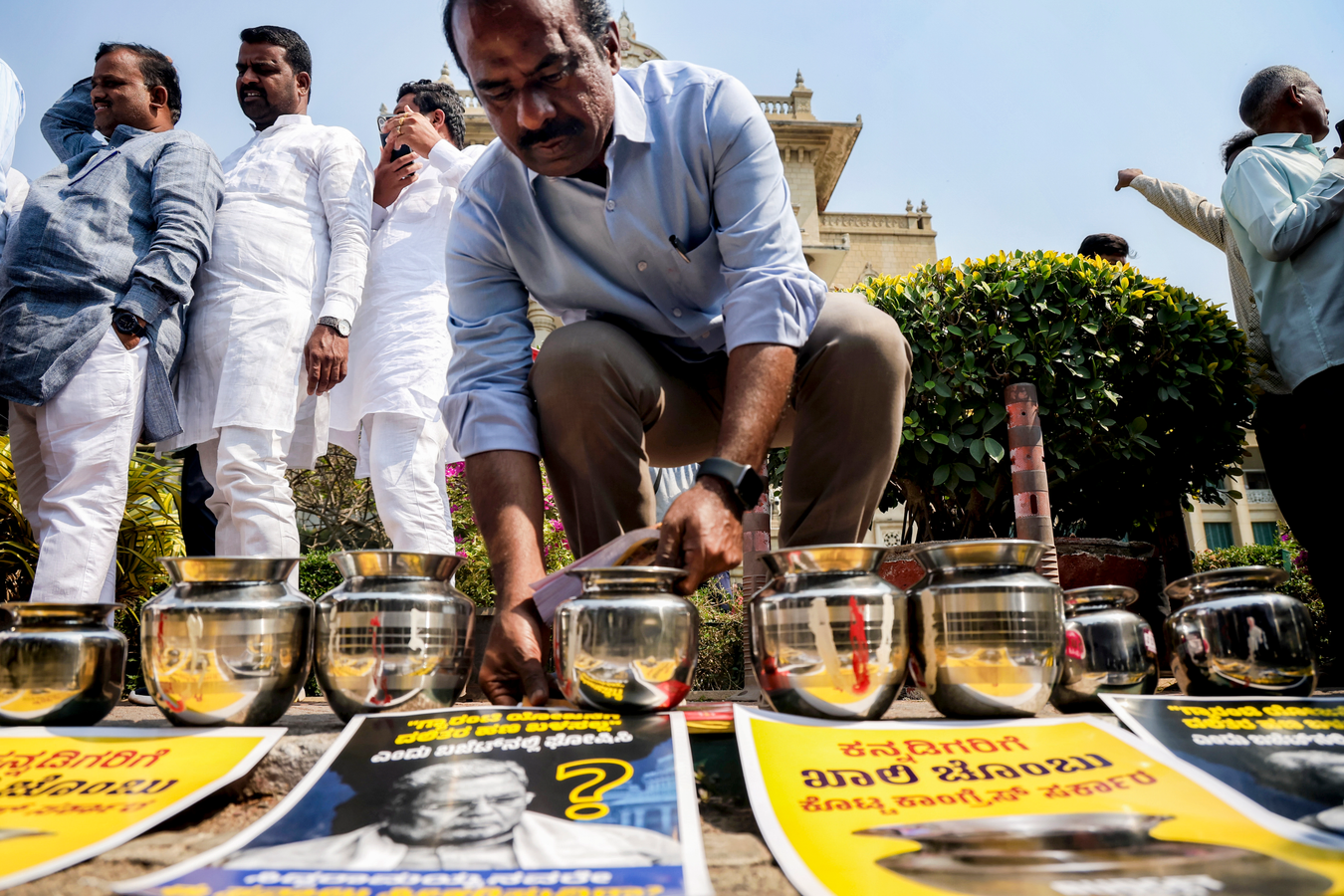
The opposition BJP staged a protest, calling the budget "empty."
"This budget is inadequate. It lacks new projects; the only new thing is increased borrowing," said Leader of the Opposition R Ashoka.
Siddaramaiah criticized the Centre's actions, stating that the NDA government was "injustice" to Karnataka by not adhering to the principles of cooperative federalism as outlined in the Constitution.
He reiterated the state's commitment to the Mekedatu balancing reservoir project on the Cauvery River and announced a ban on social media for children under 16. While he did not elaborate further in the Assembly, he later clarified in a press conference that children under 16 can possess mobile phones but cannot use social media.
A plan is being developed to implement this, he added.
"Our state is at the forefront of development across all sectors; it is one of the key states that contributes the highest tax revenues," he stated.
The budget, along with provisions for five guarantee schemes, also focuses on capital investment, employment generation, infrastructure development, and addressing regional disparities.
Siddaramaiah proposed an IT Park in Mangaluru, developing Mysuru as the second IT city in Karnataka, establishing the Bangalore Robotics and AI Innovation Zone, and providing free insulin pens to all children up to 18 years with Type-1 diabetes, among other initiatives.
Drawing an analogy from the epic tradition, the chief minister said, "The cow that yields abundant milk requires proper care. It is Bheeshma's philosophy that if it becomes weak, the entire cowherd suffers." He urged the Centre to recognize this and respond sensitively to the state's demands.
Regarding the "11G model," he explained that it includes components such as a welfare and gender equality-focused economy, good public education aimed at universal access to quality education, comprehensive healthcare for all, a grassroots economy focused on agriculture and rural development, and good governance through people-friendly administration.
He also stated that the model incorporates gig economy initiatives for labor welfare, geographical equality to reduce regional disparities, a global trade economy to promote trade and industry, a tourism-driven economy, a green economy promoting renewable energy and environment-friendly activities, and a growing urban economy supporting sustainable urban growth.
"These economic principles form the foundation of our state's development," Siddaramaiah said, adding that the finance department's budget documents elaborate on how the framework defines Karnataka's unique development model.
Siddaramaiah accused the Centre of treating Karnataka unfairly by disregarding the constitutional principles of cooperative federalism.
He also stated that changes in GST rates have resulted in reduced GST collections for Karnataka, estimated at Rs 10,000 crore for the current fiscal year and Rs 15,000 crore next year.
Siddaramaiah further said that Karnataka continues to demonstrate strong fiscal performance and robust revenue mobilization capacity. Despite structural challenges due to the Centre's tax policy changes, Karnataka's own revenue collection exhibited resilience, he claimed.