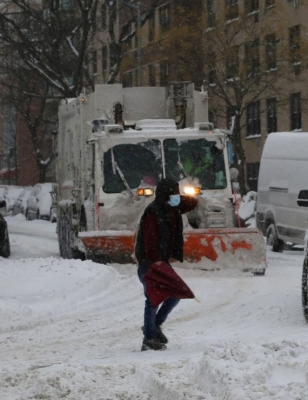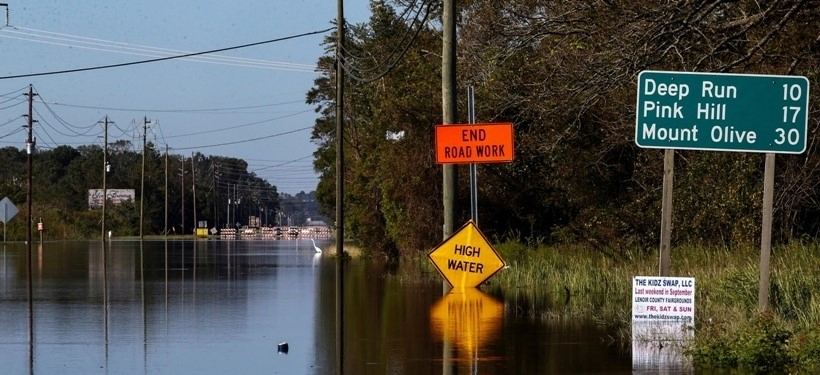
New York, February 24 – A "bomb cyclone" slammed the US Northeast, dumping over 90 centimeters of snow accompanied by winds of up to 135 kilometers per hour in some areas, cutting off power to nearly half a million people and canceling around 11,000 flights.
As the storm raged from Sunday night into Monday along a 600-kilometer stretch of coastal states from Pennsylvania to Massachusetts, governors and local authorities declared states of emergency, banning all but essential vehicles from the roads, while emergency crews struggled to cope with the heavy snowfall.
The intense blizzard was dubbed a "bomb cyclone" by weather experts because it was accompanied by a meteorological phenomenon called bombogenesis, which occurs when there is a drop of at least 24 millibars in the pressure at the center of the storm during a 24-hour period, intensifying its ferocity.
Warwick in Rhode Island reported the highest snowfall, 91 centimeters, while winds reached a speed of 134 kilometers per hour in Nantucket in neighboring Massachusetts.
So far, only two deaths have been attributed to the blizzard, both in Rhode Island.
While the snowfall had subsided in New York and most other places by Monday evening, the National Weather Service said that heavy snow and strong winds would continue into Tuesday morning across Maine, as the storm moved offshore.
Massachusetts Governor Maura Healey said of the blizzard hitting the region, "This is as bad as I’ve ever seen it."
The media in that state described it as "historic."
More than 300,000 homes were without power in Massachusetts, and 100,000 in New Jersey, as electrical lines snapped, mostly due to trees falling over.
Hundreds of cars, some with people inside, were reported stranded on snow-covered roads.
It was the worst blizzard in a decade in New York City, which was recovering from another snowstorm last month.
The 45 centimeters of snow recorded in Central Park ranked it as the ninth-highest snowfall on record.
New York’s Governor Kathy Hochul declared a state of emergency and announced what amounted to a curfew for non-essential vehicles on Sunday for parts of the state close to the coast.
In the heavy snowfall and cold wave last month, at least 18 people, mostly homeless, died in the cold, despite Mayor Zohran Mamdani's promise that the homeless would not be forced to leave their encampments.
This time, however, he changed his stance and asked social, medical, and police services to get the vulnerable off the streets, and he announced at a news conference on Monday that there were no deaths.
The bustling city roads were clear on Monday, and by evening, city buses began to operate again.
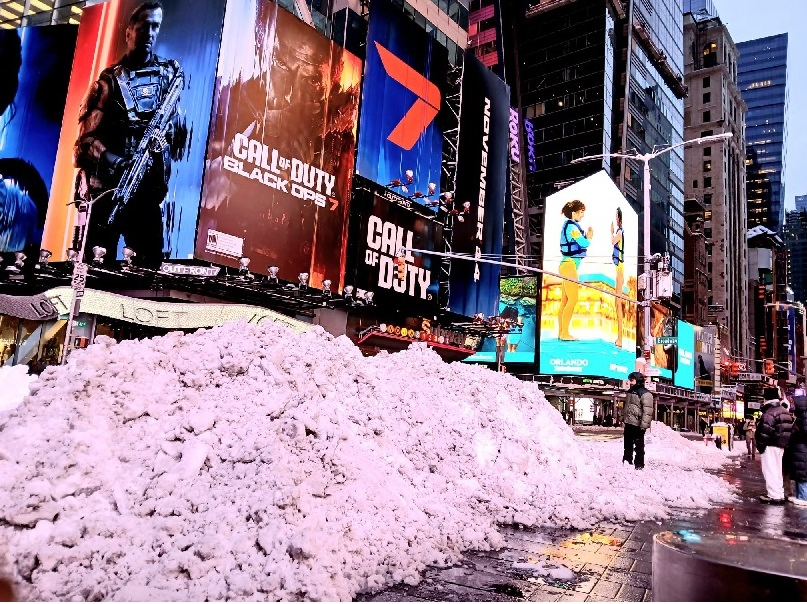
Many tourists flocked to Times Square amid the cleared snow, which had been piled into mini-mountains by emergency workers.
While stocks traded on Wall Street and other markets, powered by traders and investors working from home, most offices, including the United Nations, and schools were closed due to travel restrictions.
In some places like Rhode Island, schools and offices will be closed on Tuesday as well.
The Federal Emergency Management Agency, which would be responsible for providing assistance in disasters like this, is under the Homeland Security Department, whose budget is on hold due to Democrats' demands that the department place restrictions on the conduct of immigration officers who shot and killed two US citizens during confrontations with protestors.
President Donald Trump's administration assured that the agency would be able to provide immediate disaster relief.