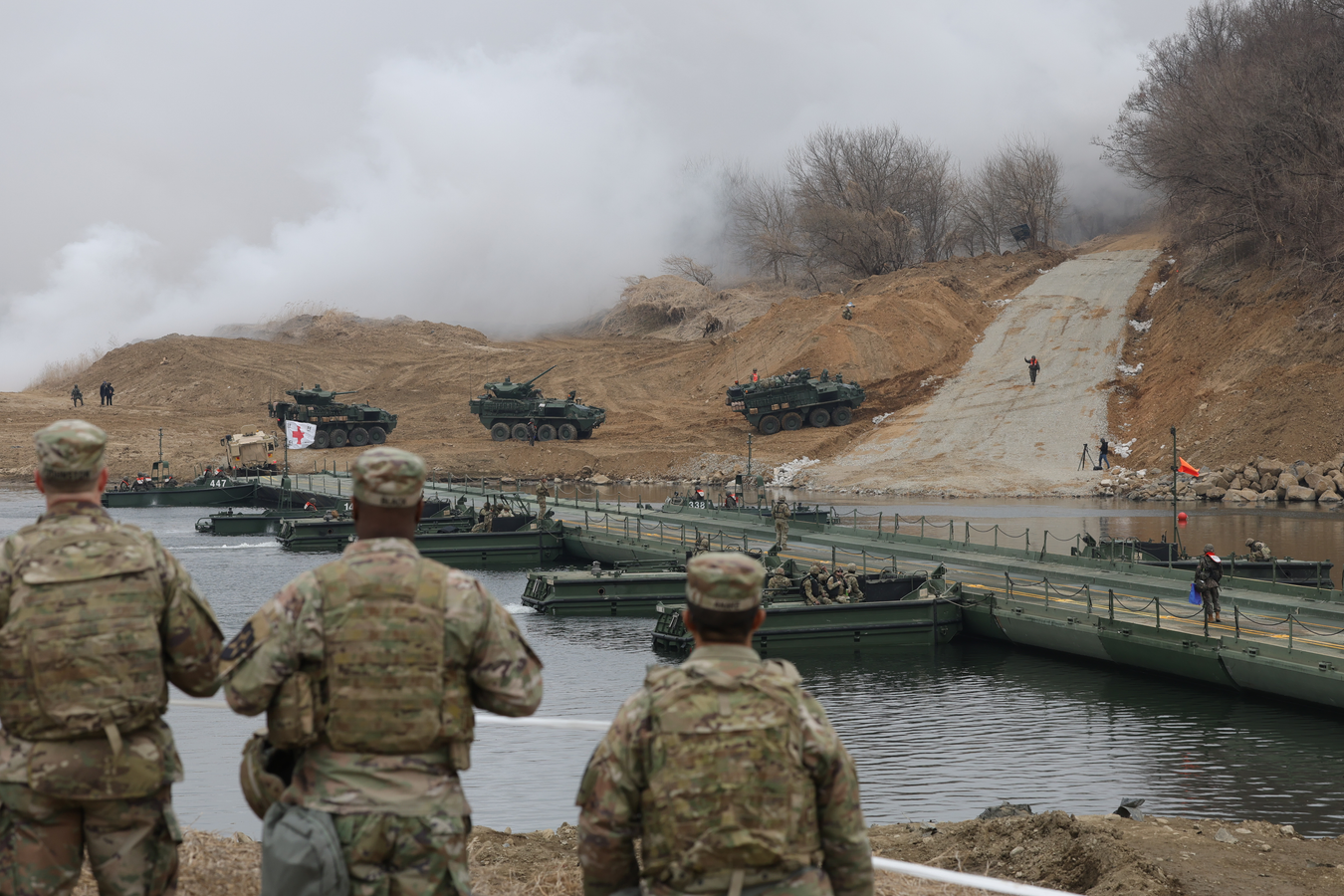
Seoul, March 14 – The South Korean and US militaries staged joint river crossing drills in the border county of Yeoncheon on Saturday as part of their annual key springtime exercise aimed at enhancing interoperability between the allies.
The field training coincided with North Korea firing around 10 ballistic missiles toward the East Sea earlier in the day. The North's missile launch appeared to be a show of force in response to the Seoul-Washington joint military exercise.
The training took place on the Imjin River in Yeoncheon, located about 50 kilometers north of Seoul, involving some 200 pieces of equipment, including KM3 amphibious bridging vehicles and ribbon bridge systems, according to the armed services, reports Xinhua news agency.
The drills are part of the field training events of the Freedom Shield (FS) exercise, which began on Monday for an 11-day run, aimed at strengthening the allies' combined defense posture.
Approximately 700 troops from the South's Capital Mechanised Infantry Division and 7th Engineer Brigade, and the US Stryker Brigade Combat Team of the 2nd Infantry Division participated in the drills.
This year, the Korean-made KM3 amphibious bridge and ferry system was connected with the United States' Improved Ribbon Bridge (IRB) for the first time in a wet-gap crossing.
The KM3, which acts as a floating bridge or ferry to carry heavy combat vehicles and trucks, enables swift troop maneuvers over streams and rivers at a faster rate than existing ribbon floating bridge equipment. It was deployed to the South Korean Army in 2024.
The drills began under a simulated attack scenario, in which US forces engaged in an assault river crossing and occupied the territory across the river.
The allies then attempted to put together a bridge across the Imjin River, with CH-47 Chinook transport aircraft dropping off sectional pontoon bridges, which were later pieced together by bridge erection boats on call nearby.
A total of 25 pontoon pieces were pieced together to form a 180-meter-long bridge across the river, enabling strikers and other equipment to cross over to push forward the enemy lines in a simulated war scenario, according to a 2nd Infantry Division official.
The Army has been staging combined drills with US forces as part of the FS exercise from March 8 to 19 across the border cities and counties of Pocheon, Paju and Yeoncheon.
Saturday's drills were attended by US Forces Korea (USFK) Commander Gen. Xavier Brunson and Army Gen. Kim Sung-min, deputy commander of the South Korea-U.S. Combined Forces Command, among others.
Standing in front of the bridge completed by the allied forces, Brunson underscored the importance of such combined training, saying drills between the allies were "what makes us different."
"It's the asymmetric advantage that we enjoy across the Indo-Pacific. The fact that we can train and build readiness across our formations and the fact that we can do this together," Brunson said. "The example that you see out there; It is the envy of the world that we get to do this here right now," he added.
The USFK commander also thanked South Korean Defence Minister Ahn Gyu-back and Joint Chiefs of Staff Chairman Gen. Jin Yong-sung for enabling the execution of this "great combined training out here."
The allies have continued combat drills since September last year to enhance interoperability of river-crossing equipment between the forces.