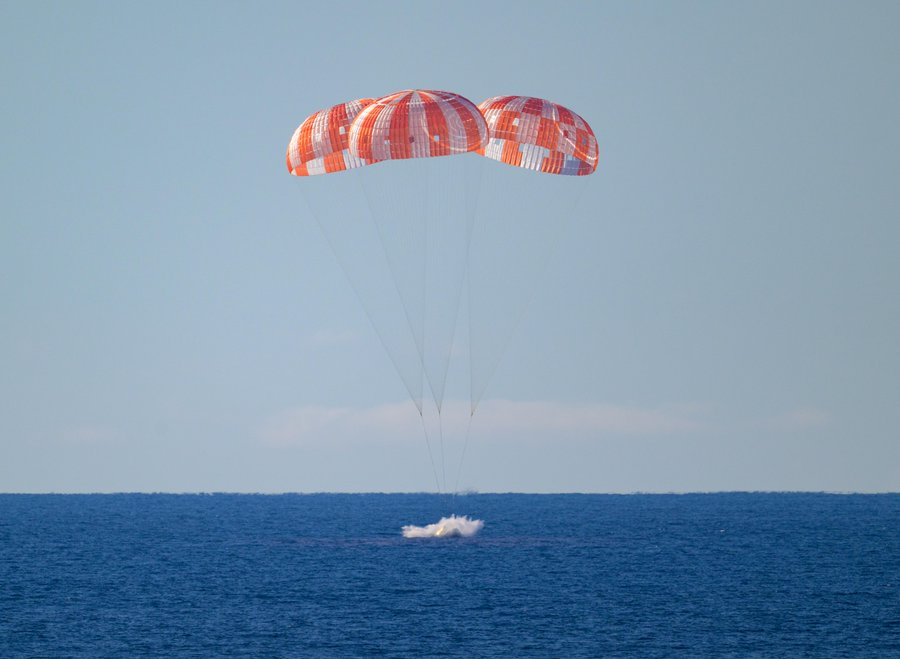
New York, April 11 – Four astronauts who ventured into deep space, an area never before explored by humans, have returned home, landing in the Pacific Ocean. This marks a significant step for humanity's return to the moon and future space exploration.
The event was watched by millions around the world, who were hoping for a sign of hope and achievement.
"What a journey," exclaimed Reid Wiseman, the commander of Artemis II, upon landing.
The Artemis II mission, lasting nine days and one hour, saw the astronauts travel 404,409 kilometers from Earth, orbiting the moon and setting a new record for the farthest distance traveled by humans.
The crew consisted of three Americans: Commander Wiseman, Christina Koch, and Victor Glover, along with Jeremy Hansen, a Canadian, on an American spacecraft, despite the differing political views of the leaders of the two nations.
"These were the ambassadors from humanity to the stars," declared Jared Isaacman, the head of NASA, as they returned.
President Donald Trump said on Truth Social, "The entire trip was spectacular, the landing was perfect."
Congratulating his fellow countrymen and the other crew on "an historic feat," Canada's Prime Minister Mark Carney wrote on X, "Welcome home."
"We'll be doing it again and then, next step, Mars," said Trump, referring to the Artemis II mission in the renewed space race, 56 years after the first human landing on the moon.
As the crew celebrated at the Houston Johnson Space Centre, NASA Associate Administrator Amit Kshatriya explained the goals: "Fifty-three years ago, humanity left the moon. This time we return to stay."
"Let us not go to plant flags and leave, but to stay with firmness in our purpose, with gratitude for the hands who built the machines and with love for the ones that we carry with us," he added.
Next year, Artemis III is scheduled to be launched with a crew who will test the Orion for docking with a commercial spacecraft for a moon landing.
Humans are expected to land on the moon again in the Artemis IV mission in 2028, with another planned later that year and after that once every year.
After building a moon base, the next big ambition for NASA is to send astronauts to Mars, a planet where there may have been life forms.
The Orion spacecraft, launched from Kennedy Space Centre on the East Coast on April 1 and traveling in a figure 8 pattern, returning to Earth at a maximum speed of 39,458 kilometers per hour before parachutes deployed and gently landing near San Diego on the West Coast.
The Orion's heatshield, which had raised some concerns when a similar cover on the uncrewed Artemis I showed signs of damage, held up this time to the searing 2,750 degrees Celsius generated at the top re-entry speed.
Medically trained Navy divers entered the Orion capsule to check the health of the crew, which Wiseman had declared after touchdown, "Green," meaning healthy.
They were plucked by helicopters and taken to an amphibious landing ship, USS John Murtha.
They clapped and cheered on the ship before going to the medical bay for more medical checkups. They'll head to Houston on Saturday.
The Artemis II mission crew faced some problems familiar to the earth-bound – a toilet malfunction and a Microsoft Outlook software problem – and a communications system glitch, all quickly fixed.
Before the launch, the Artemis II mission was postponed twice because of problems with a liquid hydrogen leak, a helium flow glitch, and hatch pressurisation. But all that was behind them on Friday.