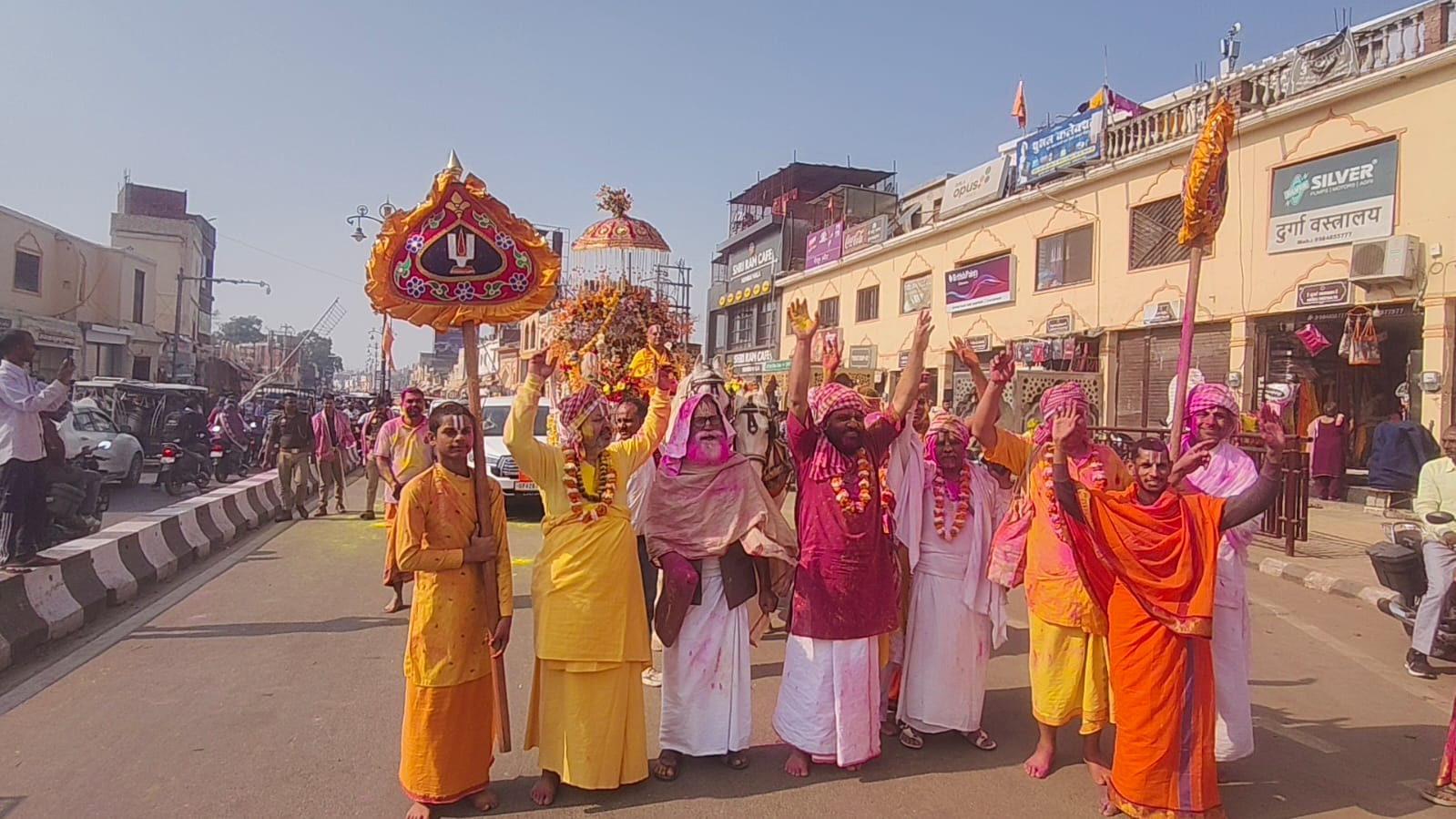
New Delhi, February 27 – As Rangbhari Ekadashi marks the beginning of the Holi festivities, the spiritual towns of Ayodhya, Sambhal, and Vrindavan have been filled with vibrant celebrations, blending devotion with color and joy.
In Ayodhya, Holi processions have begun emerging from the monasteries and temples of Ramnagari. Sadhus, smeared with 'abir' and 'gulal', were seen dancing to traditional Holi songs, signaling the arrival of the festival. In Ayodhya, Holi traditionally begins in temples and akharas on Rangbhari Ekadashi, when spiritual leaders formally commence the celebrations.
Markets across the city are bustling with activity. Shops decorated with bright colors, water guns, and festive masks are attracting large crowds. This year, water guns themed around Prime Minister Narendra Modi and Uttar Pradesh Chief Minister Yogi Adityanath have become special attractions. Children, in particular, are excited about these politically themed pichkaris, while masks featuring the Prime Minister are also witnessing brisk sales. Shopkeepers say demand has exceeded previous years, and traders expect footfall and sales to increase further as Holi approaches.
Siddhpeeth Hanumangarhi Mahant Deveshacharya Maharaj said, "This is a centuries-old tradition. At Siddhpeeth Hanumangarhi, the emblem of Lord Hanuman is worshipped, and sadhus and mahants perform rituals before inviting devotees from Ayodhya's Panchkosi region and major monasteries to celebrate Holi together."
In Sambhal, Rangbhari Ekadashi was also celebrated with great enthusiasm. From early morning, children, youth, and elders were seen drenched in colors across neighborhoods and markets. The rhythmic beats of drums and Holi songs filled the air. People greeted one another with 'gulal', while groups of youngsters played Holi in the streets. Women celebrated after offering prayers at home and in temples, applying 'abir' and 'gulal' to one another.
Markets in Sambhal also witnessed large crowds purchasing colors and water guns. The administration has put in place strict security arrangements to ensure peaceful celebrations. The festival is being observed with harmony, joy, and a spirit of brotherhood.
Meanwhile, in Mathura's Vrindavan, a large crowd of devotees gathered for Rangbhari Ekadashi at the famous Banke Bihari temple. Devotees thronged the temple premises for 'darshan', with many viewing the deity through railings due to the large crowds. On this auspicious day, Thakur Banke Bihari is believed to play Holi with devotees, adding to the divine charm of the celebrations.
Holi, the festival of colors, is celebrated on the full moon night of Phalguna, known as Phalguna Purnima. According to the Drik Panchang, a total lunar eclipse will occur on the evening of March 3, directly affecting the religious calendar.
While the Purnima tithi runs from March 3 into March 4, the visible eclipse on March 3 evening has made that time unsuitable for Holika Dahan in many regions. As a result, some states will perform Holika Dahan on March 2 and celebrate Holi on March 3. Others will hold Holika Dahan on March 3 and mark Holi on March 4.