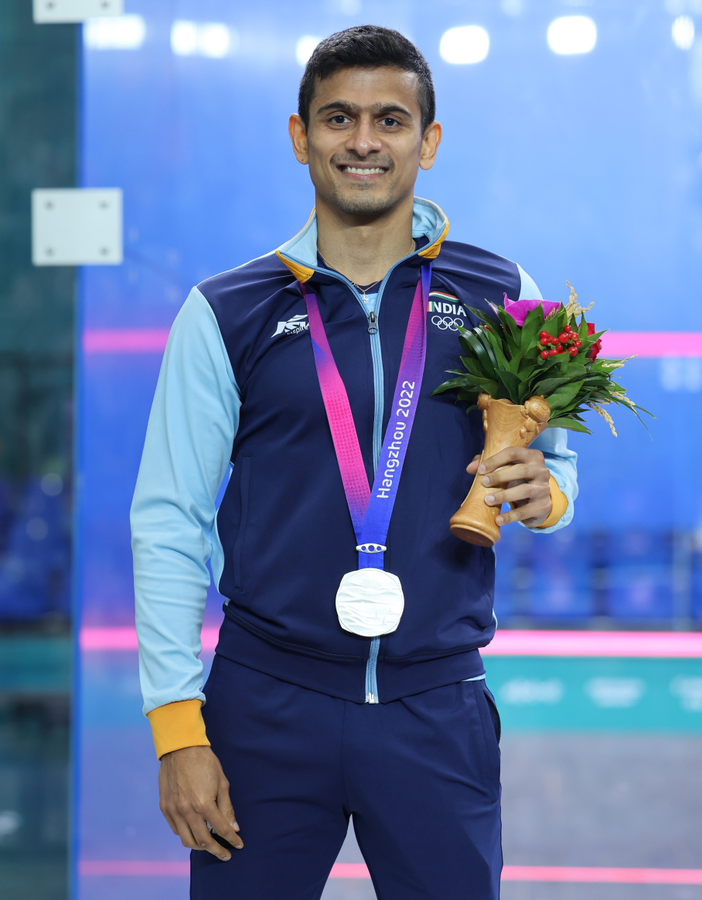
New Delhi, March 21 – Former India No. 1 Saurav Ghosal described squash players as “one of the best athletes in the world” and stated that they have received the biggest platform they deserve – the Olympics – to showcase their skills.
He also emphasized the urgent need for squash to expand its global presence and adapt to modern consumption patterns, saying the sport is no longer just competing with other disciplines but with "anything and everything" for attention as it prepares for its Olympic debut.
With squash set to feature at the 2028 Summer Olympics, Ghosal said the sport must prove its relevance by significantly increasing participation and viewership worldwide.
“We’ve obviously done really well to get into LA 28. It’s been a long journey to get into the Olympics. There is no doubt that the top squash players in the world are among the best athletes, and they deserve the biggest platform in sport, which is the Olympics, to showcase that,” he said.
However, he stressed that Olympic inclusion alone is not enough to secure squash’s long-term future at the Games.
“As a sport overall, what we need to do is to drive participation numbers across the world. It's decent, but it has to grow exponentially if we really want to be a mainstay at major events and be in conversations at major tables,” he said.
Ghosal outlined key steps needed to achieve that growth, including greater visibility and grassroots integration.
“The way to do that is one: get it on TV. Viewership is important. Leverage the countries that are doing well and boost the popularity really in a big way in those countries. Get it into schools as much as possible. Create engaging formats like what we're trying to do with World Premier Squash to get more people involved, and entertain them,” he said.
Highlighting the changing dynamics of audience engagement, Ghosal said squash must rethink how it competes for attention in today’s world.
“We have to realize that we are not just competing with people's attention with other sports. We are competing with people's attention for anything and everything in this world, including a sitcom, normal social media creator reels, anything, right? Video games, the lot, right?”
“So we have to be able to accept that, embrace that and find ways to engage with a broader base of people and the bigger the base of the base of people, the higher the kind of conviction with which the International Olympic Committee will want to have Squash in the Olympics,” he added.
Drawing comparisons with global powerhouse Egypt, Ghosal identified systemic factors behind their sustained dominance and highlighted how Egypt has retained former players within the ecosystem to maintain top-level quality.
“One is, like I said, the school thing, pretty much every school kid in Egypt knows what squash is. They've probably hit the ball at least once in their life. So when they grow up, everyone does know what squash is.
“The other piece is that what they've managed to do is that they've managed to create and hold on to the players of the past who were top players in the world and kept them involved in the ecosystem, either as coaches or administrators,” he said.
Illustrating the impact of such a system, Ghosal said exposure to elite players from a young age plays a crucial role.
“I'll just paint a picture for you, like an eight-year-old kid, walking into a club and watching the world number two train every day, there's the world number one, two, five, seven, eight, whatever, right? I mean, that makes a difference,” he said.
He compared it to Indian cricket, adding, “It's like, in cricket, for example, if you had kids walking into an academy and watching Virat Kohli bat every single day, you can see what the benchmark that you need to kind of reach.”
Ghosal said India must focus on both scale and quality to replicate such success.
“That’s what India needs to do. They need to better it in terms of quantity, because we have the numbers and in terms of quality, we need to be able to keep the players from before, we need to be able to get some people from outside who are some of the best coaches and have the Indian coaches working with them,” he said.
He also emphasised the role of technology and accessibility in building a more inclusive ecosystem.
“We need to democratise how people are connected with the system as much as possible, and using tech is important engagement is a very important part in today's day and age,” he said.
Speaking about innovation in the sport, Ghosal backed AI-driven formats as a complementary tool rather than a replacement for traditional pathways.
“These are supposed to like, sit complementary to the traditional kind of pathways, the traditional games, and the way the formats are, will and should always stay, because they are the true kind of test over a period of time of the best players in the world,” he said.
Explaining the intent behind such formats, he added, “It's to kind of generate curiosity, get more people playing dangle that carrot in front of people to kind of say that, okay, I can also be on the court with Mostafa Asal or Hania El Hammamy, which money can never buy.”
Ghosal said these initiatives are designed not just for engagement but also for skill development.
“Everything that you do on the AI will actually end up or should end up making you a better player anyway. It's not just a gimmick, the skill challenges are the things we, as professional players, actually do on a continuous basis,” he explained.
Reflecting on his own transition beyond professional sport, Ghosal admitted that redefining his identity remains a work in progress.
“I'll have to answer that question in a few years because I'm still in the process I loved playing. I loved being on the biggest stages in the so-called highest-pressure situations,” he said.
He revealed his natural inclination towards pressure moments during his playing days. “I used to almost hope and pray that I would be in the highest-pressure situations; if I had a choice, I would play the decider,” he said.
Adjusting to a new role, however, has brought different challenges. “I was a master of my own time fully, and that was great to have. I'm only appreciating that now because I don't have I'm not the master of my entire time,” he said.
Ghosal concluded by acknowledging that the transition is ongoing and comes with its own pressures. “I'm still in process, but I'm trying; it's a challenge in its own way. Hopefully, I will get there sooner rather than later,” he said.