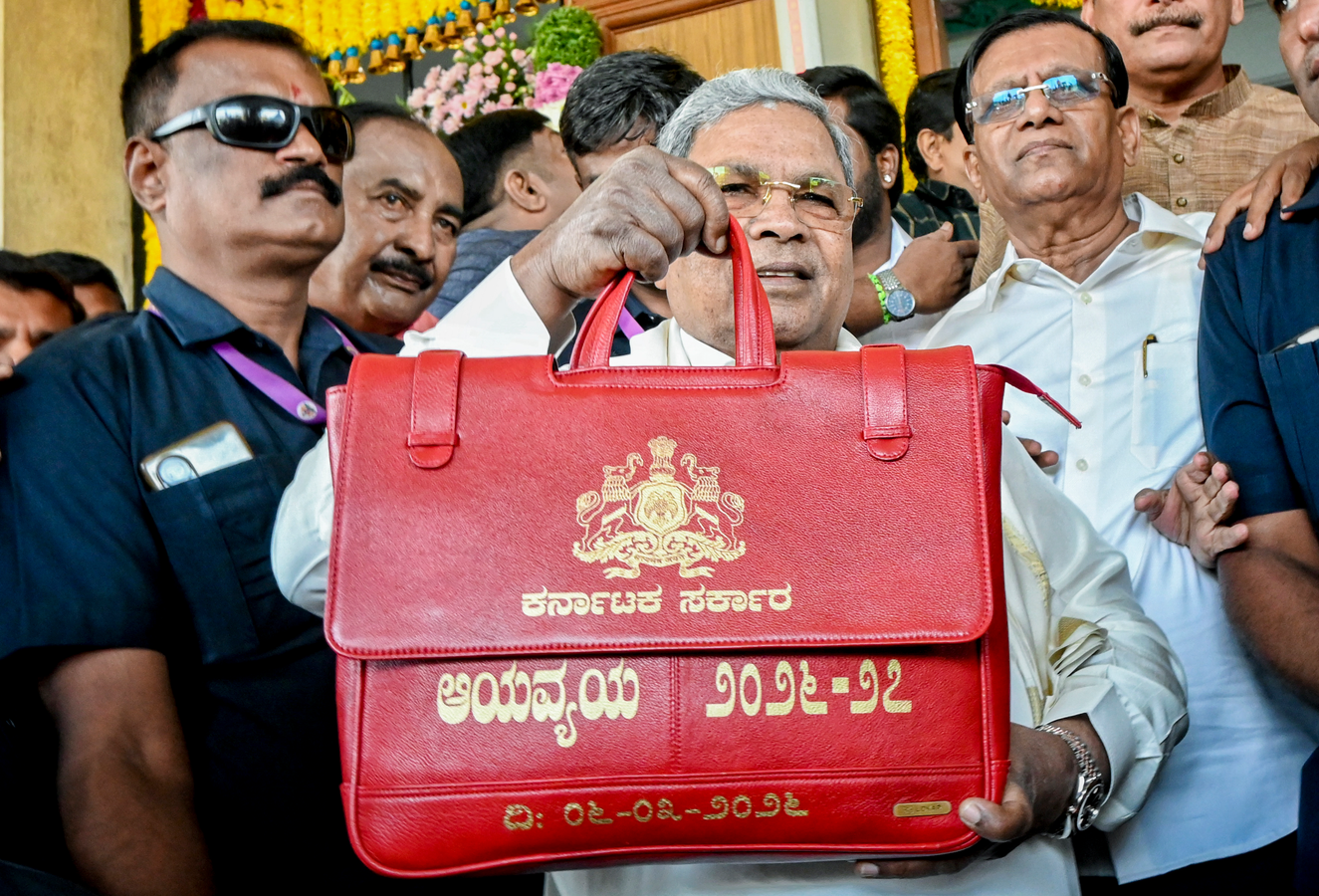
On March 6, Chief Minister Siddaramaiah stated that it is crucial for the Centre to consider the perspectives of globally integrated states like Karnataka when formulating trade policies, given recent developments related to tariff measures and evolving trade arrangements.
Presenting the 2026-27 budget, he highlighted that despite structural challenges arising from changes in the Union Government's tax policies, the state's own revenue collections have remained resilient, thanks to effective resource mobilization measures implemented by his government.
"Karnataka is currently one of the most globally integrated economies in India. Our leadership in information technology, IT-enabled services, biotechnology, aerospace and defense manufacturing, electronics and semiconductor design, start-up innovation, and advanced manufacturing has positioned us as a key contributor to India's exports and foreign direct investment inflows," Siddaramaiah said.
He further emphasized that recent developments involving the United States and other major economies have significant implications for the state.
The Chief Minister stressed that while international trade negotiations are inherently complex and require balancing strategic national interests, it is equally important to incorporate the perspectives of globally integrated states like Karnataka in trade policy formulation.
In a spirit of cooperative federalism, sustained consultation between the Union and the States strengthens India's negotiating position and ensures the protection of regional economic strengths. Karnataka will continue to work constructively with the Union Government while simultaneously reinforcing domestic resilience.
Siddaramaiah stated that the state's real GDP growth reached 8.1 per cent at constant prices in 2025-26, surpassing the national growth rate of 7.4 per cent for the same period.
"This performance was driven by broad-based sectoral growth and reflects the state's diversified and stable growth pattern," he added, noting that the government's continued emphasis on capital investment, along with a revival in private sector investment, has significantly boosted overall economic growth.
The Chief Minister highlighted that Karnataka continues to demonstrate strong fiscal performance and robust revenue mobilization capacity.
Despite structural challenges stemming from changes in the Union Government's tax policies, the state's own revenue collections have remained resilient, supported by effective resource mobilization measures undertaken by the State Government. The State's own revenues are estimated to grow by 8.3 per cent in the Revised Estimates for 2025-26 over 2024-25.
Goods and Services Tax (GST) remains the largest component of the state's tax revenue, accounting for approximately 43 per cent of the state's own tax revenue. "Karnataka ranks second in the country in GST revenue collection, highlighting its strong economic fundamentals."
Pointing out that the GST rate rationalization done in September 2025 has further reduced GST collections, the CM said that before rationalization, the state's average monthly GST revenue collections in 2025-26 were registering a growth (net of refunds) of about 10 per cent.
However, following the implementation of rate rationalization, the average monthly growth has moderated sharply to around 4 per cent in 2025-26, he said. "The rate restructuring has resulted in a reduction in overall GST collections by approximately Rs.10,000 crore for the current financial year and Rs.15,000 crore for next year."
The moderation in GST revenues has intensified the fiscal pressures on all States, as their revenue base is more directly affected by rate rationalization and structural changes, compared to the Union Government, Siddaramaiah said.
"While States face revenue compression, the Union Government continues to mobilize significant revenues from sin and luxury goods through different forms of taxation, the proceeds of which accrue entirely to the Government of India," he said, adding that in view of the large revenue losses, the state will continue to press for adequate compensation from the Union government for revenue losses arising from GST rationalisation.
Siddaramaiah also said that the 16th Finance Commission has submitted its report for the award period 2026-31 and has recommended a tax devolution share of 4.131 per cent for Karnataka, which is an increase of 13 per cent over the share recommended by 15th Finance Commission.
While the state was expecting the restoration of the devolution share of 4.71 per cent provided by the 14th FC, the 16th FC's recommendation is a partial redressal of the injustice caused to the State.
The state welcomes the inclusion of GSDP contribution, as it is a directional shift recognising the state's performance and contribution to national economic growth by the 16th Finance Commission, he said. "We hope that this progressive rebalancing of equity and efficiency will be carried forward by the next finance commission as well, and high-growth states like Karnataka will be encouraged to perform better."