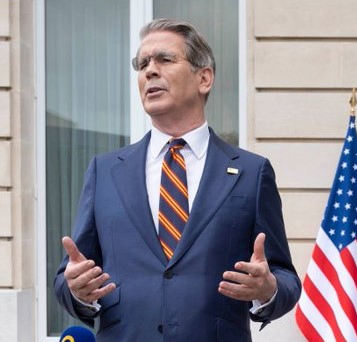
Washington, March 17 – The United States is allowing Iranian oil tankers to transit the Strait of Hormuz despite the ongoing conflict, as part of efforts to stabilize global energy supplies, Treasury Secretary Scott Besant said.
“We are seeing more and more fuel ships start to go through. The Iranian ships have already been leaving. And we have allowed that to happen to supply the rest of the world,” Besant told CBS News.
He added that Indian and Chinese vessels were also moving through the region. “We have seen Indian ships leaving now. So, the Indians who rely heavily on Gulf oil, we believe some Chinese ships have also left,” he said.
These remarks come as oil prices have surged, with US crude touching $100 a barrel amid fears of disruption in one of the world’s most critical maritime choke points.
Besant said Washington expects shipping activity to increase gradually without the need for military escorts. “We think that there will be a natural opening that the Iranians are allowing. And for now, we are fine with that. We want the world to be well supplied,” he said.
The administration has also taken steps to ease supply pressures by issuing a temporary waiver on Russian oil shipments already at sea. “We gave a 30-day waiver for Russian oil that was already on the water. It was about 130 million barrels,” he said.
Besant pushed back against concerns over easing restrictions, arguing that keeping prices stable limits Moscow’s earnings. “If oil spikes to $150, but Putin was getting 70 per cent of that, or oil stays at 95 to a hundred, where is he getting more money if it spikes to 150?” he said.
He said the global supply shortfall remains significant but manageable. “It looks like the deficit is about 10 or 14, and that's before any of the ships are coming out of the straits,” he said.
To offset disruptions, Saudi Arabia and the United Arab Emirates have redirected some exports away from the Gulf. Strategic petroleum reserves have also been tapped globally. “The global SPR release was the largest ever, it was 400 million barrels,” Besant said.
The Treasury Secretary framed the broader military campaign as an attempt to weaken Iran’s regional reach. “President Trump has made it clear that… his goal is to degrade and destroy the capabilities, the military capabilities of the regime,” he said, adding that Washington wants “to destroy the Iranian ability to project power outside of their borders.”
He described Iran as “the head of the snake for global terrorism everywhere,” citing its links with proxy groups and activities across regions.
At the same time, he dismissed the idea of a coordinated Iranian response, suggesting internal disarray. “There is this coherent Iranian plan… First of all… they are a smoothly functioning government… we believe that the current ayatollah is injured… and maybe incapacitated,” he said.
The Strait of Hormuz handles a large share of global oil and gas shipments, making any disruption a major concern for energy markets. Asian economies, including India, are particularly exposed due to their dependence on Gulf crude.