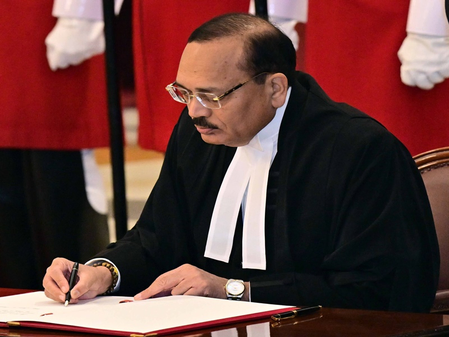
New Delhi, March 25 The Supreme Court on Wednesday strongly objected to what appeared to be an attempt to influence judicial proceedings, with Chief Justice of India (CJI) Surya Kant warning of contempt of court charges after a litigant’s relative purportedly contacted his family member regarding a court order.
During the hearing of a case related to medical admission, CJI Kant expressed strong displeasure over the incident and questioned the conduct of the petitioner’s father.
“Why should there be contempt proceedings against him? He dared to call my brother and ask how the CJI had passed the order? Will he dictate terms to me?” CJI Kant remarked orally.
Directing the lawyers appearing in the case to verify the facts, CJI Kant said: “You must verify this — and as a lawyer, you should first withdraw if the client is misbehaving.” “Even if he hides outside India, I know how to deal with such people. Never attempt this again. I have dealt with such elements for the last 23 years,” CJI Kant added.
Expressing regret about the alleged conduct, the lawyer apologized before the apex court.
The development came in a case involving a plea by two candidates from Haryana seeking admission to a postgraduate medical course under the Buddhist minority quota in a private medical college in Uttar Pradesh.
The petitioners claimed eligibility under the Buddhist minority quota based on a conversion supported by certificates issued by a Sub-Divisional Officer in Haryana.
In an earlier hearing, the Bench, also comprising Justice Joymalya Bagchi, had expressed serious doubts over the bona fides of the claimed conversion.
Questioning the timing and intent, the apex court had observed that the petitioners had appeared in NEET-PG as General Category candidates and had declared that they did not belong to the Economically Weaker Sections. “This is a new kind of fraud. Don’t make us say more,” it had remarked, cautioning against attempts to misuse minority status to secure admissions.
The Supreme Court further noted that the petitioners belonged to the “Punia” community and questioned how candidates from a traditionally non-minority background could claim such benefits after multiple attempts as general category applicants.
Taking note of the larger implications, the apex court had directed the Chief Secretary of Haryana to provide guidelines governing the issuance of minority certificates and to clarify whether candidates who had earlier declared themselves as General Category — and were above the EWS threshold — could subsequently claim minority status.
It directed the Chief Secretary of Haryana to clarify the policy framework and the basis on which such certificates were granted.
Separately, in a related development concerning the legal consequences of religious conversion, the Supreme Court on Tuesday held that a person professing a religion other than Hinduism, Sikhism or Buddhism cannot claim Scheduled Caste status.
A Bench of Justices Prashant Kumar Mishra and N. V. Anjaria upheld an Andhra Pradesh High Court ruling, holding that conversion to Christianity results in the “immediate and complete loss” of Scheduled Caste status under the Constitution (Scheduled Castes) Order, 1950.
“The bar is absolute and admits no exception,” the court observed, adding that a person cannot simultaneously profess another religion and claim benefits meant for Scheduled Castes.