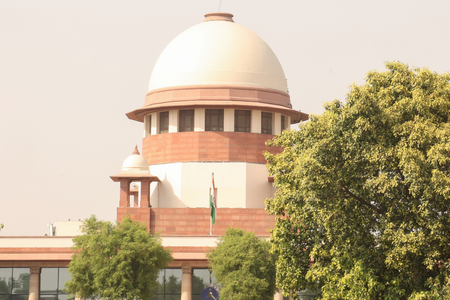
New Delhi, February 25 – Chief Justice of India (CJI) Surya Kant expressed strong disapproval on Wednesday regarding references to "corruption in the judiciary" in a newly introduced Class 8 Social Science textbook published by the National Council of Educational Research and Training (NCERT), stating that no one would be permitted to "defame or denigrate" the institution.
The development arose from a CJI Kant-led bench after senior lawyers Kapil Sibal and Abhishek Manu Singhvi raised concerns over the contents of the revised textbook.
Sibal argued that members of the legal fraternity were "deeply disturbed" that schoolchildren were being taught about corruption in the judiciary, describing the inclusion as "entirely scandalous".
"We are deeply disturbed as members of this institution to find that children in Class 8 are being taught about corruption in the judiciary. We have a significant stake in the institution. We have copies of the book," the senior counsel told the top court.
In response, CJI Kant said he was already aware of the controversy and had received several communications from members of the judiciary expressing concern over the matter.
"I can assure all of you that I am fully aware of it," the CJI remarked, adding that several High Court judges were also "perturbed" by the contents of the book.
When Sibal urged the Supreme Court to take suo motu cognizance, CJI Kant said that he had already initiated proceedings on the issue.
"Wait for a day. This is definitely concerning the entire institution. The Bar and the Bench are perturbed. Every stakeholder in the system is really disturbed. I am receiving a lot of calls and messages," the CJI said.
"I will not allow anyone on earth to taint the integrity of the institution and defame the institution. At any cost, I will not permit it. Whoever it may be, the law will take its course. I know how to deal with it," he added.
The controversy stems from the newly released Class 8 Social Science textbook brought out by NCERT, which introduces a section discussing challenges faced by the judiciary under a chapter titled 'The role of the judiciary in our society'.
The revised chapter identifies issues such as "corruption at various levels of the judiciary", large-scale pendency of cases, shortage of judges, complex legal procedures, and inadequate infrastructure as factors affecting the justice delivery system.
The earlier edition of the textbook primarily explained the structure, independence, and functions of the judiciary, while acknowledging delays in disposal of cases through the commonly cited phrase "justice delayed is justice denied".
The updated textbook also provides approximate figures relating to pendency of cases, noting around 81,000 matters pending before the Supreme Court, nearly 62.4 lakh cases in High Courts, and about 4.7 crore cases before district and subordinate courts.
Addressing accountability mechanisms, the book explains that judges are governed by a code of conduct regulating both judicial and personal behaviour and refers to institutional procedures for complaints, including the Centralised Public Grievance Redress and Monitoring System (CPGRAMS), which reportedly received over 1,600 complaints between 2017 and 2021.
NCERT has been undertaking large-scale textbook revisions in accordance with the National Education Policy (NEP) 2020 and the National Curriculum Framework (NCF) for School Education.
The revised textbook, released on February 23 in line with NEP 2020, also revisits key historical developments, including the 1919 Jallianwala Bagh massacre and the 1946 Direct Action Day, along with an expanded discussion on the Partition of India.