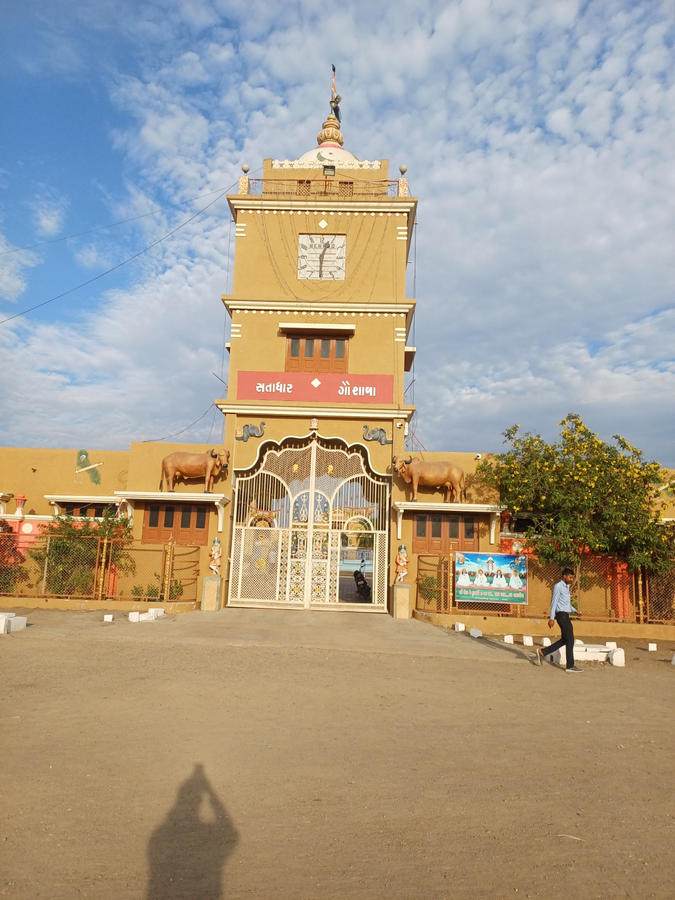
Gandhinagar, March 29 – In a remarkable example of sustainable living and self-reliance, Satadhar Dham has emerged as a model for renewable energy use. Its massive community kitchen, which caters to around 10,000 pilgrims daily, is entirely powered by biogas.
Located in Gujarat's Junagadh district and associated with Saint Appa Giga, this revered pilgrimage site – known for its evening aarti – has now gained recognition for operating the state's largest-capacity biogas facility.
Currently, four biogas plants, each with a capacity of 85 cubic metres per day, are operational on the premises, while two additional plants of similar capacity are under construction.
The initiative has significantly reduced dependence on conventional fuels and positioned the shrine as a symbol of eco-friendly practices.
The temple complex houses nearly 1,000 cows, whose dung forms the primary raw material for the biogas plants.
Nearly 8,000 kg of cow dung is processed daily to generate fuel for the 'annakshetra' (community kitchen), ensuring uninterrupted cooking for thousands of devotees.
Previously, the kitchen relied heavily on firewood, consuming 800–900 kg per day.
A shift to LPG had also proven costly, requiring 10 to 15 cylinders daily.
The transition to biogas has not only reduced expenses but also minimized environmental impact.
Mahant Vijay Bapu of Satadhar Dham highlighted the significance of the initiative, saying that the institution has achieved complete self-reliance in cooking.
He added that the slurry produced as a byproduct of the biogas process is effectively utilised as organic fertiliser in agricultural activities, creating a sustainable cycle of resource use.
The initiative aligns with the broader vision of Prime Minister Narendra Modi and the leadership of Gujarat Chief Minister Bhupendra Patel to promote renewable energy and environmental sustainability.
Support from the Gujarat Energy Development Agency (GEDA) has played a key role in scaling such efforts.
Under its Institutional Biogas Plant Scheme, subsidies are provided to encourage organisations to adopt clean energy solutions.
Across Gujarat, gaushalas, educational institutions, and charitable trusts are increasingly converting organic waste – such as cattle dung, agricultural residue, and kitchen waste – into biogas through anaerobic processes.
The resulting fuel serves as an economical alternative for cooking, while the residual slurry boosts soil fertility.
Officials noted that over the past five years, 193 institutional biogas plants with a combined capacity of 13,955 cubic metres per day have been established across the state.
For the financial year 2025–26, the Union government has earmarked Rs 12 crore under the scheme, with around 60 new biogas plants currently being installed.
Similar targets have been set for 2026–27.
The initiative at the Satadhar Dham stands as a compelling example of how traditional institutions can embrace modern, sustainable practices while continuing to serve society at large scale.