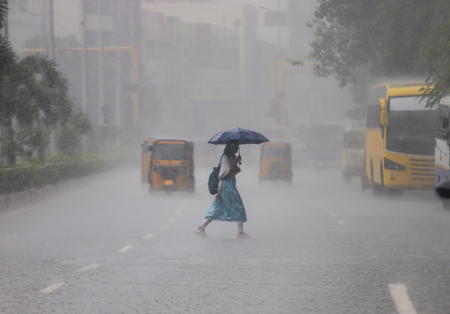
Chennai, March 17 – A cyclonic circulation over the southeast Arabian Sea and the adjoining Lakshadweep region has triggered a forecast of moderate rainfall across parts of the Western Ghats and southern Tamil Nadu on Tuesday, with isolated thunderstorms likely in one or two locations.
According to the India Meteorological Department (IMD), the cyclonic circulation is a key driver of the current weather pattern across the region. In addition, another atmospheric circulation extends from the southwest Bay of Bengal towards the Comorin Sea region.
A separate cyclonic system has also been reported over the northern coastal areas of Tamil Nadu, further intensifying weather instability.
Due to the combined effect of these systems, districts along the Western Ghats and several parts of southern Tamil Nadu are expected to receive moderate rainfall, accompanied by thunder and lightning in isolated areas.
Weather officials have also indicated that localised heavy showers may occur in some hilly and adjoining regions.
The rainfall activity is expected to persist over the coming days. On Wednesday, moderate rain is likely over the delta districts and nearby areas. By Thursday, similar conditions are forecast to continue, with moderate rainfall expected in parts of the delta region as well as southern Tamil Nadu.
The IMD has also issued a temperature outlook for the region. Maximum temperatures across Tamil Nadu, Puducherry, and Karaikal are expected to remain around 2 degrees Celsius above normal levels on Tuesday. However, from Wednesday through Friday, temperatures are likely to decline gradually, with a drop of up to 2 degrees Celsius below the seasonal average anticipated in several areas.
Authorities have advised residents, particularly those in hilly and rain-prone regions, to remain cautious due to the possibility of thunderstorms and lightning.
Farmers, fishermen, and people engaged in outdoor activities have been urged to plan their schedules carefully in view of the changing weather conditions.
The Meteorological Department said it is closely monitoring the evolving systems over the Arabian Sea and the Bay of Bengal and will issue timely updates and advisories as required.