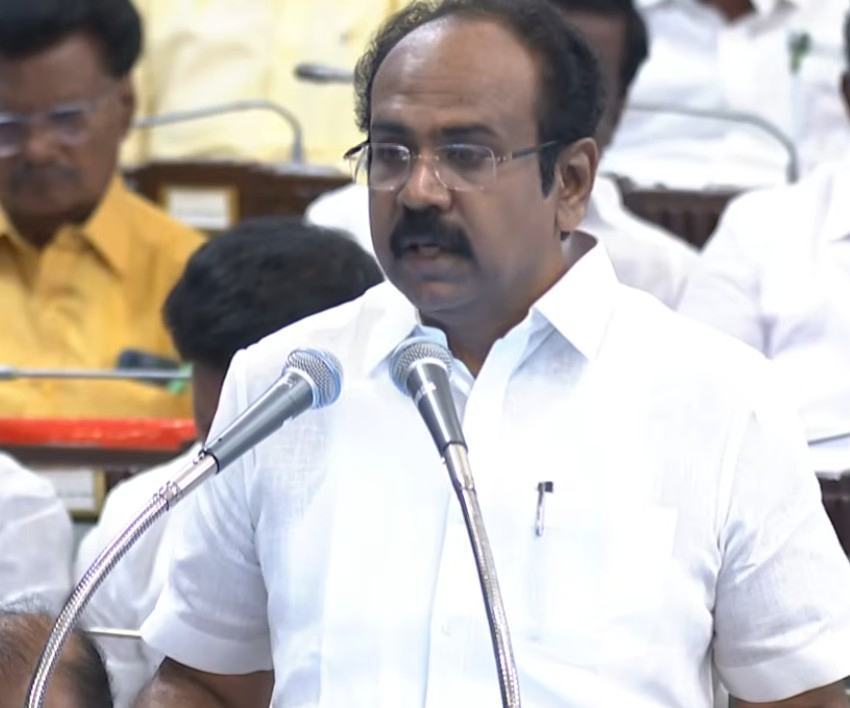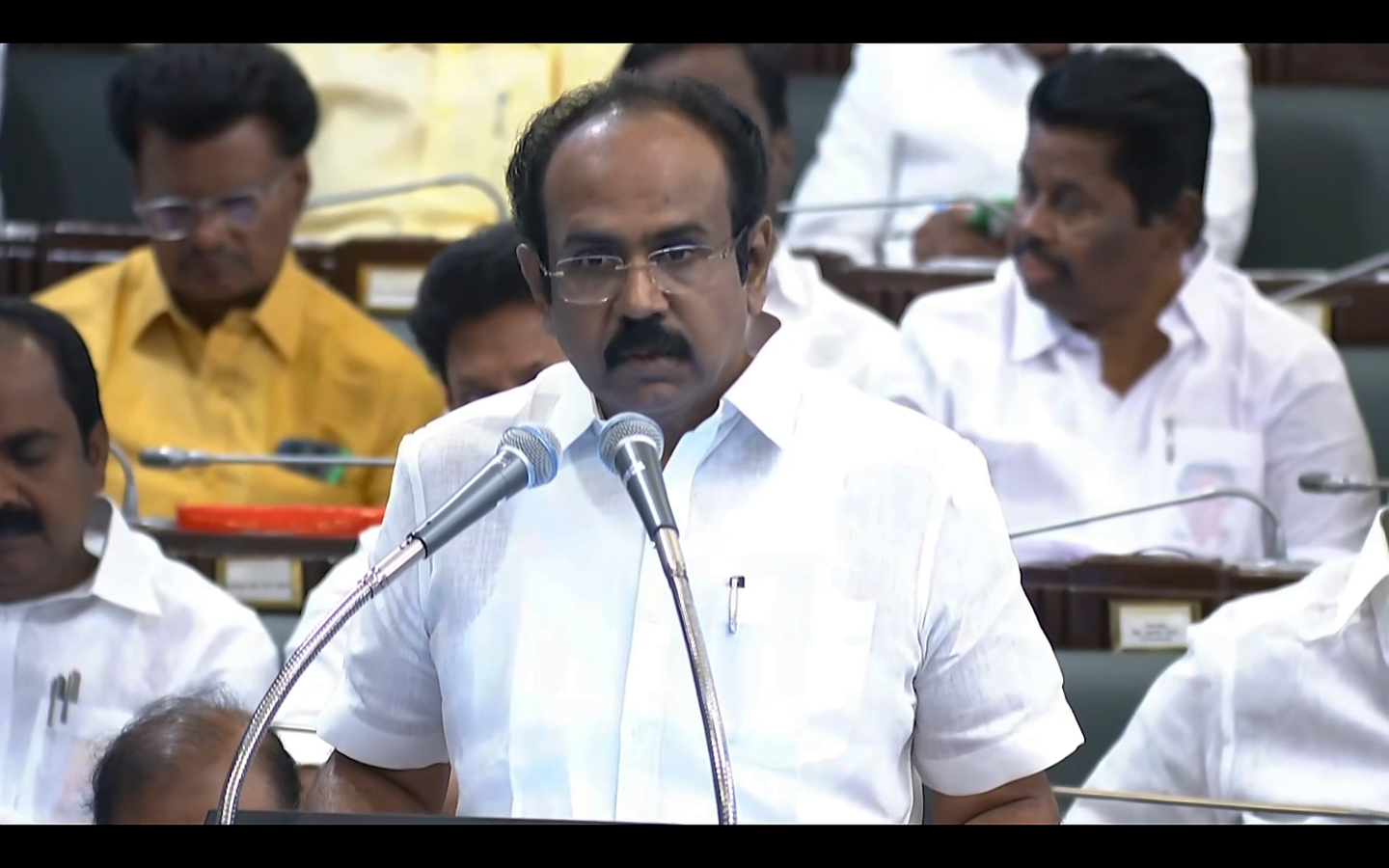
Chennai, February 17 – Tamil Nadu Finance Minister Thangam Thenarasu presented the interim budget (2026-27) of ₹2.55 lakh crore for the state, which will go to polls, allocating ₹4,000 crore for the DMK’s flagship scheme of free bus travel for women.
Out of the ₹2,55,391 crore allocated for various sectors, a maximum of ₹57,039 crore is earmarked for education, ₹35,773 crore for urban development, and ₹22,090 crore for the health department.
In the interim budget, the government projects revenue receipts of ₹3,44,575 crore. The state’s own revenue constitutes 74.67% of the total revenue receipts. The remaining 25.33% comes from central taxes and grants-in-aid from the Union government.
The interim budget estimates a total revenue expenditure of ₹3,93,272 crore, representing a 3.79% growth over the Revised Estimates for 2025-26.
The minister stated that the fiscal deficit as a percentage of Gross State Domestic Product (GSDP) is estimated at 3.00% in the interim budget estimates for 2026-27. He also noted that the state's overall outstanding debt is estimated at ₹9,52,374 crore in the Revised Estimates for 2025-26, compared to ₹9,29,959 crore in the budget estimates for 2025-26.
He emphasized that this demonstrates the government's commitment to fiscal consolidation despite various economic and fiscal challenges.
In his address, the minister also alleged that the Union government appeared to be making every effort to artificially create a fiscal crisis in Tamil Nadu.
He stated that in a federal polity, instances of unfair treatment by the Union government towards states have occurred in the past.
He further stated, "However, I firmly believe that the challenges faced by this government are unprecedented."
The minister alleged that the Union government appears to be making every effort to artificially create a fiscal crisis in Tamil Nadu, including denying sanction for major infrastructure projects, withholding funds for centrally sponsored schemes, curtailing tax revenues, and imposing unfair conditions.
He listed the challenges that the government is currently facing.
For social security schemes, a total allocation of ₹5,463 crore has been made.
He said that to enhance the operational efficiency, service delivery, and financial position of transport corporations, a Viability Gap Fund has been created with a corpus of ₹2,000 crore to provide performance-based incentives.
"In this interim budget, ₹4,000 crore has been allocated for the Vidiyal Payanam scheme (free bus travel scheme for women beneficiaries), ₹1,782 crore for the student bus fare scheme, and ₹1,857 crore for diesel subsidy."
Overall, ₹13,062 crore has been allocated to the Transport Department in the interim budget.
The revenue deficit in the interim budget estimates for 2026-27 is estimated at ₹48,696.32 crore.
The government plans to borrow a total of ₹1,79,809.65 crore during 2026-27 and make repayments of ₹60,413.42 crore. As a result, the outstanding borrowing as of March 31, 2027, will be ₹10,71,770.34 crore.
Regarding the 16th Finance Commission's report, the minister stated that it has been a disappointment for Tamil Nadu. "Even when all states had unequivocally sought a higher share in the divisible pool of central taxes, the 16th FC has recommended retaining the share at 41%. It is disappointing to see that our serious concern towards the increasing levy of cesses and surcharges has not found place in the Commission’s recommendations."
The construction work for the second phase of the Chennai Metro Rail project, covering a distance of 118.9 km across three corridors at an estimated cost of ₹63,246 crore, is progressing rapidly.
Regulatory clearances from the Railway Board for commissioning the first stage of phase-II metro project and metro rail corridor from Poonamallee bypass to Porur, which will be integrated with the existing metro line at Vadapalani, are expected soon. This 14.6 km stretch, comprising 11 metro stations, is expected to be opened for public use shortly.
"The government of Tamil Nadu is continuously urging the Union government to reconsider this decision and to accord approval for the Metro Rail projects in Coimbatore and Madurai Metro, as has been done for other similarly placed cities in the country," he said.
Despite numerous obstacles caused by the step-motherly treatment of the Union Government, including denial of funds and withholding of welfare schemes, the state continued to achieve remarkable milestones, he claimed.
"In the present economic context, Tamil Nadu’s growth rate exceeds that of the national GDP, which is an encouraging development. This relative advantage is anticipated to persist in the forthcoming year," the minister added.
The Interim Budget speech of the minister was nearly 2.30 hour-long and it is considered as among the lengthiest addresses.
The assembly election is due in April 2026 in Tamil Nadu, and it is expected that the polls will be held that month.