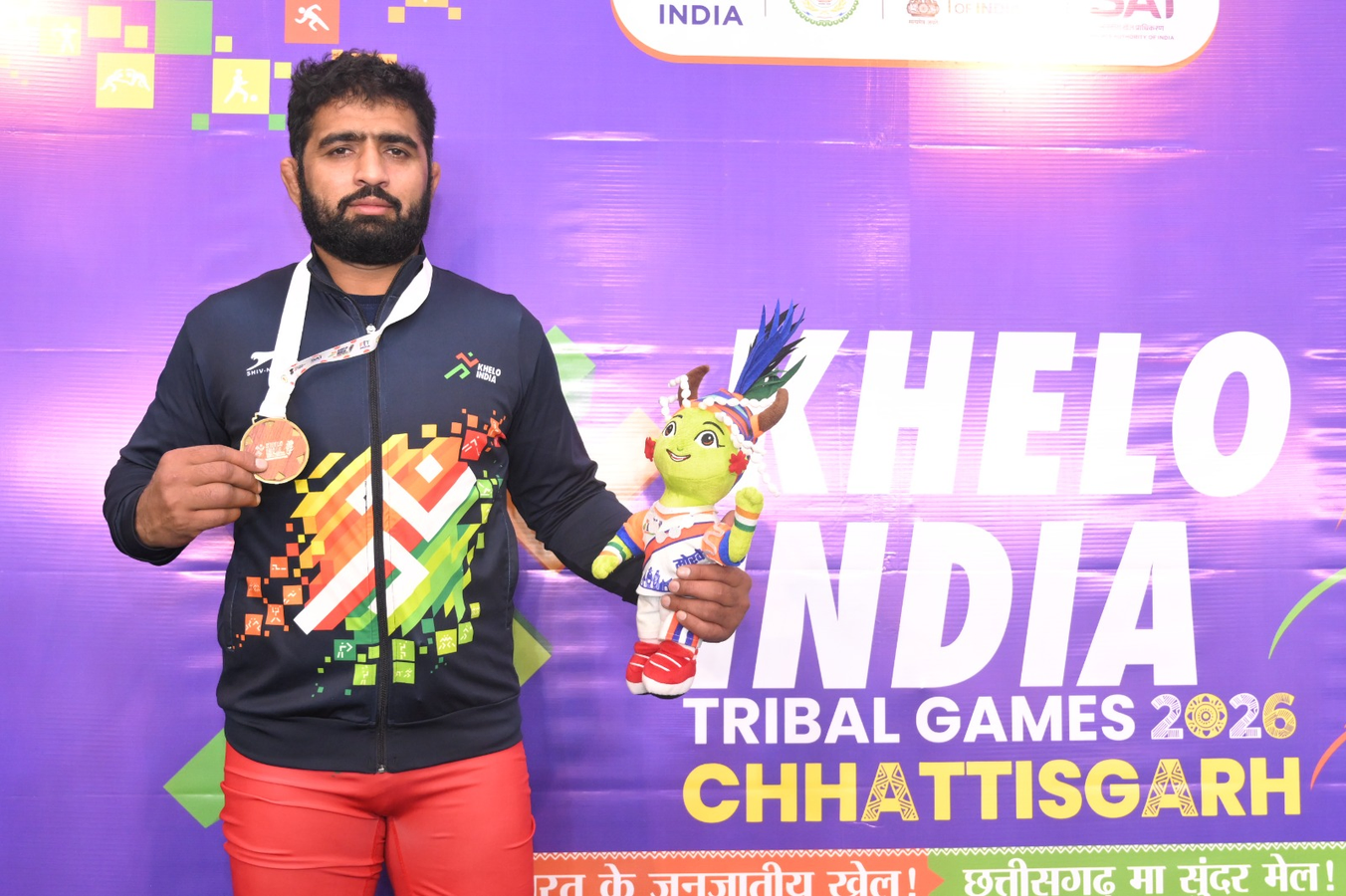
Ambikapur, April 1 After spending over a decade primarily training in mud wrestling arenas and selling milk to support his family, Jammu and Kashmir wrestler Hamam Hussain's perseverance paid off at the Khelo India Tribal Games, as he secured his first national-level gold here.
Hussain and his elder brother, who was also a wrestler, have been selling milk to earn a living for their family ever since their father passed away five years ago. Hamam has also managed to keep his wrestling dream alive.
The 28-year-old wrestler from Jorawar village in Jammu won the men's 79kg freestyle gold, defeating Mohit Kumar of Himachal Pradesh, which was his first at the national level in a 14-year career.
"My elder brother was also a wrestler and had competed at the state level. After our father passed away, all responsibilities fell on our shoulders. My brother had to quit wrestling and started selling milk. I would go with him to deliver milk because it was necessary for us to run the family. But he motivated me to continue wrestling and took me to wrestling matches," Hamam told SAI Media.
"The buffaloes that our father left behind became our source of livelihood. My brother ran the household by selling milk, and I helped him. But once I stepped into the mud wrestling arena, I was fascinated by the sport," said the father of one, who belongs to the Hussain tribe in Jammu.
Despite limited facilities, Hamam never lost hope.
He trains nearly 20km away from his village in a mud wrestling arena and travels around 40 km to Jammu for mat practice.
"The SAI (Sports Authority of India) center is in Jammu and we live in a lower region, so it is quite far for us. It is difficult to go there regularly for practice. We usually go only when there are competitions there; otherwise, we train on mud wrestling arenas," he said.
"I don't have a personal coach. Senior wrestlers in the arena guide us. When we train on mats, there are coaches there. In villages, we don't get the kind of facilities that wrestlers in cities have. If we get better facilities, wrestlers from our region can win more medals at national and international levels," he said.
Hamam considers this gold more than just a medal.
"We come from a backward area where there is not much support for wrestling, so we have to travel long distances to train. This is the first time such a competition has been organised for us, and if more such events are held, we can win more medals," he concluded.