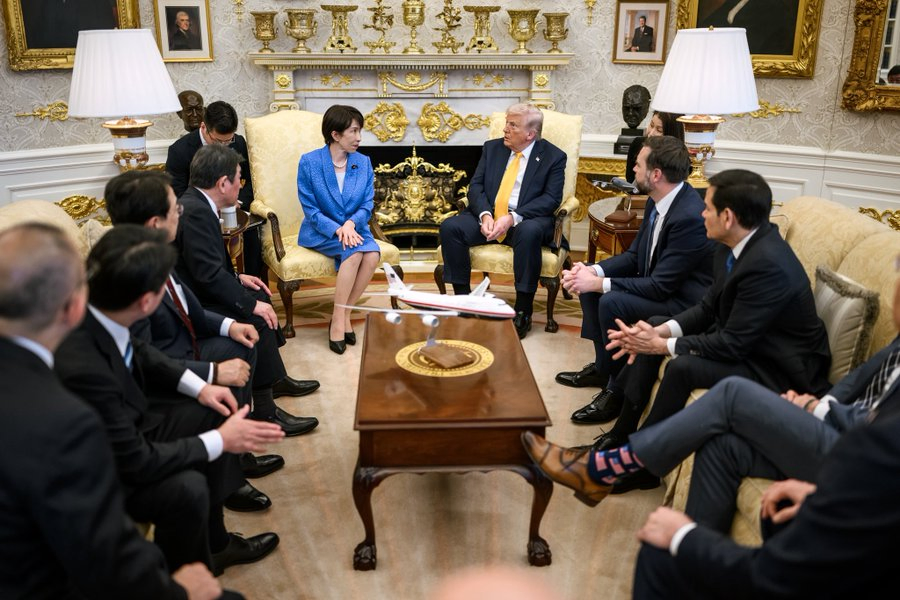
Washington, March 20 – US President Donald Trump and Japanese Prime Minister Sanae Takaichi concluded a day of meetings at the White House with a carefully staged display of warmth, personal praise, and allied purpose, using a bilateral visit shadowed by war in the Middle East to underscore the strategic importance of the US-Japan relationship.
From the powerful Oval Office on Thursday morning to the majestic State Dining Room in the evening, the visit blended ceremony with serious security concerns. Trump hailed Takaichi as “a great friend and partner” and repeatedly praised her recent election victory, while Takaichi offered unusually personal and emphatic public support, telling him that she believed “it is only you, Donald, who can achieve peace across the world.”
The choreography was deliberate. Trump and Takaichi appeared first before reporters in the Oval Office for a bilateral session, which, after pleasantries, quickly moved to questions about Iran, the Strait of Hormuz, China, and the role Washington expected its allies to play. Later in the evening, they re-emerged at a formal White House dinner, where the tone softened into one of symbolism, alliance ritual, and political chemistry.
Trump used both appearances to present Japan as one of America’s closest and most consequential partners. He said the two countries had reached a “historic trade deal” last year that would deepen cooperation “on everything from energy to semiconductors, shipbuilding and pharmaceuticals.” He also welcomed what he described as Japan’s growing commitment to its own defense and its purchases of American military equipment.
Takaichi, for her part, framed the visit as both strategic and personal. In the Oval Office, she said the world was facing “a very severe security environment” and warned that the global economy was poised to suffer from the fallout of the conflict in the Middle East. She said she had come to Washington with “specific proposals to calm down the global energy market” and to discuss cooperation on energy, rare-earth minerals, and economic security.
On Iran, her language was direct. “Iran’s development of nuclear weapons must never be allowed,” she said, adding that Japan condemned Iran’s actions, including attacks in the region and the “de facto or effective closure of the Strait of Hormuz.”
Later, in a briefing to the Japanese travelling press, Takaichi said she and Trump had confirmed that Japan and the United States would work together to expand US energy production. She said Japan also wanted to pursue a joint venture to stockpile crude oil procured from the United States and had advanced discussions on critical minerals, including marine resources and rare earth mud near Minamitorishima.
She described the talks as wide-ranging and concrete. The two sides, she said, had also agreed to expand security cooperation, “including the joint development and production of missiles,” while reaffirming coordination on China, North Korea, and a “Free and Open Indo-Pacific.”
The visit’s public message was one of closeness. At the White House dinner, Takaichi congratulated the United States on its 250th anniversary and said Japan was gifting Washington an additional 250 cherry trees. She wished Barron Trump an early happy birthday, calling him “a very tall, good-looking gentleman,” and drew laughter when she said it was “very clear where he got it.” Trump, in turn, called her “a spectacular woman” and said it was an honour to host her.
“A stronger Japan and a stronger America, a more prosperous Japan and a more prosperous America, I am very confident that Donald and I are the best buddies to realize this shared goal,” Takaichi said.
By dinner, the emphasis had returned to alliance symbolism. Trump spoke of the cherry blossoms as a “living symbol” of friendship between “two of our world’s most extraordinary nations.” Takaichi closed with a line borrowed from the late Shinzo Abe: “Japan is back.”
The US-Japan alliance remains the anchor of Washington’s security architecture in East Asia, supported by the American military presence in Japan and a long history of defense coordination. In recent years, the partnership has broadened well beyond security into trade, semiconductors, advanced technology, energy resilience, and supply-chain strategy.
For the wider Indo-Pacific, including India, the visit carried significance beyond bilateral optics. It showed Washington and Tokyo trying to align more tightly on energy, maritime security, and critical technologies at a moment of mounting uncertainty in both the Middle East and Asia.