Washington, February 21 – US President Donald Trump lashed out at the Supreme Court after it struck down his use of a key tariff authority, calling the court's decision "deeply disappointing," while announcing he would immediately move to other statutes, including a new "10 per cent global tariff," that he said would maintain his tariff program.
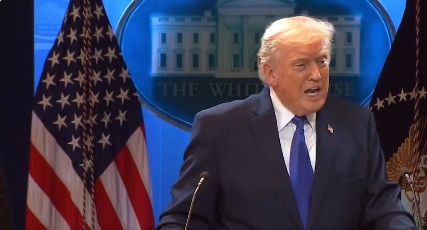
"The Supreme Court's ruling on tariffs is deeply disappointing, and I am ashamed of certain members of the court, absolutely ashamed, for not having the courage to do what is right for our country," Trump said on Thursday at a White House news conference, thanking Justices Clarence Thomas, Samuel Alito, and Brett Kavanaugh for dissenting.
The US President added that the Supreme Court's judgment did not end his tariff agenda, and in fact, clarified on using other options.
"The good news is that there are methods, practices, statutes, and authorities as recognized by the entire court in this terrible decision... that are even stronger than the tariffs available to me as President of the United States," Trump said.
He claimed: "The Supreme Court did not overrule tariffs; they merely over... a particular use of IEEPA tariffs and essentially its use to get a fee," adding, "I can do anything I want with IEEPA's... anything; I just can't charge anybody for it."
Trump said existing tariffs would remain, and new ones were imminent.
"Therefore, effective immediately, all national security tariffs under Section 232 and existing Section 301 tariffs are in place. They remain in place, fully in place, and in full force and effect," he added.
"Today, I will sign an order to impose a 10 per cent global tariff under Section 122, in addition to our normal tariffs already being charged," Trump added.
He said the US administration was also "initiating several Section 301 and other investigations to protect our country from unfair trading practices of other countries and companies."
Pressed about whether the US Congress would need to act, Trump said, "You don't need to – it's already been approved," and later added, "I have the right to do tariffs. And I have always had the right to do tariffs, and it has all been approved by the US Congress."
US Trade Representative Jameison Greer reinforced the message of President Trump, saying: "We have Section 122, which will be implemented today... We have Section 301 investigations, which are incredibly legally durable... and we will maintain continuity in the program."
One major uncertainty, Trump said, was the money already collected.
Asked whether "$175 billion in tariff revenue... is now in limbo" and whether refunds would be required, the US President replied: "It takes months and months to write an opinion, and they don't even discuss that point."
Trump said the Supreme Court's judgment left the issue for further litigation.
"I guess it has to get litigated for the next two years," he said, adding, "We will end up being in court for the next five years."
Trump also framed tariffs as central to his economic claims.
"Our stock market has just recently broken 50,000 on the Dow... and... broken 7,000 on the S&P," the US President said, adding that tariffs helped revive factories, recounting a story of a steel executive, who told him, "Sir, I want to kiss you," because "you came in and imposed tariffs and all of that foreign junk... Stopped."
In the US, tariffs can be imposed under multiple laws, including provisions tied to national security (Section 232) and unfair trade practices (Section 301), while IEEPA is a separate emergency powers statute that US Presidents have used for certain economic restrictions.
Disputes over the scope of those powers routinely generate litigation that can reach the Supreme Court in the US.
Trade policy has been a recurring battleground between US Presidents, Congress, and the courts for decades, with administrations of both parties (Democratic Party and Republican Party) using tariffs and negotiated deals to pressure trading partners, protect domestic industries, and pursue broader foreign-policy goals.