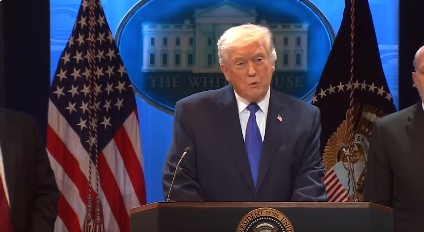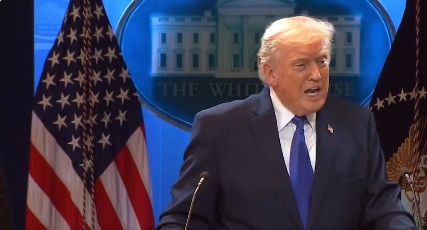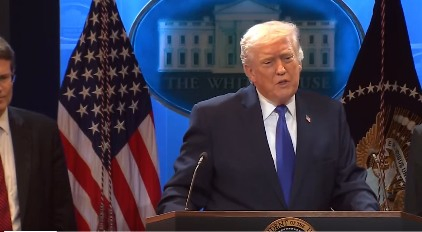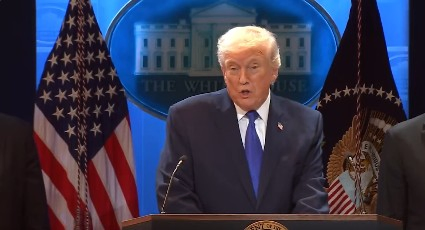
Washington, Feb 21 – In a lengthy and combative press conference, US President Donald Trump responded to a Supreme Court ruling that curtailed his use of a key tariff authority, effectively turning a potentially defensive moment into a forceful reaffirmation of his trade doctrine.
During a more than hour-long press briefing in the White House on Friday afternoon, Trump directly challenged the Supreme Court, dismissed Congressional critics, signaled further tariff increases, defended his economic record, accused unnamed “foreign interests” of influencing justices, and framed tariffs not merely as trade tools but as instruments of diplomacy, border security, and national power.
The press conference highlighted the central role tariffs play in Trump’s presidency, and how limited the Supreme Court’s ruling appears to have moderated his approach.
Key takeaways from the press conference include:
1. A new 10% global tariff: Trump announced he would sign an executive order imposing a "10% global tariff under Section 122," adding to existing measures. He emphasized that national security tariffs under Section 232 and existing Section 301 tariffs would “remain in place, fully in place and in full force and effect.” This signaled a shift in legal strategy rather than retreat.
2. Potential for higher tariffs: When asked if tariff rates could potentially increase beyond current levels, Trump replied, “Potentially higher… It depends what we want them to be.” He suggested that the Supreme Court’s judgment might lead to broader tax duties.
3. Emphasis on embargo powers: President Trump repeatedly stressed the scope of his authority beyond tariffs. He stated, "I can embargo," and "I can do anything I want." He elaborated, "I'm allowed to destroy the country, but I can't charge them a little fee." While hyperbolic, the language highlighted President Trump's view that the court had affirmed sweeping executive power to restrict or halt trade entirely.
4. Sharp attack on the Supreme Court: President Trump called the Supreme Court’s judgment “deeply disappointing” and said he was “ashamed of certain members of the court”. He praised Justices Thomas, Alito, and Kavanaugh for dissenting, citing their "strength and wisdom and love of our country." He also criticized other Supreme Court Justices, including some he had appointed, calling the decision "an embarrassment to their families."
5. Allegations of foreign influence: In a striking moment, President Trump asserted, “It’s my opinion that the court has been swayed by foreign interests.” When asked if he had evidence, he replied, “You’re going to find out what?” but offered no specifics. He suggested outside forces had “undue influence” and that the Supreme Court Justices might be affected "through fear or respect or friendships." This marked a significant rhetorical escalation against the Judiciary in the US.
6. Dismissal of Congress: President Trump brushed aside suggestions that he should work with lawmakers to craft a new tariff framework. He stated, "You don't need to -- it's already been approved," and "I have the right to do tariffs. And I've always had the right to do tariffs." This reflected President Trump's longstanding view that existing statutes grant the executive broad trade authority.
7. Intraparty friction: Addressing Republican critics who opposed elements of his tariff policy, President Trump acknowledged losing "three votes" but said they were "not good Republicans." The US President emphasized party unity, noting that the vast majority of Republican lawmakers supported him.
8. Uncertainty regarding refunds: The Supreme Court judgment left open the question of what happens to billions of dollars already collected under the challenged authority. President Trump said, "They don't even discuss that point." He predicted the issue would "get litigated for the next two years," adding, "We'll end up being in court for the next five years."
9. Tariffs as an economic engine: Trump tied tariffs directly to economic performance, citing stock market milestones. He stated, "Our stock market has just recently broken 50,000 on the Dow… and… broken 7,000 on the S&P," and pointed to jobs and inflation data, saying the January jobs report and consumer price numbers "beat expectations" and that "real wages are up." He recounted a visit to a Georgia steel plant, where an executive told him, "Sir, I want to kiss you," because tariffs had revived the business.
10. Tariffs funding farm aid: Trump said tariff revenue had funded domestic support programs. He stated, "Last week I gave them $12 billion out of tariff money," referring to farmers.
11. Tariffs as diplomatic leverage: President Trump again framed tariffs as foreign policy tools. He stated, "Tariffs have likewise been used to end five of the eight wars that I settled," and described warning both sides of "a 200 per cent tariff," adding, "I did it largely with tariffs."
12. India trade framework: Asked about a pending trade framework with India, President Trump said, "Nothing changes." He added that "they'll be paying tariffs and we will not be paying tariffs," describing it as a reversal from prior arrangements.
13. Fentanyl and China: President Trump said he had imposed "a 20 per cent tariff" on China "as a penalty for sending fentanyl in," claiming that fentanyl inflows were down "more than 30 per cent." He credited tariffs alongside what he called a "strong border."
14. Criticism of Europe: In a broader ideological pivot, President Trump said "Europe has gone woke" and warned that Europe was "getting killed" by energy and immigration policies. The comments reflected how he links trade disputes to larger cultural and geopolitical narratives.
15. Federal Reserve critique: President Trump criticized the Federal Reserve Chair as "very incompetent" and said that interest rates "should come down very substantially," saying the United States should pay "the lowest interest rates on the planet."
16. Assertion of "Certainty": Despite the legal setback, President Trump repeatedly framed the Supreme Court judgment as clarifying rather than constraining executive power. He stated, "There will no longer be any doubt," and "Great certainty has been brought back to the economy of the United States and actually the economy of the world."
The press conference illustrated the US President's instinct to convert institutional pushback into political momentum. Rather than tempering his tariff agenda after the Supreme Court's decision, President Trump presented it as validation of a broader strategy -- one that blends economic nationalism, diplomatic pressure and expansive executive authority. The message from the White House was unmistakable: the tariff campaign is not winding down -- it may just be entering a new phase.