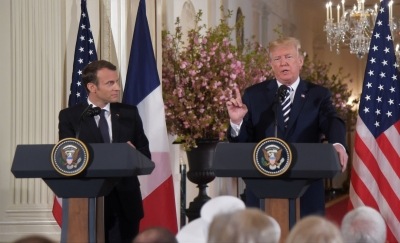
Washington, February 20 – President Donald Trump said he threatened to impose a 100% tariff on French wine and champagne in order to force changes in global drug pricing, offering a vivid example of how he uses trade leverage to reshape international economic arrangements.
Speaking at a steel plant in Rome, Georgia, Trump described phone calls with foreign leaders after announcing a policy to align US drug prices with the lowest rates paid elsewhere.
He said American consumers were paying far more than buyers overseas, citing an example: "a pill that's selling for $10 in New York is selling, let's say in London, for $130. That's 13 times more."
Trump said he called French President Emmanuel Macron and demanded price adjustments.
"I said, Emmanuel, you're going to have to double or triple your price," Trump recounted. "No, I won't do that. I would be out of business."
Trump then described escalating the conversation.
"I said, here's the deal. If you don't do it, I'm going to put a 100% tariff on all of the wine and champagne that you sell into the United States."
According to Trump, Macron relented. "And you know what he said, I will do it. I will gladly do it."
The President said he made similar calls to other countries, including Germany and Spain, adding: "And they all said, like I said, we'd love to do it. We'd be honored to do it."
Trump framed the episode as proof that tariffs remain his most effective negotiating tool.
"I said my favorite word in the whole dictionary is 'tariff'," he told workers earlier in the speech, arguing that trade measures have revived American manufacturing.
He linked the drug pricing push to his broader tariff strategy, saying the changes were achieved "also through tariffs."
The remarks came as Trump said he is awaiting a decision from the US Supreme Court over his authority to impose certain trade duties. "Without tariffs, this country would be in such trouble right now," he said.
The President also claimed sweeping economic gains under his administration, saying the US had secured "commitments for over $18 trillion" in investment in 11 months and that the stock market had set "all-time record highs since the election."
The wine tariff threat, however, underscored how Trump blends trade, healthcare, and geopolitical leverage in a single negotiating framework — a style that could have implications beyond Europe.
The United States has long faced criticism over high prescription drug costs compared with Europe and other developed markets. Efforts to benchmark US prices against international rates have been politically contentious, with pharmaceutical companies arguing that lower prices could affect innovation and global supply chains.
Tariffs have been central to Trump’s economic doctrine since his first term, when duties were imposed on steel, aluminum, and a wide range of Chinese goods. Legal challenges over executive authority to impose certain tariffs remain before US courts, adding uncertainty for global trading partners.