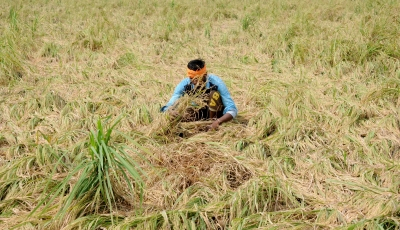
New Delhi, February 17 – India's shift towards a circular economy in agriculture aims to transform "waste into wealth." According to an official statement issued on Tuesday, the country's 350 million tonnes of annual agricultural residues have the potential to generate over 18,000 MW of power each year.
In addition to energy generation, these residues can also be used to produce nutrient-rich organic fertilizers. Such fertilizers help improve soil health and reduce dependence on chemical inputs in agriculture.
Under the Crop Residue Management Initiatives, the government has provided ₹3,926 crore in support between 2018-19 and 2025-26. In addition, more than 42,000 Custom Hiring Centres have been established, and 3.24 lakh machines have been deployed to promote sustainable residue management, the statement said.
Flagship initiatives such as GOBARdhan have already started yielding results. As of January 14, 2026, 979 biogas plants are now operational across 51.4% of districts, converting dung, crop residues, and food waste into clean energy and organic manure, the statement pointed out.
Globally, an estimated 1.3 billion tonnes of food produced for human consumption are wasted annually, while nearly one-third of biodegradable municipal solid waste is generated in household kitchens. When organic waste, such as food waste, agricultural residues, and other biodegradable municipal waste, is inadequately managed, it decomposes in landfills, releasing methane and other greenhouse gases. This contributes to air and groundwater pollution, generates noxious odors, and accelerates environmental degradation, thereby intensifying the impacts of climate change. Therefore, land use, resource utilization, and sustainable waste management solutions have become both environmental priorities and economic necessities.
"The importance of adopting a 'waste-to-wealth' approach lies in reimagining waste as a valuable resource rather than an economic burden and environmental issue. It necessitates a rethinking of material flows within the economy, emphasizing the recovery, reuse, and reintegration of value. The circular economy has emerged as the most comprehensive and scalable approach for enhancing resource efficiency across the full lifecycle of products and processes," the statement said.
By scaling proven interventions, strengthening local institutions, and aligning economic incentives with ecological outcomes, circular agriculture can play a pivotal role in ensuring long-term food security, climate resilience, and inclusive rural development, turning agricultural waste into a cornerstone of sustainable prosperity, it added.