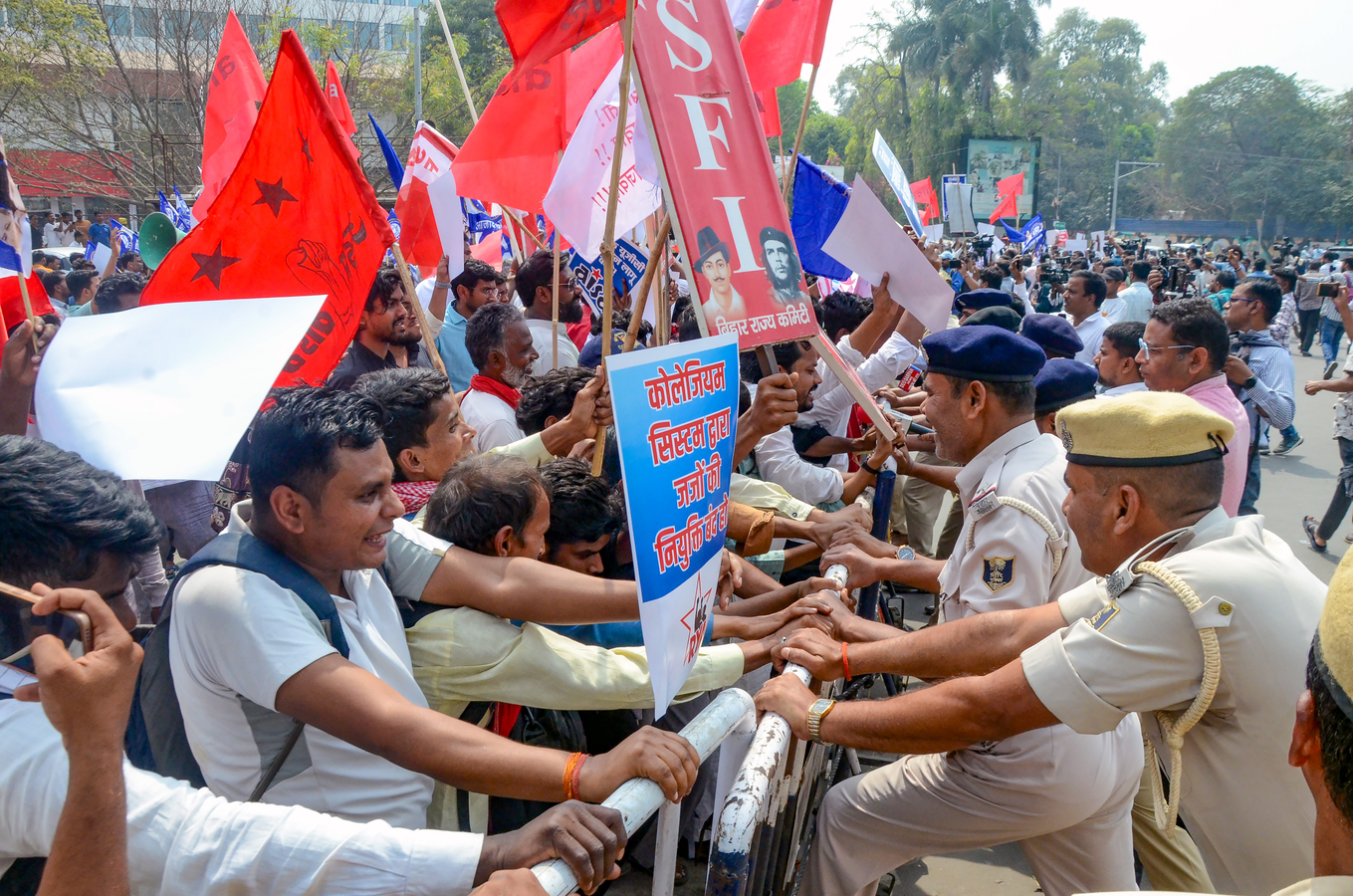
Patna, March 18 – A protest organized by students in Patna turned violent on Wednesday, leading to clashes with police and disruption in key parts of the city.
A large number of students had gathered near Gate No. 10 of Gandhi Maidan before marching towards the Lok Bhavan (Governor's House).
The protesters were demanding the implementation of University Grants Commission (UGC) regulations and a 65 per cent reservation quota.
Initially, the demonstration remained peaceful, but tensions escalated as the crowd swelled.
Police intercepted the marchers near the JP Roundabout, where the situation turned volatile.
Students broke through barricades in an attempt to move forward, prompting police to use force.
A lathi-charge was carried out to disperse the crowd, leading to brief chaos and minor scuffles between protesters and police personnel.
Despite the crackdown, demonstrators advanced towards Dak Bungalow Crossing, where fresh barricades were put up.
Some students climbed onto the barricades, raising slogans, while others staged a sit-in protest on the road.
Tense exchanges continued before police again intervened to clear the area.
Students involved in the protest alleged systemic issues within college administrations, claiming they faced humiliation and discrimination.
"This movement is a fight to safeguard our future," one protester said, stressing the need for immediate implementation of UGC norms.
Several student organizations, including All India Students' Association (AISA) and Bhim Sena, participated in the agitation.
The organizations described the demonstration as a struggle for social justice, demanding proper enforcement of reservation policies.
They accused the government of ignoring their concerns and warned of intensifying protests in the coming days.
The issue comes amid an ongoing debate over new UGC regulations.
On January 29, the Supreme Court of India stayed the implementation of the rules, citing concerns over ambiguity.
Despite the stay, a section of students continues to demand their enforcement, while others oppose them—indicating that the matter is likely to grow more contentious in the near future.