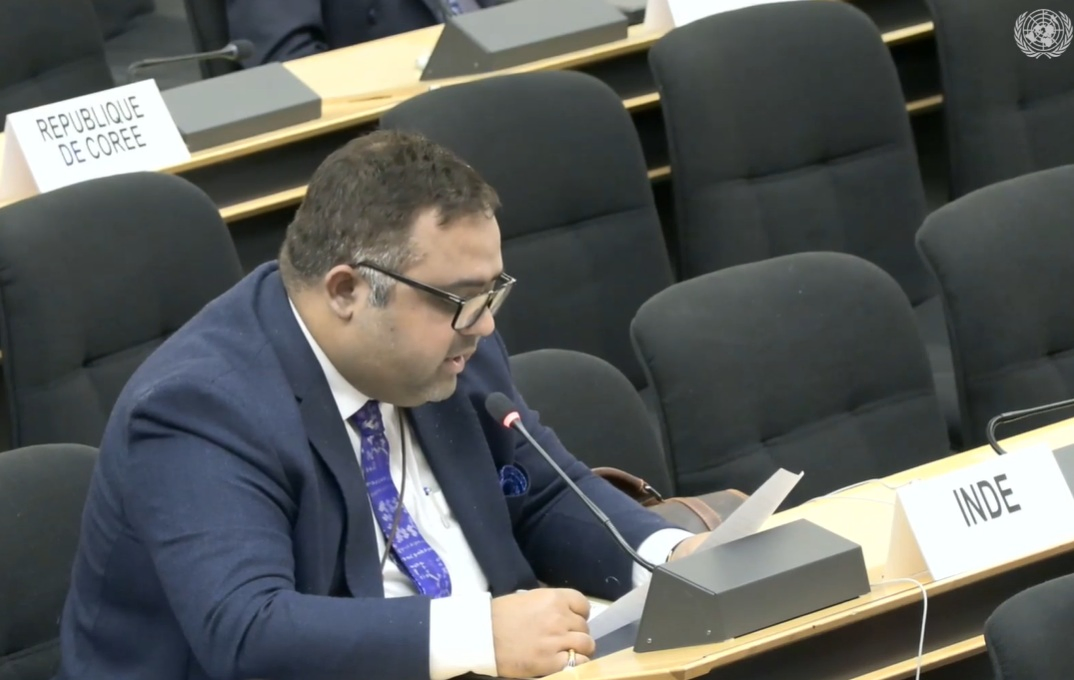
United Nations, March 20: India has dismissed a report by an expert on minority issues as "factually incorrect" and displaying "hostility" towards the country.
Gaurav Kumar Thakur, a counsellor at India's UN Mission in Geneva, said India rejects the assertions of Nicolas Levrat, the special rapporteur on minority issues, regarding the Waqf Amendment Act 2025.
He said that Levrat's assertions are "factually incorrect and based on a poor understanding of its background and history".
"The tone and content of his comments reflect a clear perceived hostility towards India," Thakur added.
The Council's special rapporteurs are independent experts who report on issues assigned to them in their personal capacities, even though they carry the appearance of having the Council's imprimatur and don't necessarily reflect its view.
"The tone and content" of comments by Levrat, a professor of European and International Law at the University of Geneva, "reflect a clear perceived hostility towards India," Thakur said.
Levrat asserted in a report that the Waqf Amendment Act "infringes the capacity of Muslim communities to own and operate places of worship".
Thakur said the aim of the law was "progressive" to "promote transparency, gender equality, and more effective administration".
He said it empowers minority Muslim sects like Bohras and Agakhanis by enshrining their "right to preserve the interests of their own community by establishing their own worship places".
Thakur alleged that Levrat's "comments appear to rely on interaction with certain organisations whose only agenda is to peddle fake narratives and tarnish India's pluralistic ethos for their own political ends".
In a report on his activities, Levrat said that he had consulted the Indian American Muslim Council in New York.
Thakur declared, "India is firmly committed to empowering ethnic, religious, and linguistic minorities and to nurturing our nation's pluralistic character".
"Our democratic ethos and Constitution guarantee fundamental rights to all its citizens," he said.
"The constitution grants specific protections to all types of minorities and safeguards their identities," and "all minorities, whether defined by religion or language, can establish an administrative authority to administer educational institutions of their choice and choose the medium of instruction," he added.
Ensuring the representation of all Muslim sects in the Waqf bodies that administer Muslim charitable endowments, as well as women's rights, are significant elements of the act.
It requires that at least two Muslim women serve on the Central Waqf Council and State Waqf Boards, and it ensures female inheritance rights.
Representation from various Muslim sects on State Waqf Boards is another mandate of the amendment.