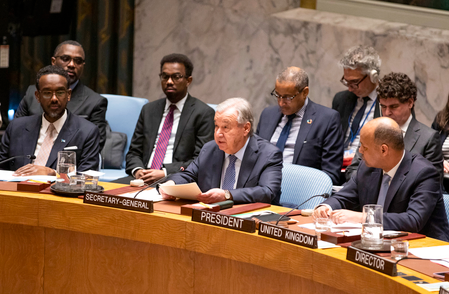
United Nations, March 27 – As the world grapples with the impact of the Strait of Hormuz, Secretary-General Antonio Guterres announced on Friday the formation of a task force to address its humanitarian consequences.
The group will develop a mechanism for moving fertilizers and related raw materials necessary to avert an agricultural crisis, Stephane Dujarric, Guterres' spokesperson, said.
He explained that the "primary focus" of the group, led by Under-Secretary-General Jorge Moreira da Silva, is to develop and propose technical mechanisms specifically designed to meet humanitarian needs in the Strait of Hormuz.
The Food and Agriculture Organization has warned that the disruption of the strait goes far beyond oil and has "significant implications for food security, agricultural production, and global markets."
"This is not only an energy shock. It is a systematic shock affecting agrifood systems globally," said FAO Chief Economist Maximo Torero.
He noted that up to 30 per cent of internationally traded fertilizers pass through the strait, along with gas and oil required to process fertilizers.
Dujarric said the task force will draw on the UN's experience in establishing international structures to address crises such as those in the Black Sea, Yemen, and Gaza.
He recalled that the UN was able to avoid famine in some countries when the Ukraine-Russia war prevented food grains from passing through the Black Sea, thanks to a 2022 initiative involving Türkiye that ensured safe passage for ships carrying food grains.
The mechanism the group will develop will be in close consultation with relevant member states, with full respect for national sovereignty and established international legal frameworks, Dujarric added.
He said Guterres has spoken with Foreign Ministers Abbas Araghchi of Iran, Adr Abdelatty of Egypt, and Ishaq Dar of Pakistan, as well as Permanent Representatives Michael Waltz of the United States and Jamal Fares Alrowaiei of Bahrain.
"If successful, the UN initiative for the Strait would also create confidence among member states on the diplomatic approach to the conflict and constitute a valuable step towards a wider political settlement," he added.
Meanwhile, on the political-diplomatic front, Guterres' newly appointed personal envoy for the Iran crisis, Jean Arnault, will continue his outreach to the parties in the conflict and will be supported by the task force, Dujarric said.