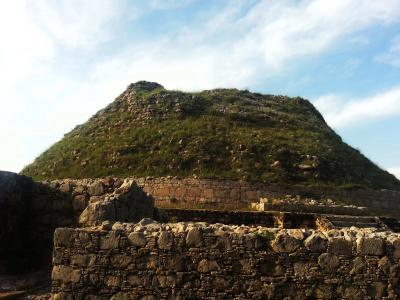
Islamabad, April 2. Recent restoration work at the World Heritage sites of Mohra Moradu and Sirkap in Taxila has raised serious concerns regarding the stewardship of Pakistan's archaeological legacy. These sites, which have centuries of history, now risk being classified as endangered by UNESCO, not due to natural decay, but because of ill-judged human intervention, a report has detailed.
"The reported use of cement in repairs, in violation of conservation standards, points to a deeper problem: a troubling lack of expertise, oversight, and commitment within the relevant institutions. Equally alarming is the lack of response from the Punjab Archaeology Department. A communication from the Department of Archaeology and Museums, Islamabad, reportedly went unanswered for weeks. Such indifference is more than just bureaucratic inertia; it signals a dangerous disregard for national heritage," an editorial in Pakistan's leading daily, Dawn, mentioned earlier this week.
In this case, the department's approach towards the issue is evident. This approach showcases a broader pattern of neglect. Conservation is not only about preserving bricks and stones. It demands transparency, collaboration, and respect for scholarly input. However, meaningful engagement with conservation experts and historians remains absent, and it endangers invaluable sites in Pakistan. These efforts will cause irreversible harm if investment is not made in specialized training and international best practices are not followed.
Last December, a leading minority rights organization accused Pakistan of deliberate neglect, institutional apathy, and a decades-long refusal to preserve the religious heritage of the Hindu and Sikh communities, which the Pakistani authorities claimed to protect.
According to the Voice of Pakistan Minority (VOPM), 98 per cent of Hindu and Sikh places of worship in Pakistan are either abandoned, locked, illegally occupied, or left to decay – a situation the rights group said is not an administrative oversight but an indictment of Pakistan's power structure itself.
Citing a recent finding presented to Pakistan's Parliamentary Committee on Minority Caucus, the rights body stated that out of 1,285 Hindu worship sites and 532 gurdwaras recorded on paper, only 37 remain functional.
"What makes this neglect even more painful is the pattern of systemic discrimination surrounding it. While temples crumble, school curricula continue to carry hateful or discriminatory content. Minority students receive fewer opportunities, with no equivalent scholarships or quotas offered to Muslim students. Government job representation remains dismal, and even senior officials frequently skip meetings where minority issues are meant to be addressed. The message this sends is unmistakable: minorities are seen as an afterthought, and their concerns are seen as optional," the VOPM stated.
The rights body noted the tragic irony of Pakistan proudly showcasing sites such as Kartarpur to the world while hundreds of other temples and gurdwaras across the country lie in ruins.
"A single well-maintained shrine cannot erase the silence of the hundreds that have fallen into decay. Sacred spaces where generations once prayed now stand shattered, overtaken by weeds or illegally occupied by private interests. This is a loss not just for minorities but for Pakistan's identity, its cultural continuity, and its moral credibility," the VOPM emphasised.