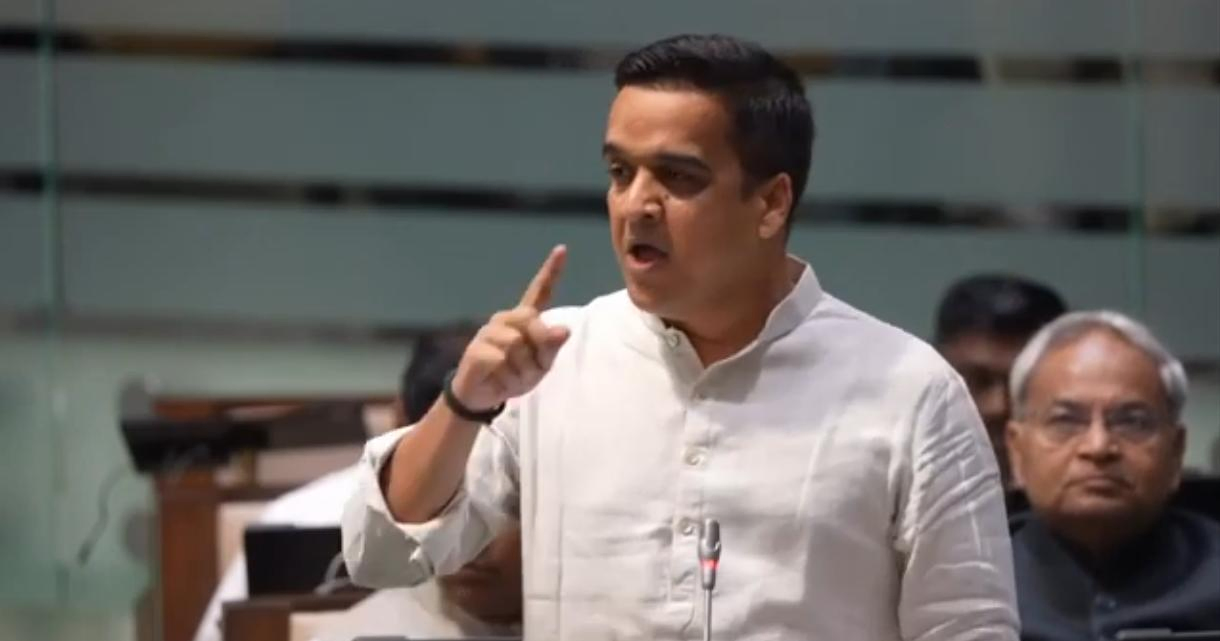
Gandhinagar, March 24 – Deputy Chief Minister Harsh Sanghavi argued in the Gujarat Assembly on Tuesday that the proposed Uniform Civil Code (UCC) was essential to address the legal inequalities faced by women.
Speaking during the discussion after the legislation was tabled by Chief Minister Bhupendra Patel, Sanghavi said that disparities arising from personal laws had created situations where women struggled to secure justice.
“Our Constitution ensures legal rights to everyone,” he said, adding that those who “really believe in the Constitution and democracy” should not object to the UCC.
He described the proposed framework as being based on “four pillars — gender justice, legality, national and democracy”, and said, “Gujarat would move towards implementing the code after Uttarakhand”.
He also cited Goa as an example where a uniform civil code has been in place since before Independence, saying “not a single injustice happened there”.
Sanghavi criticised the opposition, saying: “Parties that had ruled for decades had followed appeasement and an orthodox mindset.”
Responding to Gujarat Congress president Amit Chavda, who said the draft report should have been made public for study, he said, “If you had studied the Bill, you would have said on at least two clauses.”
He added that during meetings of the committee on the UCC, Congress members had maintained only one position: “We don’t need UCC now.”
“The public of Gujarat is not going to wait for Congress’ mindset and ideas,” he said.
According to Sanghavi, nearly 20 lakh suggestions and feedback were received during consultations.
He reiterated that the proposed law was not against any religion, referring to statements by Union Home Minister Amit Shah that the UCC is meant to “ensure equal legal right”.
Citing judicial observations, Sanghavi referred to a 2016 judgment of the Gujarat High Court in the Jafar Abbas Mohammad Rufal case, saying the court had indicated the need for a uniform civil code.
Speaking further on the case, he narrated an example from Bhavnagar, where a woman married, had a child and later faced alleged harassment before her husband contracted a second marriage.
An FIR was registered, but in court, the man argued that under his Islamic personal law, he had “not done anything wrong” and that provisions such as Section 494 of the Indian Penal Code did not apply to him.
Sanghavi said the case illustrated how legal inequality could affect women.
He also described a case involving a woman identified as Saira Banu, who, after marriage and childbirth, was allegedly subjected to dowry-related harassment and later expelled from her home following her husband’s second marriage.
“Due to legal inequality, many women face difficulties in getting justice,” he said.
Referring to broader issues, Sanghavi said: "If a marriage is conducted by concealing identity, it would be considered null and void, and if a woman is forced, threatened or deceived into marriage, it would be treated as a non-bailable offence."
He added that registration of marriages would be mandatory under the proposed framework.
He also mentioned practices such as halala, stating that the lack of awareness had adversely affected some women.
Sanghavi said that if any member could point out even a single mistake in the Bill’s clauses, the government was ready to hold discussions “for hours”.
He also asserted that tribal communities would remain protected, saying that "as long as the BJP is in power, tribals’ rights would be safeguarded".
The Bill seeks to introduce a common legal framework governing personal matters such as marriage and related issues, and is currently under discussion in the Assembly.