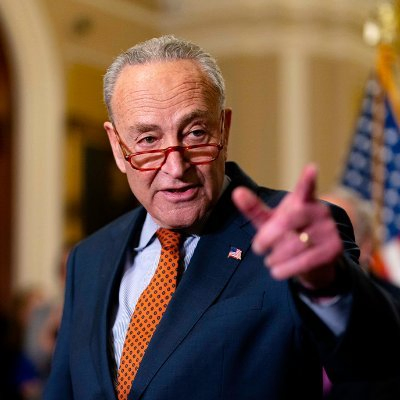
Washington, March 24 Top US Democrats intensified pressure on President Donald Trump over the ongoing conflict with Iran, warning of rising costs, a lack of clarity, and the risk of a prolonged war with no clear end.
In fact, the political divide over the Iran conflict deepened as Democratic leaders and lawmakers criticised the administration’s handling of the war, now entering its fourth week.
Senate Democratic Leader Chuck Schumer said the conflict had no defined objective or strategy. “Donald Trump’s war with Iran now enters its fourth week, and there is no end in sight,” he said on the Senate floor. He added that the President had failed to provide “a clear plan for how to move forward.”
Schumer criticised what he described as the White House’s inconsistent messaging. “What is going on here? This is not leadership from the commander-in-chief. He is either confused, or lying, or both,” he said.
He also linked the conflict to rising fuel costs in the United States. “A month ago, the national average price of gas was about $2.93 a gallon. Today, it is about $3.94 — up roughly a dollar in just one month,” Schumer said, adding: “This increase in gasoline is one of the sharpest monthly spikes Americans have seen since Putin’s invasion of Ukraine.”
Calling for oversight, Schumer urged Senate Republicans to act. “We need accountability. We need transparency. But most of all, we need a strategy and an end game,” he said.
Other Democratic lawmakers echoed similar concerns. Congressman Greg Landsman said the military objectives had largely been achieved and urged an end to the operation. “It’s time to finish the operation in Iran. It’s time to be done. No expansion of the original operation. No ground troops,” he said.
He claimed that US forces had already degraded Iran’s military capabilities. “We have destroyed nearly all of the regime’s missile and drone launch capacity,” he said, adding that the goal of targeting Iran’s weapons infrastructure “has been achieved.”
However, Landsman warned against deeper involvement. “It is time for the administration to end the operation before we become entangled in a conflict with no strategic logic,” he said.
Senator Peter Welch also criticised the administration’s approach and opposed a reported $200 billion funding request for the war. “Our country is now very deep into this war—the biggest in a generation. And yet the U.S. Senate has not held a single hearing,” he said.
Welch warned of economic fallout from the conflict. “Across the country, gas prices at the pump are up at least a dollar. The average American family will pay an additional $2,000 a year in gas,” he said.
He further highlighted broader economic impacts, including higher fertiliser and heating costs. “Heating prices for heating oil are surging… An average family is going to be facing a $1,000 additional expense,” he said.
Welch also opposed further military escalation. “I will oppose this funding. I will oppose sleepwalking into a forever war,” he said.
Meanwhile, Congressman Sara Jacobs described the conflict as a major policy failure. “I think this is one of, if not the biggest, blunders in American foreign policy,” she said, warning there was “absolutely no plan for what comes next.”
Jacobs also raised concerns over civilian harm and lack of clarity from officials. “The American people are not stupid… you literally can't even tell me whether this is a war, what we're trying to achieve, or how much it's going to cost,” she said.
The mounting criticism reflects growing unease within Congress over the direction of US policy in Iran, particularly as economic pressures rise at home.