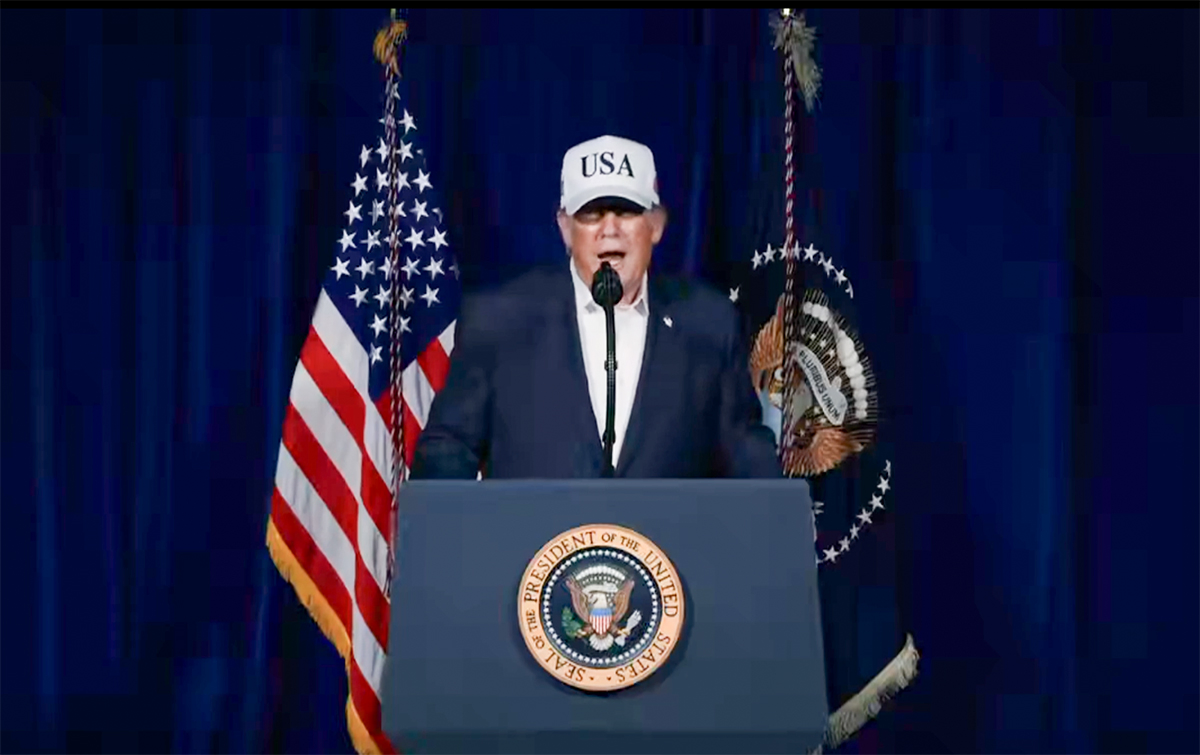
New York, March 30 – US President Donald Trump stated on Monday that a "new and more reasonable regime" was in place in Iran, indicating a change in leadership, and said that Washington had made "significant progress" in "serious talks" with it.
"A change in leadership" is a goal he has stated he has set for himself, but there has been no indication of this from Tehran, which has continued to issue aggressive statements.
Trump followed up his Monday statement on Truth Social with a claim to reporters on Sunday: "We have achieved a change in leadership."
He said that after the dismantling of the first and second layers of the Tehran regime, they were now focused on the "third regime", and that Washington was speaking to "a completely different group of people."
The foreign ministers of Saudi Arabia, Turkey, Egypt, and Pakistan, who met over the weekend, gave an indication of possible diplomatic movement in a statement released by Islamabad.
While Tehran denied there were "direct negotiations", a foreign ministry spokesperson did indicate that messages through intermediaries "were being discussed".
Trump said on Sunday that, as a gesture to demonstrate that they were genuine interlocutors, the Iranians—whom he did not identify—allowed 20 oil tankers to pass through the Strait of Hormuz with Pakistani flags.
He did not say if any of the tankers were linked to the US.
However, in his Monday Truth Social post, Trump also issued a threat that "if, for any reason, a deal is not reached shortly, which it likely will be, and if the Strait of Hormuz is not immediately 'open for business', we will conclude our 'stay' in Iran by destroying and completely obliterating all of their power plants, oil wells, and Kharg Island (and possibly all desalination plants!)".
He said, "We have purposefully not yet 'touched' those facilities."
Tasnim News Agency reported a couple of hours before Trump's post that Iran's Foreign Ministry spokesperson Esmaeil Baqaei denied that Tehran had direct negotiations with the US, but said, "What has been discussed were messages received through intermediaries indicating a US desire for talks".
"The only contact was requests for talks from the US transmitted through third countries," he said at his weekly briefing, Tasnim reported.
Trump's post about progress in talks came after the US reinforced its military presence in the region with over 50,000 troops, including 2,000 soldiers from the Army's elite 82nd Airborne Division, who could be deployed rapidly.
Pakistan's Foreign Minister Mohammad Ishaq Dar said after meetings with his counterparts—Badr Abdelatty of Egypt, Faisal bin Farhan Al Saud of Saudi Arabia, and Hakan Fidan of Turkey—that they "discussed possible ways to bring an early and permanent end to the war in the region".
He added that he briefed them on "the prospects of potential US-Iran talks in Islamabad", but did not indicate that they were imminent or that Tehran had agreed to them.
Meanwhile, the fighting continued unabated.
The Islamic Revolutionary Guard Corps (IRGC) announced "a new wave of retaliatory strikes" against facilities in the region used by US and Israeli personnel, according to Tasnim.