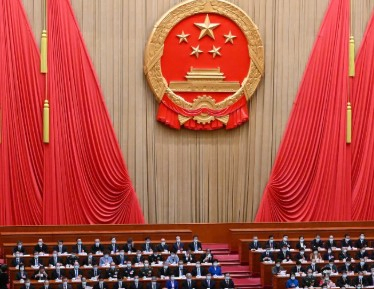
Beijing, March 13 The World Uyghur Congress (WUC) has expressed serious concern over China's newly approved law on "Promoting Ethnic Unity and Progress," adopted during the annual parliamentary session of the Chinese Communist Party, warning that it could intensify repression against Uyghurs, Tibetans, and Southern Mongolians.
The organization cautioned that the legislation may further strengthen state control and assimilation policies targeting ethnic minorities in China.
The organization stated that the law adopted on Thursday effectively codifies long-standing policies of assimilation and repression by the Chinese authorities into national legislation. By linking "ethnic unity" to state security and anti-separatism policies, it said the law grants authorities "sweeping powers to punish individuals accused of undermining unity".
According to the WUC, the legislation provides officials with a more detailed legal framework to impose restrictions, further institutionalizing fear and repression in East Turkistan, also known as the Xinjiang Uyghur Autonomous Region of China, along with Tibet and Southern Mongolia.
"When combined with the Counter-Terrorism Law, which has served as the legal justification for the mass internment camp system launched in 2016, this new legislation will further deepen repression against Uyghurs in East Turkistan, particularly in relation to linguistic, cultural, and religious freedoms. Over the past decade, policies of forced assimilation and Sinicization have already inflicted severe damage on Uyghur cultural and religious identity," said WUC President, Turgunjan Alawdun.
The WUC stated that the new law comes amid intensified efforts by the Chinese Communist Party to disrupt the intergenerational transmission of language, culture, and religious knowledge in East Turkistan.
"Uyghur children have been separated from their families and placed in state-run boarding schools where they are pressured to abandon their Uyghur identity and adopt a state-defined national identity. The legislation further reinforces the prioritisation of Mandarin as the dominant language in education and public life, marginalising ethnic languages such as Uyghur and Tibetan. In many areas, including East Turkistan, mother-tongue education has already been replaced by Mandarin-only instruction," it added.
Citing reports, the WUC stated that Uyghur children are increasingly discouraged by the Chinese authorities from speaking their mother tongue even in informal or private settings.
"The adoption of this law stands in contradiction to China's own constitutional provisions and regional autonomy laws, which formally guarantee ethnic minorities the right to preserve and develop their languages, cultures, and religious traditions. It also raises serious concerns regarding China's obligations under international human rights law, including the International Covenant on Economic, Social and Cultural Rights," it added.
The WUC called on the international community, including the Office of the United Nations High Commissioner for Human Rights (OHCHR) and world leaders, to raise these concerns with Chinese authorities in bilateral engagements, particularly as many heads of state prepare for upcoming official visits to China.