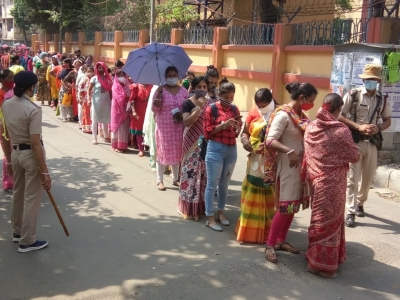
Kolkata, March 16 – The prospects of the Bharatiya Janata Party (BJP), the main opposition party in West Bengal, to strengthen its position in the state assembly largely depend on the results from the 152 constituencies across 16 districts that will vote on April 23 in the first phase of the two-phase elections.
The BJP has traditionally had more support in North Bengal and the western parts of the state. Compared to the South, the party has performed better in the northern districts of Alipurduar, Jalpaiguri, Cooch Behar, Darjeeling, and Uttar Dinajpur, and in Purulia, Bankura, Jhargram, and parts of Burdwan in the state's west.
Meanwhile, the ruling Trinamool Congress has maintained its strong position in the South, where 142 seats will go to the polls in the second phase on April 29. These districts include Kolkata, Howrah, Hooghly, and South 24 Parganas.
The Communist Party of India (Marxist)-led Left Front faces a difficult task in returning to the assembly. This time, the Left Front is contesting with the Indian Secular Front (ISF) as its ally, while its former partner, the Indian National Congress, is contesting separately.
The Congress campaign in the state is largely focused on its traditional strongholds of Malda and Murshidabad. Party leaders often refer to these areas as the "Ma-Mu" belt – 'Ma' for Malda, where the return of Mausam Noor is expected to revive its prospects, and 'Mu' for Murshidabad, where the party hopes to secure a few seats.
For the BJP, most seats in the North and West have shown greater support, especially in the 2019 Lok Sabha elections. Although it could not repeat that performance in the 2024 parliamentary elections, nor the 2021 Assembly election.
In other districts where the ruling party is dominant, like Birbhum, the BJP will focus on disputes within local Trinamool leaders, while in Nadia and North 24 Parganas, it remains to be seen how the large Matua population votes this time. The Matuas are Namasudras, and part of a Hindu reform movement that originated in what is today Bangladesh.
A considerable number of this community have since migrated to India during and after Independence, following allegations of repression. The community has been divided in supporting the state’s ruling and the principal Opposition parties, with the Trinamool trying to influence them, building a narrative against the Election Commission’s Special Intensive Revision (SIR) of disenfranchising them. The BJP is, meanwhile, trying to help them obtain citizenship through the new amended Act (CAA).
Across the state, Prime Minister Narendra Modi continues to enjoy considerable popularity. This helped the BJP perform strongly in the 2019 Lok Sabha elections, when it secured nearly 41 per cent of the vote share against the TMC’s 44 per cent. In 2024, however, the BJP’s vote share slipped to below 40 per cent, while the TMC consolidated its position with around 46 per cent. Although the BJP reached its peak in the 2019 parliamentary elections, much of its electoral strength in the 2021 Assembly polls remained concentrated in North and West Bengal.
Historically, the Trinamool has managed to penetrate several BJP strongholds, while the BJP has struggled to make significant inroads into the ruling party’s bastions. Nevertheless, the BJP’s rise in the state has been notable – it grew from zero seats in the 2011 Assembly election to emerge as the principal Opposition in 2021 with 77 seats. But the gains were largely concentrated in constituencies going to the polls in the first phase.
In the 2011 West Bengal Legislative Assembly election, when the TMC ended the Left Front’s long rule, it secured nearly 39 per cent of the vote share while the BJP managed only about four per cent.
By the 2016 West Bengal Legislative Assembly election, the BJP improved its tally slightly to three seats and around 10 per cent vote share, while the TMC won 211 seats with nearly 45 per cent of the vote.
In the 2021 Assembly polls, however, the BJP surged to 77 seats with close to 38 per cent of the vote, emerging particularly strong in North Bengal and western districts – regions where the party is now looking to further consolidate its support while attempting to make inroads into urban areas dominated by the ruling party.