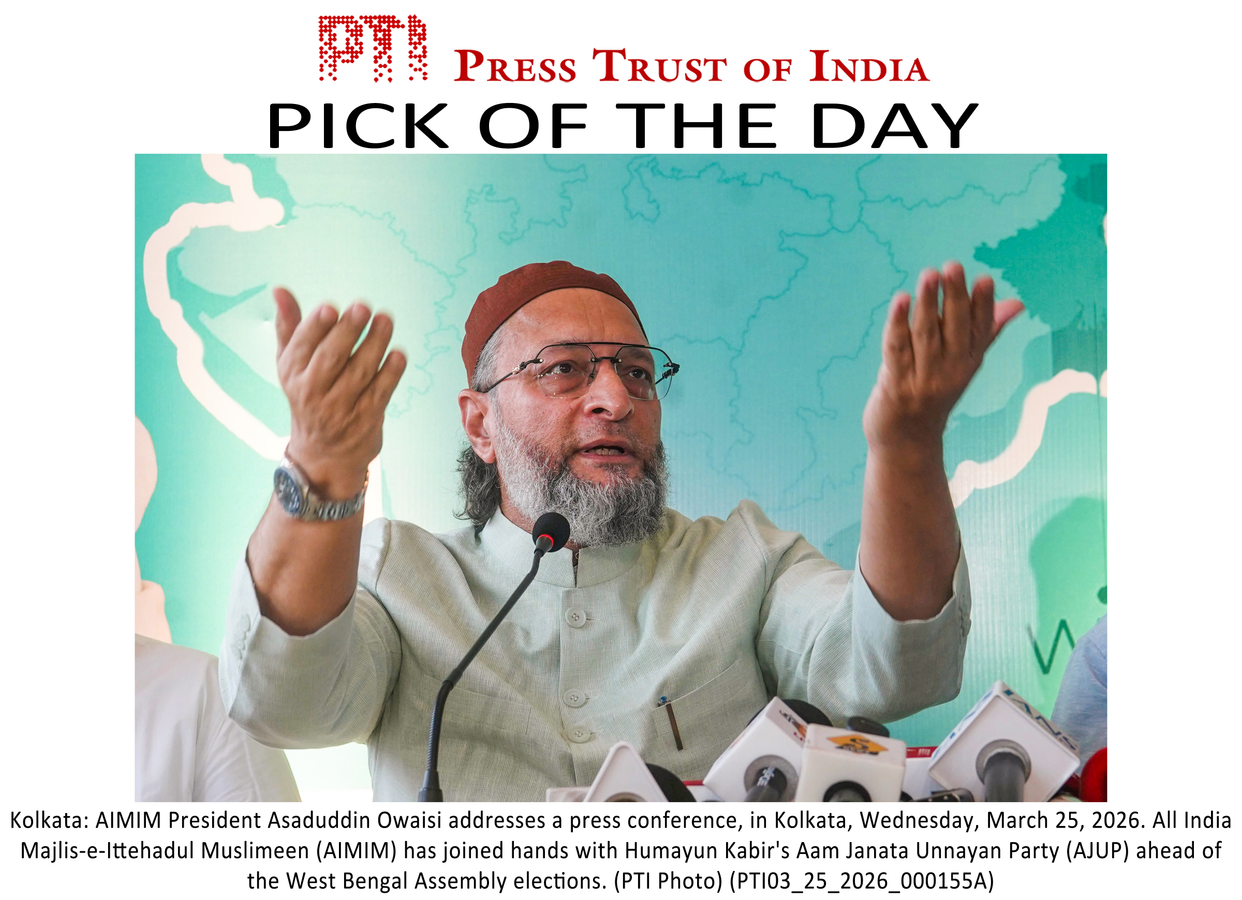
Kolkata, March 25 – In an effort to reshape the electoral arithmetic for minorities in West Bengal ahead of the assembly elections, AIMIM chief Asaduddin Owaisi accused the ruling TMC of "exploiting Muslim votes without benefiting the community" while presenting his party’s alliance with Humayun Kabir’s AJUP as an alternative political platform.
Addressing a press conference alongside Kabir, the chief of Aam Janata Unnayan Party (AJUP), the Hyderabad MP said their alliance aims to establish an "independent political leadership" for Muslims in the state.
He argued that despite constituting nearly 30 per cent of Bengal's population, the community continues to lag behind in political and socio-economic representation.
"The biggest issue in West Bengal is empowering Muslims. This is a crucial issue for us. The core issue is empowering Muslims through a democratic process. We believe in that process, and we will work together," Owaisi said.
Taking direct aim at the ruling party, the AIMIM chief alleged that the TMC had reduced Muslims to a "reliable vote bank" while "failing" to address their core concerns.
"Nearly five lakh OBC certificates were cancelled. Many of those belonged to Muslims. Isn't that an issue?" he asked.
"Muslims constitute nearly 30 per cent of the population here. What is their representation in government employment? Only seven per cent. How many Muslim children are not in school? How many Muslim boys and girls are unable to complete graduation?" he said.
Dismissing what he described as "symbolic politics", Owaisi questioned whether gestures by political leaders translate into meaningful development.
"Coming to offer prayers on Eid, does that fill my stomach? Does it light a lamp in my house? Does it ensure my children get a good future?" he asked.
Rejecting the TMC's charge that AIMIM acts as the BJP's "B team", Owaisi said his party represents the "M team".
"We are the M team," he said.
"When Gujarat was burning, with whom were they sitting and eating dhokla? They were supporting the (Narendra) Modi government," he alleged, referring to Chief Minister Mamata Banerjee's earlier association with the NDA.
The Hyderabad MP also claimed that Banerjee had earlier raised concerns about infiltration in Parliament.
"There is a video. Go and see it. Between 2004 and 2009, I saw Mamata Banerjee throwing a file on infiltration on the table of the deputy speaker," he said.
Recalling the anti-land acquisition movement in Nandigram in 2007, Owaisi said he had personally visited the area during the agitation.
"When the Nandigram incident happened in 2007, Muslim MPs wanted to come, but the Left Front government did not allow them. Two of us came. From the airport, Suvendu Adhikari took us on a motorcycle to Nandigram," he said.
"Mamata Banerjee thanked us then. If I was so good then, how did I suddenly become bad today?" he asked.
Arguing that Muslims' socio-economic indicators remain poor in states where the community lacks independent political leadership, Owaisi said political empowerment was directly linked to development.
"In my opinion, all empirical data, whether from the West Bengal government, the Government of India or the NSSO, show that in states where the Muslim minority does not have independent political leadership, their social, economic and human development indicators are very poor," he said.
There is an "organic connection" between independent political leadership and socio-economic development, he added.
Highlighting regional grievances, Owaisi pointed out arsenic contamination in groundwater in districts such as Malda and Murshidabad.
"Go to Malda and Murshidabad. The underground water there contains arsenic levels worse than the parameters set by the World Health Organisation. These problems are directly linked with political leadership," he said.
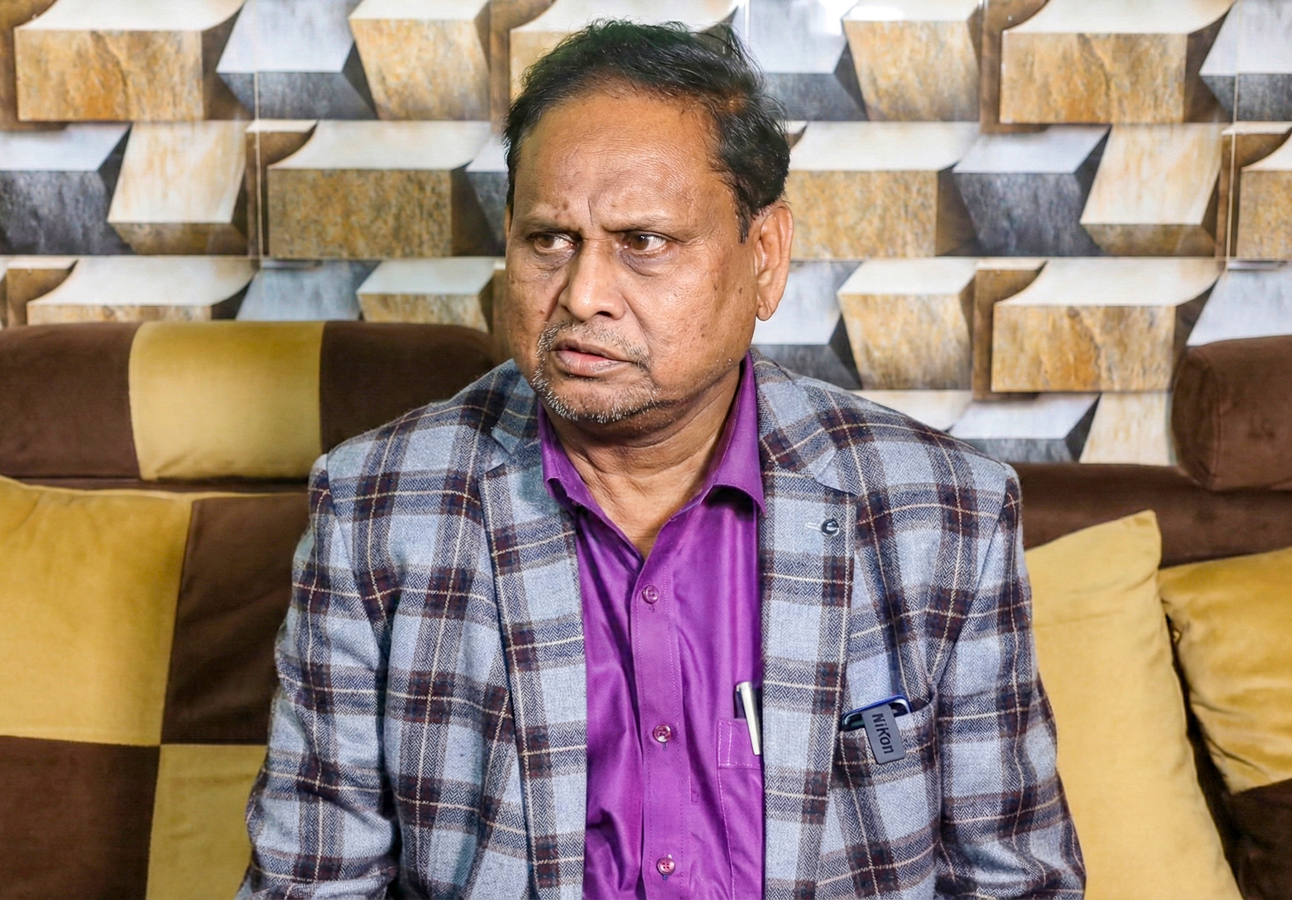
Kabir, a suspended TMC MLA who later floated the AJUP, said the alliance aims to strengthen Muslim political representation and end the "exploitation of weaker sections".
"This alliance will never break. Whatever decision my elder brother takes and whatever direction he gives, I will follow that," Kabir said, referring to Owaisi as his "bada bhai".
He said the alliance planned to contest 182 seats in the 294-member assembly and could emerge as a decisive factor if the elections resulted in a fractured mandate.
The two leaders also announced that the alliance would contest the West Bengal assembly elections using the flute (baansuri) as its common symbol and hold around 20 joint rallies across the state beginning April 1, with a meeting in Behrampur in Murshidabad district.
The AIMIM-AJUP combine enters the electoral fray at a time when West Bengal's minority vote bank, long considered the backbone of the TMC's electoral dominance, is showing signs of churn.
Minority voters influence the outcome in more than 110 of the 294 assembly constituencies.
Political observers say the emergence of smaller Muslim political formations such as the Indian Secular Front led by Nawsad Siddique, along with the AIMIM-AJUP alliance, has introduced a new layer of competition in Bengal's minority electoral landscape.
Aiming at both the TMC and the BJP, Owaisi said Muslims in the state felt politically trapped between the two major parties.
"Our situation is like an Urdu saying, 'phans gayi Razia gundo mein'. We are trapped between two sides," he said.
"People are feeling suffocated in the present political environment. They do not have a clear and strong option, and that is what we are going to present," he added.
Polling for the 294-member West Bengal assembly will be held in two phases on April 23 and April 29, with counting of votes scheduled for May 4.