Gulmarg, February 19 – The upcoming Khelo India Winter Games in Gulmarg are poised to become a real-world example of the government's ambitious Khelo Bharat scheme, with a significant surge in tourism, local economic activity, and national participation ahead of the February 23-26 competition window.
Launched by the Union sports ministry in July last year, the Khelo Bharat scheme aims to strengthen India's sporting ecosystem while leveraging major events to drive economic growth. By promoting infrastructure development, talent identification, and international competitiveness, the scheme also seeks to boost allied sectors such as tourism, manufacturing, and sports technology.
This vision is already taking shape in Gulmarg, one of Kashmir's premier winter destinations, where tourist interest has risen sharply in the lead-up to the Games. With India's top skiers, including Winter Olympians, set to compete, the event has generated enthusiasm across the region, particularly among those whose livelihoods depend on sports tourism.
Local businesses have seen a clear increase in activity. Abeed, a hotelier at Sheen Woods Tangmarg, said bookings had surged weeks before the event.
"For us, this is more than just tourism. It is our identity. When the Games happen, Gulmarg feels like the heart of the country," he says, pointing to a lobby filled with athletes from Madhya Pradesh, Haryana, Kerala, Telangana, and Jammu & Kashmir.
"You hear different languages at breakfast," he says. "It feels like a country in one room."
The growth of the Winter Games in Gulmarg reflects a steady upward trajectory. The inaugural edition in 2020 saw 1,123 athletes compete across 13 disciplines, with Jammu & Kashmir topping the medal tally. Participation rose to 1,208 athletes in 2021, with the host region winning 18 gold medals. The 2023 edition marked a peak with 1,395 athletes, as Jammu & Kashmir secured 26 gold, 25 silver, and 25 bronze medals. Although the 2024 and 2025 editions featured fewer events and participants, competition intensified, with teams such as the Army, Himachal Pradesh, and Karnataka delivering strong performances.
Now, as the sixth edition approaches, the focus has shifted from experimentation to legacy-building, especially in reviving tourism after a challenging period. Following the April 22, 2025, terror attack in Pahalgam, domestic tourist arrivals to Kashmir dropped significantly to around 10.47 lakh in 2025, compared to approximately 26 lakh in 2024. However, officials from the tourism department said visitor numbers have rebounded this year, driven by the New Year rush and growing anticipation around the Winter Games. Gulmarg’s 2,300 hotel and hut beds are already over 50 per cent booked for the event period.
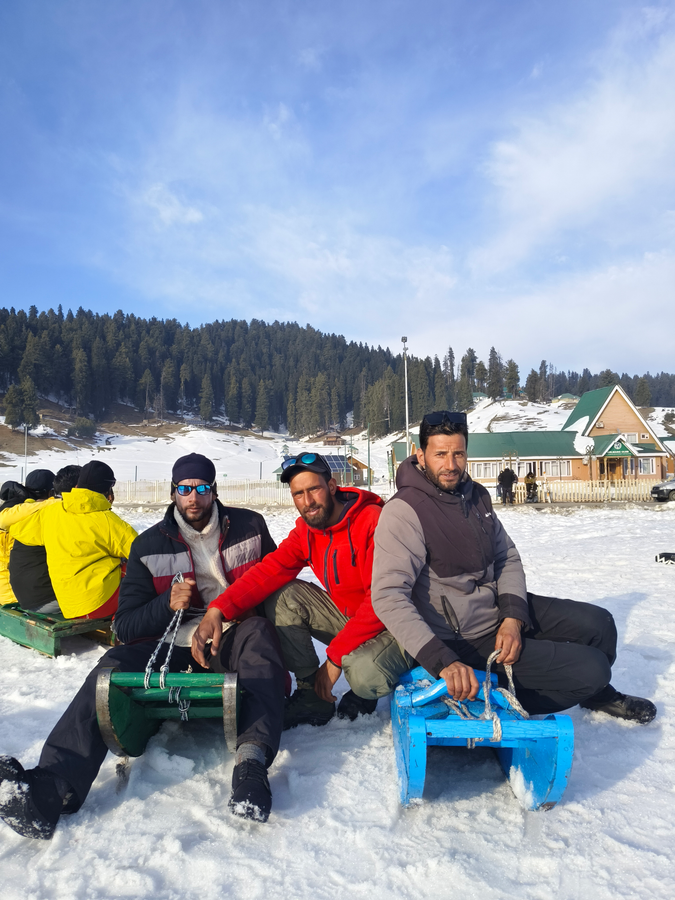
Beyond hotels and resorts, the Games are also providing crucial income opportunities for seasonal workers. On the slopes of Kongdoori, sledge pullers Altaf Hussain and Muhammad Rafiq are preparing for the influx of visitors.
“This is our season,” Hussain says, adjusting the ropes over his shoulders. “When the games start, Gulmarg comes alive.”
The duo typically earn between Rs 500 and Rs 1,500 per tourist, depending on distance and time, with daily earnings ranging from Rs 1,500 to Rs 3,000 during peak periods, a stark contrast to lean days when tourist footfall is minimal.
The 2026 edition will feature four medal disciplines: ski mountaineering, alpine skiing, Nordic skiing (cross-country), and snowboarding, attracting athletes and spectators from across the country.
As Gulmarg prepares to host another major winter sporting spectacle, the Khelo India Winter Games are emerging as more than just a competition. They represent a tangible demonstration of how sports policy can energize local economies, strengthen national sporting culture, and reaffirm Gulmarg's place as India's winter sports capital.