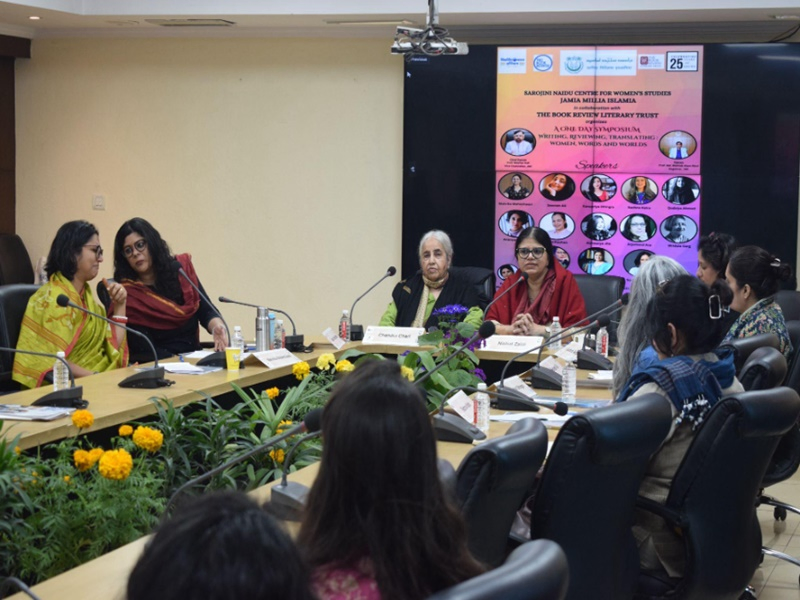
New Delhi, February 23 – The role of women in shaping contemporary literary discourse came to the forefront as prominent writers, reviewers, and translators converged at the Sarojini Naidu Centre for Women’s Studies (SNCWS) at Jamia Millia Islamia for a national symposium, an official said on Monday.
The symposium reaffirmed Jamia Millia Islamia’s (JMI) commitment to fostering inclusive and critical academic spaces that highlight women's voices in literature, scholarship, and translation, and to promoting dialogue that bridges disciplines and communities, according to a statement issued by Saima Saeed, Chief Public Relations Officer, JMI.
The national symposium on “Writing, Reviewing, Translating: Women, Words, and Worlds” was organized on February 17 at Mir Anis Hall, Jamia Millia Islamia, in collaboration with The Book Review Literary Trust, to mark the 25th anniversary of the Sarojini Naidu Centre for Women’s Studies.
Nishat Zaidi, Director of the Sarojini Naidu Centre for Women’s Studies, outlined the journey and achievements of the Centre, highlighting its academic contributions and role in advancing gender-focused scholarship over the past 25 years.
Chandra Chari, Founder Editor of The Book Review Literary Trust, shared her thoughts on the origins and objectives of The Book Review journal and its sustained commitment to fostering critical literary culture in India.
She emphasized the importance of book reviewing as a vital intellectual practice and highlighted the role of women in shaping contemporary literary discourse through writing, criticism, and translation.
A session titled “Reviewing, Writing, Publishing Women – A Critical Exploration of Gendered Literary Landscapes” was moderated by Dr Aakriti Mandhwani.
The panel featured Semeen Ali, Rachna Kalra, Malvika Maheshwari, Sucharita Sengupta, and Kanupriya Dhingra, who shared insights drawn from their professional and academic engagement with literature and publishing.
The speakers reflected on questions of identity and authorship, editorial gatekeeping, the politics of literary knowledge, and the sustainability of women’s writing in South Asia.
The discussions also highlighted the need to move beyond reductive categorizations of “women’s writing”, to encourage mentorship and alternative platforms, and to view reviewing as both scholarship and resistance, the statement said.
A second session titled “Writing the City”, moderated by Faiz Ullah, explored literary engagements with urban spaces, particularly Delhi.
Speakers Ananya Vajpeyi, Ekta Chauhan, and Aishwarya Jha reflected on the city as a site of memory, transformation, and affect.
The discussion examined urban villages, shifting cityscapes, nostalgia, and the interplay between lived experience and literary imagination, highlighting the dynamic relationship between geography and literary expression.
A third session titled “Writing/Translating Women” was moderated by Amina Hussain, Assistant Professor at SNCWS.
The panel included renowned Hindi author Mridula Garg, noted translator Arjumand Ara, Deeba Zafir, and Firdous Azmat Siddiqui.
The speakers addressed the epistemic marginalization of women’s writing, the complexities involved in translation, intersectional concerns of caste and class, and representations of Muslim women in literature and history, the statement added.
The session emphasized that writing must provoke critical reflection, that translation demands ethical responsibility, and that marginal voices must be represented with nuance and sensitivity, reinforcing the broader objectives of the symposium.