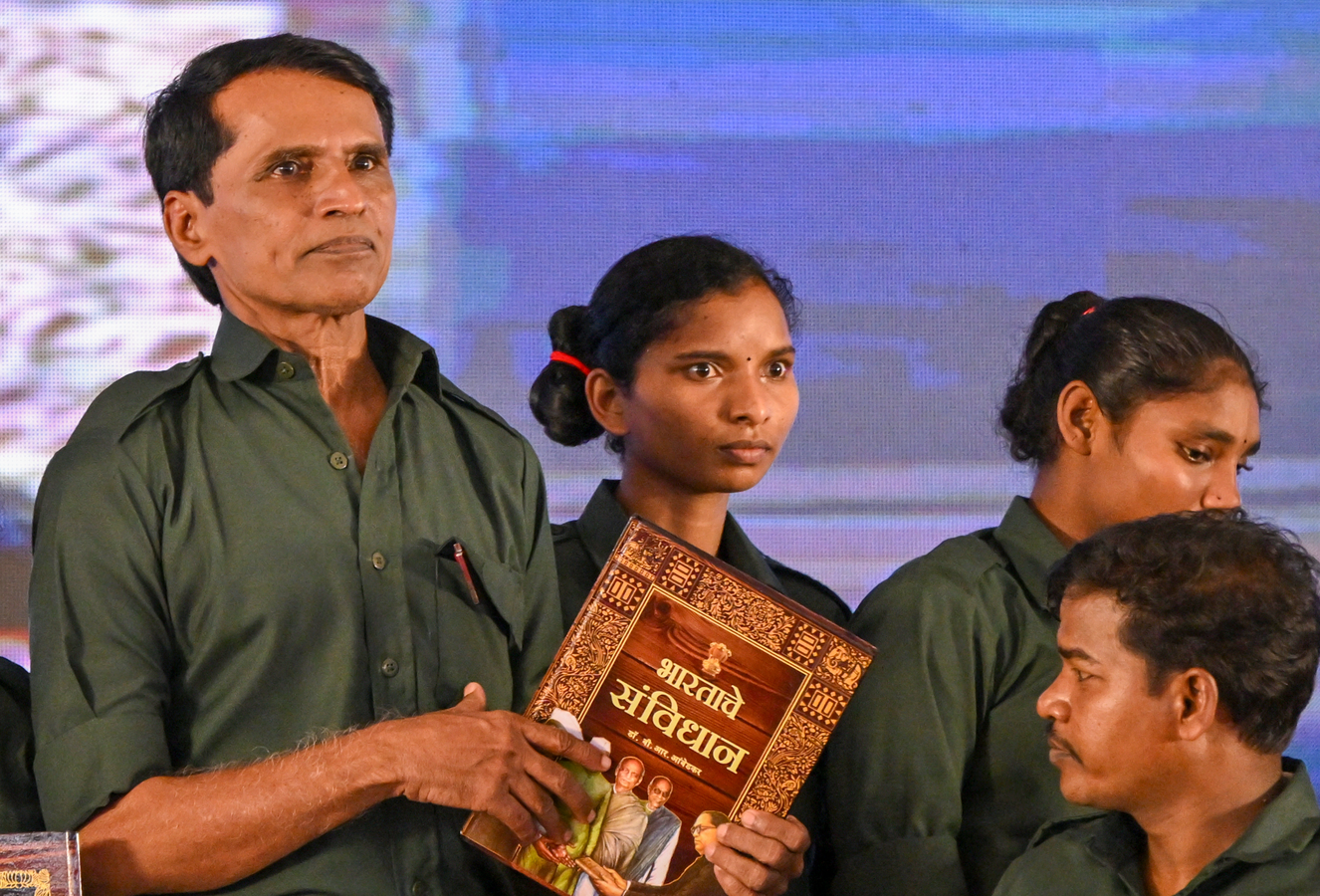
After spending four decades in the jungles of Central India, Bhupathi decided to surrender because he could not bear to see his comrades dying one after another, and also realized the futility of the armed struggle.
People turn to revolutionary paths because of persistent exploitation, and the "system" must ensure that nobody feels the need for Naxalism.
The Naxal movement has failed, and the remaining Maoists should accept this.
Mallojula Venugopal Rao, who had over 70 cases related to Naxal violence registered against him in Gadchiroli, surrendered in the district along with 60 Maoist cadres on October 15, 2025.
Born into a Brahmin family in Peddapalli, Telangana, Bhupathi, who studied at an industrial training institute, said he wanted to fight against social exploitation and joined the Naxalite movement in the 1970s, inspired by the communist-led uprising in Telangana during 1946 to 1953.
"In November 2024, I clearly expressed my view to the (Maoist) organization's leaders, including Ganapathi, Basavraj, and Devji, that working with arms is now impossible. Many people said I was wrong, while some agreed. I reached this conclusion after considering the country's situation. We had no choice but to helplessly watch one member after another die before our own eyes. That was why I made the decision to surrender," said Bhupathi.
"I spent 43 years in the jungles of the Central region. You can imagine our life in darkness from the fact that I saw electricity for the first time after 15 years," he said.
Their fight was not against the police but against the system, he said, adding, "People turn to `kranti' (revolution) only when exploitation persists in society. Therefore, the system must now realize that society should never feel the need for Naxalism."
There has been no recruitment into the Naxalite organization from Gadchiroli since 2013 because it "drifted away from the people", Bhupathi said, adding that when an organization disconnects from the people, its end is certain.
Talking about his former comrades, he said the slain Maoist Hidma's contribution to the organisation was significant, and he was idolized by the youth due to social media. Senior Maoist Milind Teltumbde -- who was killed in November 2021 -- too was his close friend, he said.
"In April 2025, Basavraj and I were ready to join the mainstream, but Basavraj changed his mind and was later killed in an encounter," he said.
"I worked with Milind Teltumbde from 2008 to 2021. He was a good friend, but he too lost his life. Senior Maoist leader Ganapathi is also very ill. Considering this overall situation, the Naxal movement has failed, and we must accept it. Yet some are still not ready to join the mainstream. Armed revolution is not possible in today's situation.... Therefore, the remaining members should also come to the mainstream," Bhupathi said.
The son of a freedom fighter, he once aspired to become a Chartered Accountant, but the social situation and the family legacy of struggle led him to join the student movement, he said.
On January 24, 1983, Bhupathi left home and never returned. His wife joined the Maoist organization in October 1986. They first met in a village in Aheri taluka of Gadchiroli, and married in 1987 as they found each other ideologically compatible. But later he asked her to surrender because of her illness, he said.
"My father had participated in the freedom struggle, and hence my brother and I faced little objection from him. But my mother became very emotional. My relationship with brother Kishanji was very close. He was my hero," Bhupathi said.
Mallojula Koteswara Rao alias Kishanji was killed in an encounter with security forces in West Bengal in 2011.
While being part of the Naxalite organisation, Bhupathi also penned books such as 'Ye Jungle Hamara', 'Rago' and 'History of Women in Dandakaranya'. To keep track of what was happening in the world, he read newspapers regularly, and also made himself familiar with new technology. "I used everything from computers to mobiles when needed," he said.
The life in the forest was not easy, especially because of his background, he said. "Coming from a Brahmin family, everyone at home was vegetarian. But in the movement, I ate everything from ants to snakes in the jungle. Being an atheist, I never thought about caste or religion," he said.
" I have not abandoned my political ideology, only the arms," said the former Maoist. Having joined the mainstream society only recently, he was studying the social and political situation in the country, and can not speak about the future immediately, he added.