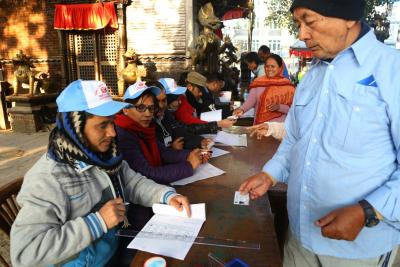
New Delhi, February 21. Nepal, where parliamentary elections are scheduled for March 5, witnessed the beginning of formal campaign activities on February 16, which included public meetings, rallies, the use of loudspeakers, and other related activities, all of which will end three days before the election date.
This election can be described as one of the most consequential since the abolition of the monarchy in the country in 2008. It comes in the wake of the youth-led Gen Z anti-corruption protests last year, which toppled the K. P. Sharma Oli government and forced the dissolution of parliament.
The March election is widely seen as a test of whether Nepal's younger generation can reshape the country's political landscape and break the dominance of the older generation. The Gen Z protests of September 2025 were a turning point in Nepal, largely organized through social media platforms.
The protestors demanded accountability, transparency, and economic reforms. Many first-time candidates from this movement are contesting seats, hoping to represent the aspirations of Nepal's young population. They believe that with nearly a million new voters registered since 2022, the youth vote could decisively shape the outcome.
Among the main contenders is Balendra Shah, 35, the former Mayor of Kathmandu, popularly known as "Balen," representing the Rastriya Swatantra Party (RSP), founded by former television host Rabi Lamichhane in 2022.
Balen, a 35-year-old engineer-rapper-turned-politician with strong youth appeal, is being projected as the future Prime Minister and is pitted against Oli in the latter's stronghold of Jhapa-5 constituency.
Meanwhile, the Communist Party of Nepal (Unified Marxist Leninist) is being led by the 73-year-old Oli, who remains a powerful figure.
Another former Prime Minister, Pushpa Kamal Dahal 'Prachanda' (71), is the coordinator of a platform of Left parties, Nepali Communist Party (NCP).
Nepali Congress, the country's oldest party, is now under the leadership of Gagan Thapa (49), who represents a generational shift by replacing yet another former Prime Minister, Sher Bahadur Deuba, who will be 80 this June.
Also present is the Rastriya Prajatantra Party (RPP), which pursues monarchist sympathies, with former king Gyanendra Shah still enjoying pockets of support.
Earlier, Nepal was ruled by the Shah dynasty for 240 years, until the 1990 People's Movement introduced constitutional monarchy and multiparty democracy.
After the 2006 peace accord with Maoist insurgents, Nepal transitioned to a federal democratic republic in 2008. Since then, Nepal has struggled with political instability, frequent government changes, and corruption scandals.
The 2026 election is widely being seen as a chance to consolidate democracy and empower a new generation of leaders. While this election will be choosing the people's representatives – deciding whether Nepal will continue under the influence of veteran leaders or embrace the Gen Z activists and reformists – the outcome will determine the Himalayan republic's diplomatic stand in the future.
New Delhi shares a long and trusted relationship with Kathmandu, strengthened by regular high-level exchanges. Bilateral cooperation spans across the economy, trade, power sectors, and social, cultural, and educational sectors.
Recently, China has extended its influence in Nepal, especially with Kathmandu's then Maoist governments, largely through Beijing's ambitious Belt and Road Initiative (BRI), which evolved through a series of agreements with China, beginning in 2017.
In December 2024, during his Beijing visit as Prime Minister, Oli signed a framework with China for BRI cooperation. This framework is intended to guide future projects and cooperation under the BRI – including infrastructure development and economic collaboration – with a validity of three years and the possibility of extension.
However, there have been significant delays in the implementation, with no major projects yet finalised, raising concerns about the effectiveness of the initiative.
Additionally, there has been concern among sections in Nepal, who expressed caution regarding the financial implications of the projects, particularly in light of Sri Lanka's financial difficulties linked to similar Chinese investments.