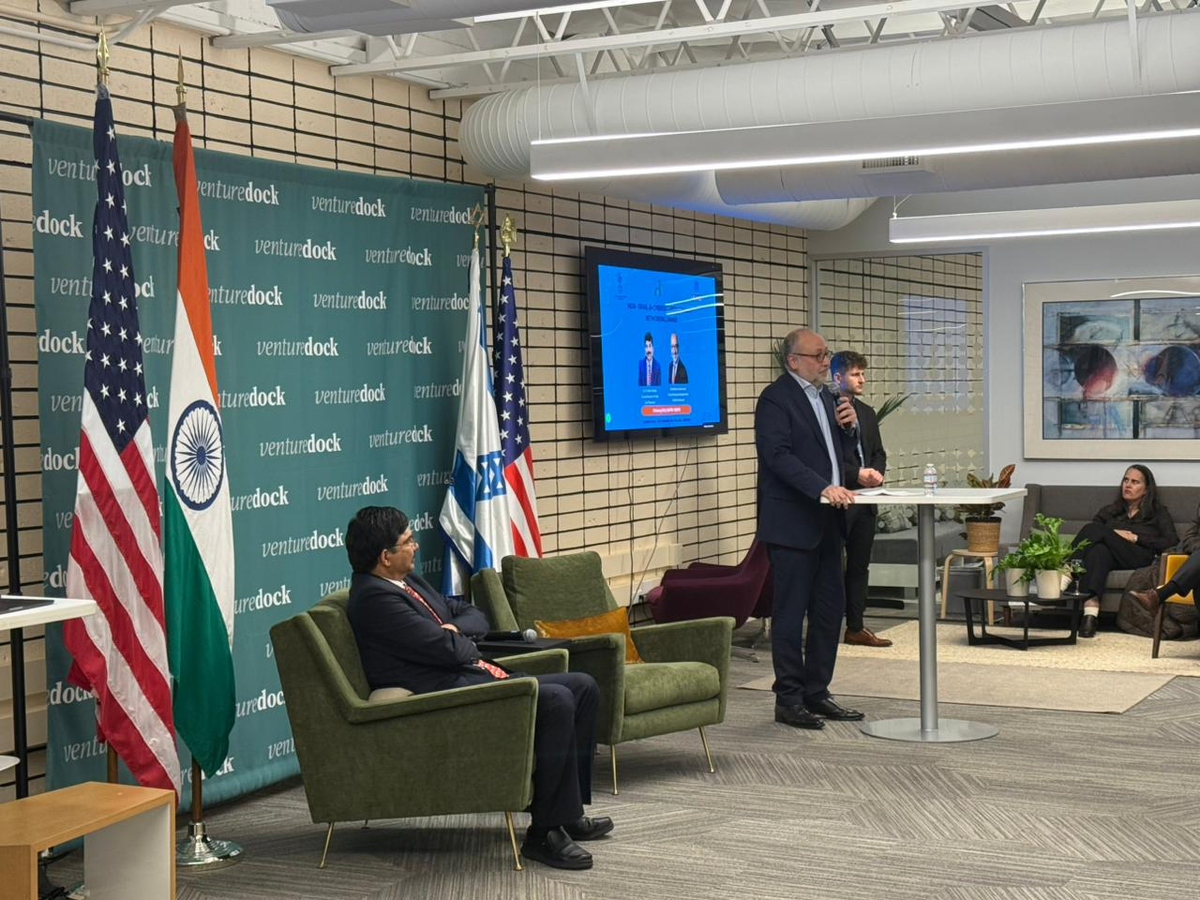
Washington, February 14. Indian and Israeli officials joined technology executives and investors in Silicon Valley this week to deepen cooperation in artificial intelligence and cybersecurity, warning that the rapid rise of AI brings both opportunity and risk.
The India–Israel AI-Cybersecurity Connect, held on February 11 in Palo Alto, drew more than 130 founders, venture capitalists, and cybersecurity experts. The event was hosted by the Consulate General of India in San Francisco, the Consulate General of Israel, and Venture Dock.
The gathering focused on strengthening collaboration among India, Israel, and the United States in AI, cybersecurity, and other critical technologies. The discussion centered on the theme “Cybersecurity for AI, and AI for Cybersecurity.”
Dr. K. Srikar Reddy, the consul general of India in San Francisco, highlighted the long-standing ties between the two countries and their growing innovation partnership.
“We are happy to bring these three vibrant innovation ecosystems together,” Reddy said. “India, the US, and Israel are strategic partners, and responsible AI and cybersecurity must be developed not only for our countries, but for the betterment of the world.”
Reddy also pointed to India’s upcoming AI Impact Summit in New Delhi, expected to draw participation from more than 100 countries. The summit will focus on “people, planet, and progress,” with emphasis on inclusive growth and expanding access to healthcare and education through AI.
Marco Sermoneta, the consul general of Israel to the Pacific Northwest, reflected on the progress since India and Israel established diplomatic relations in the early 1990s.
“To see what we have achieved in 30 years is outstanding,” Sermoneta said. “AI is no different. I truly believe that both India and Israel are forces for good in this world, especially in this century.”
He cited expanding cooperation in AI, education, and entrepreneurship, including joint boot camps and hackathons, and said Silicon Valley provides a natural platform to strengthen institutional ties.
The keynote speaker, Jay Chaudhry, chief executive of cybersecurity firm Zscaler, described AI as transformative but potentially dangerous.
“If you need help with your heart, you go to a heart surgeon, not a general physician. We are the heart surgeons of cyber security,” Chaudhry said, underscoring the need for deep specialization.
He called AI both “powerful and dangerous,” saying it represents a technological wave larger than the internet, mobile, or cloud computing. While AI can boost automation and productivity, he warned it also lowers barriers for attackers.
Chaudhry said AI agents could become a new vulnerability, with organizations potentially deploying “50 to 100 per employee.” If compromised, he said, those agents could have broad access across enterprise systems.
Addressing startup culture, Chaudhry said the short answer to preserving momentum is “a lot of hard work.” He stressed the importance of hiring people with genuine “fire and desire.” “We become what we read, what we watch, who we hang around with,” he said.
A panel discussion on cybersecurity in an AI-driven world examined how AI accelerates digital transformation while amplifying cyber risks.
“One of the largest problems in cybersecurity today is just a lack of skill. You just can’t find people. And entrepreneurs that solve that problem using these models across the entire cybersecurity domain are going to be some of the largest companies ever,” said Guru Chahal, a partner at Lightspeed Ventures.