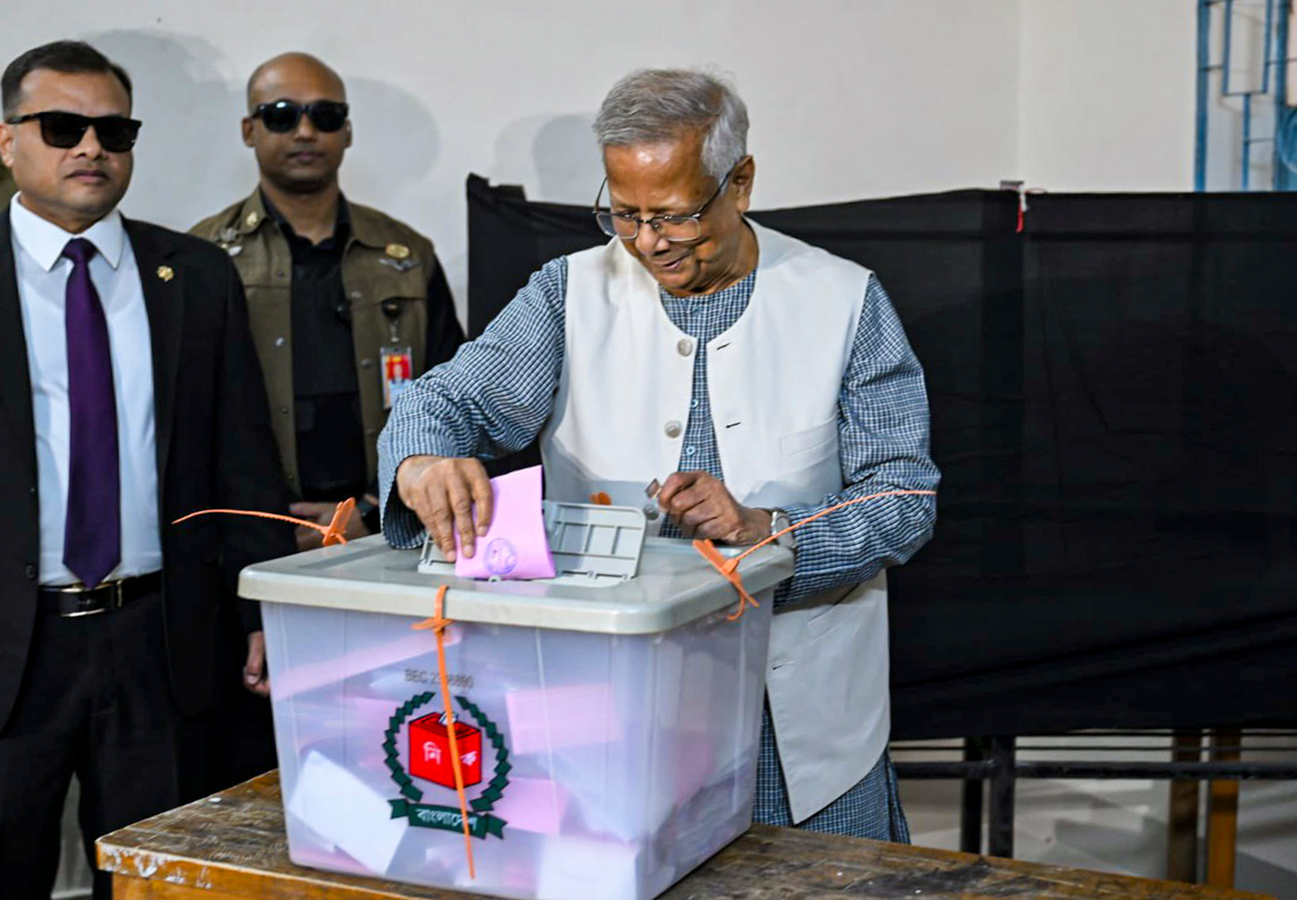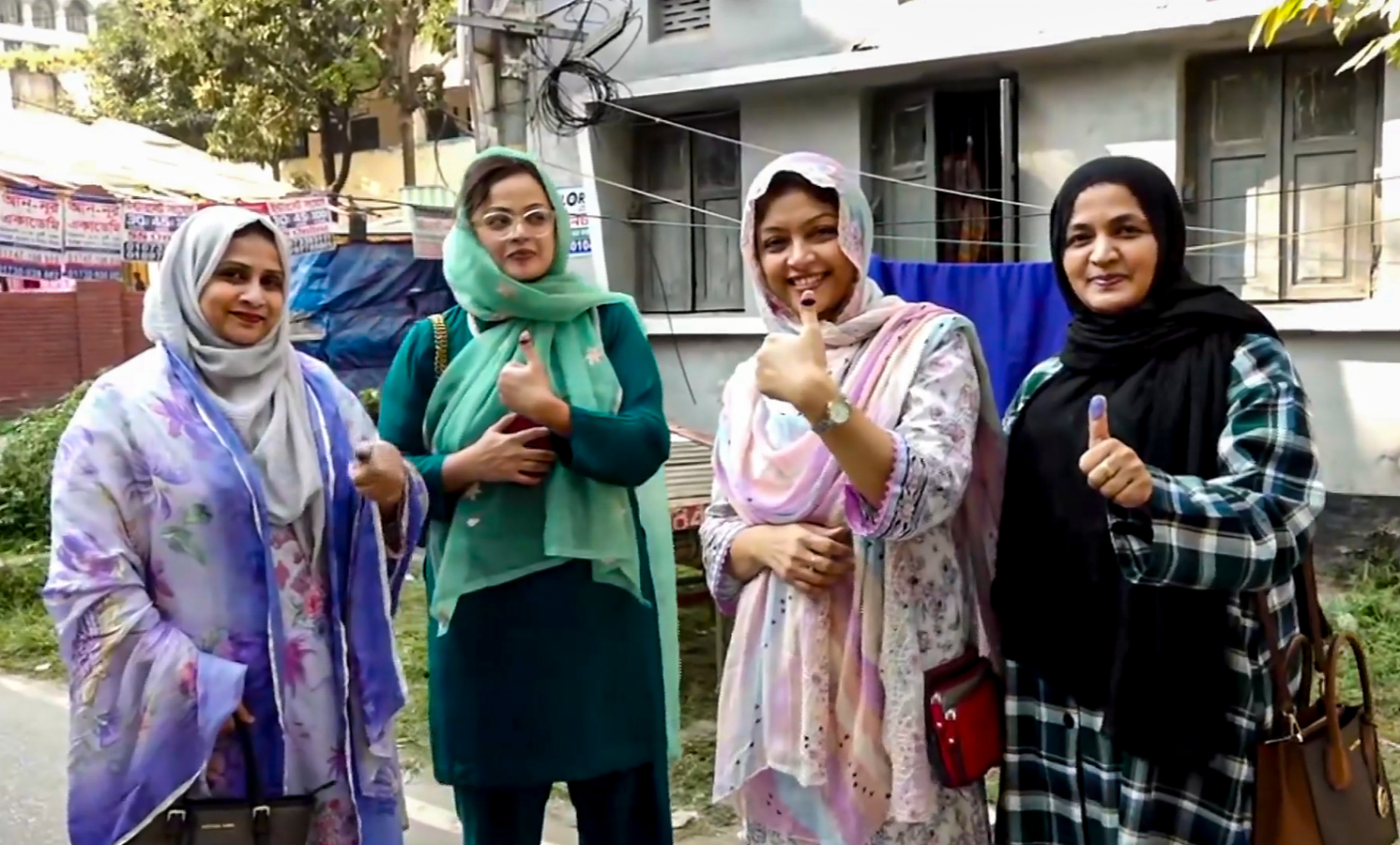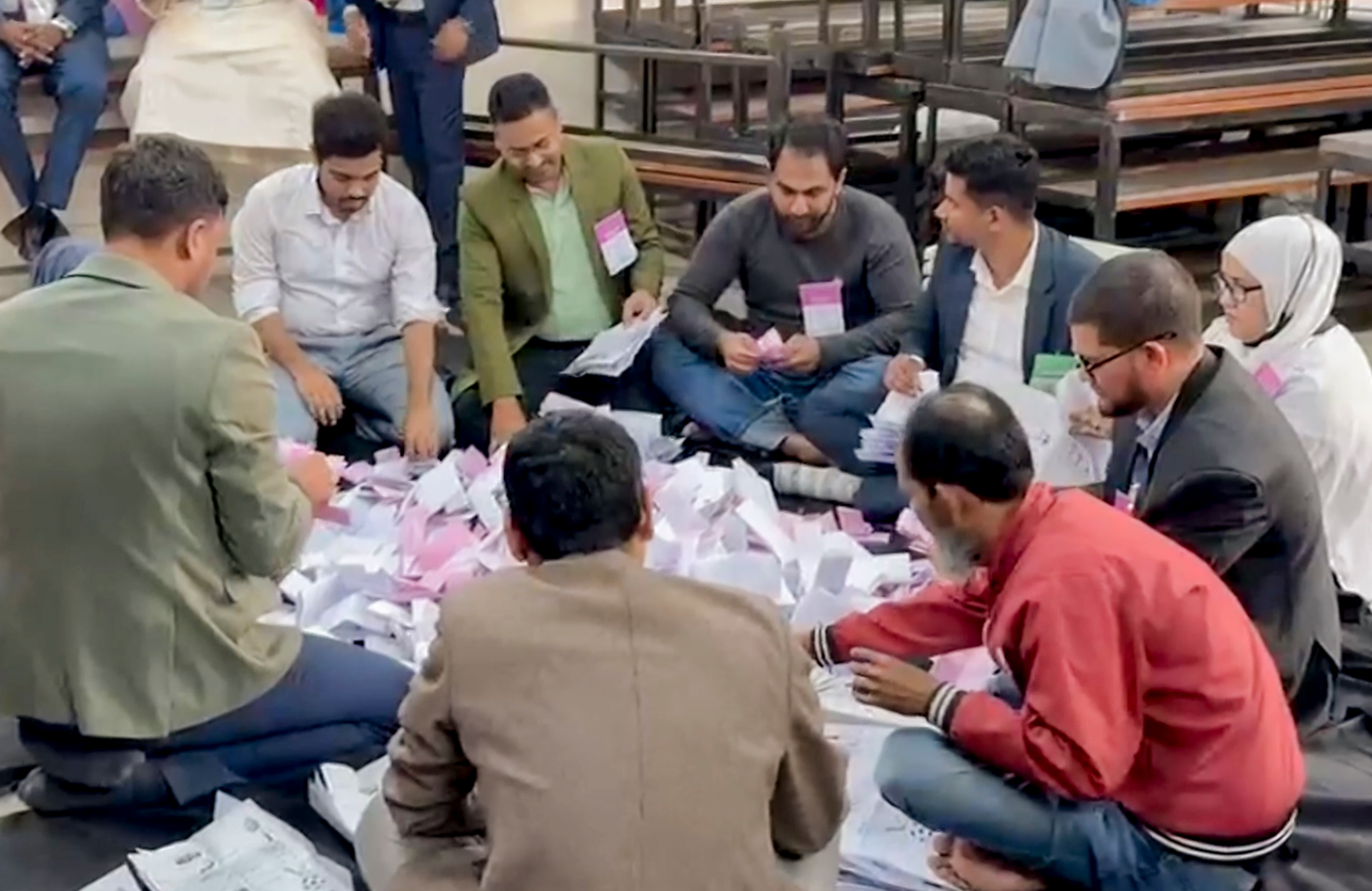
Dhaka, February 12 – Voting concluded across Bangladesh on Thursday in the country’s crucial general elections, marking a pivotal moment in its political landscape. The elections aimed to elect a new government, replacing the interim administration that took office after the Awami League’s rule ended in August 2024.
Alongside the general elections, a referendum was held on the implementation of the "July National Charter," a comprehensive 84-point reform package.
The counting of votes began shortly after 4:30 pm (local time) when voting concluded at polling stations. However, in areas where voters were in line, voting continued until they cast their ballots.
"We expect the initial results to be available overnight," an election commission official stated.
The elections are seen as a direct contest between the Bangladesh Nationalist Party (BNP) and its former ally, Jamaat-e-Islami, without the presence of ousted Prime Minister Sheikh Hasina's now disbanded Awami League.
Jamaat, which leads an 11-party alliance, described the voting as "excellent," expressing optimism about securing a "landslide victory," despite allegations of isolated incidents of violence and irregularities.
BNP Election Steering Committee spokesperson Mahdi Amin stated that his party's victory is "inevitable and clear."
Election Commission Senior Secretary Akhtar Ahmed reported that around 48 per cent of eligible voters had cast their ballots by 2 pm nationwide.
Chief Adviser Muhammad Yunus thanked the people for their participation in the general elections and the referendum.
"I urge political parties and candidates to uphold democratic principles, tolerance, and mutual respect, even after the final results are announced. Differences of opinion are inevitable, but in the national interest, we must remain united," he said.
"We will work collectively to build a state that is accountable, inclusive, and based on justice," he added. "Let us collaborate on this journey to strengthen democracy."
Yunus had earlier described the elections and the referendum as a historic opportunity, urging the nation to celebrate Bangladesh's birthday.
Prior to the elections, both BNP and Jamaat leaders had expressed concerns about potential manipulation and emphasized the importance of a "free, fair, and impartial" electoral process.
BNP candidate Tarique Rahman stated his confidence that his party would regain power after over 15 years, while demanding timely release of results.
"If the election is held in a free, fair, and impartial manner, then why shouldn't we accept it? We will accept the results. However, of course, there must be impartiality and peaceful conduct," the 60-year-old leader said.
Jamaat-e-Islami, which opposed Bangladesh's 1971 independence from Pakistan, aims to form the first Islamist-led government in constitutionally secular Bangladesh under the leadership of its 67-year-old chief, Shafiqur Rahman.
"We want results that come through a fair process. If the vote is free and impartial, we will accept the outcome. Others must also accept it. That is the beauty of democracy. This is what we want," he said.
He alleged that attempts were made to cast fake votes in different parts of the country, adding that their polling agents were attacked and wounded in several places.
Both BNP and Jamaat have asked their party workers to remain at polling stations until results are announced.
The Election Commission deployed nearly 1 million security personnel – the largest-ever in the country's electoral history – to ensure security for the elections.
Approximately 900,000 law enforcement personnel were deployed to maintain order and prevent violence during the voting. Authorities deployed Armoured Personnel Carriers and Rapid Action Teams in key areas of the capital.
For the first time, drones and body-worn cameras were used for election security.
Approximately 127 million voters were registered to cast their ballots across 42,779 polling centres in 299 out of 300 constituencies nationwide. One constituency was cancelled due to the death of a candidate.
A total of 1,755 candidates from 50 political parties and 273 independents contested the election. The BNP fielded the highest number of 291 candidates. There are 83 female candidates.
This was Bangladesh's first election in decades without a female leader in a prominent position. Hasina is barred from contesting, and her rival Khaleda Zia died in December after a prolonged illness. The two women had dominated the country's politics for about four decades.
Hasina's party, which commands a significant number of votes, called the elections "a well-planned farce" and demanded "free, fair, and inclusive elections under a neutral caretaker government."
Analysts said many Awami League activists and supporters preferred to cast their votes "because of ground-level realities," particularly to avoid persecution by potential winners in their respective areas.
They said the election appeared not just as a critical test for two major parties but also for setting Bangladesh's future political structure, with Yunus-floated referendum seeking virtually to rewrite the 1972 Constitution.
The interim government spearheaded a massive campaign asking voters to vote "Yes" to endorse the referendum.
If the "yes" vote wins, the newly elected Parliament could form a constitutional reform council to make a massive constitutional change within 180 working days from its first session.
There were also reports of violence in some places. At least four people died after falling ill at or near polling stations in four districts during voting hours.
In Gopalganj, three persons, including a 13-year-old girl, were injured in an alleged hand bomb attack at a polling station, BDnews24 reported.
In a separate incident, a series of hand bomb explosions have taken place outside a polling station in the Munshiganj-3 constituency, temporarily disrupting voting.
Also, a BNP leader died during an altercation with Jamaat-e-Islami activists outside a polling centre in Khulna.
Some 55,454 observers from 81 local organisations have monitored the elections, while the number of foreign poll monitors was 394.
The Daily Star newspaper reported "ballot stuffing allegations spark clash between Jamaat and BNP activists" in northeastern Sylhet’s Balaganj subdistrict last night, forcing security interventions.
In Dhaka, police arrested a Jamaat leader for buying votes while crude bombs exploded near seven polling centres in southwestern Gopalganj hours before voting.
Three persons were arrested on allegations of distributing ballot paper photocopies among activists of a party at Kalai area of northwestern Joypurhat.