Dhemaji’s Women Struggle to Rebuild Lives as Men Migrate in Search of Work
Dhemaji, Assam, May 11 — In the flood-ravaged district of Dhemaji in Assam, the impact of climate change is no longer a distant threat but a lived reality. With the men migrating to southern states like Tamil Nadu and Karnataka for work, women like 52-year-old Lakhisekhi Bara are left behind to face the brunt of displacement, uncertainty, and mounting responsibilities.“Will our house still be standing when we return someday? What about the land?” her husband asks her over the phone from Chennai, where he now works as a construction labourer. Bara has no answer. She moved to Dhemaji with her daughter-in-law after floods in 2023 destroyed their home and farmland in a neighbouring district.
“We used to survive on agriculture, but now even daily wage work is unpredictable. There was no way to manage a household with such income. That’s why my husband and son had to leave,” Bara explained.
Rising Floods, Rising Responsibilities
Dhemaji, one of India’s 250 most backward districts, is situated in a region frequently ravaged by floods, affecting more than 23 lakh people across 28 districts in Assam. The ever-changing course of the Brahmaputra River, which originates in the Tibetan Plateau and flows through Assam, defines the state's increasingly volatile flood map.In Bara’s village, men of working age are scarcely seen. Most have migrated for work, leaving behind women, children, and the elderly.
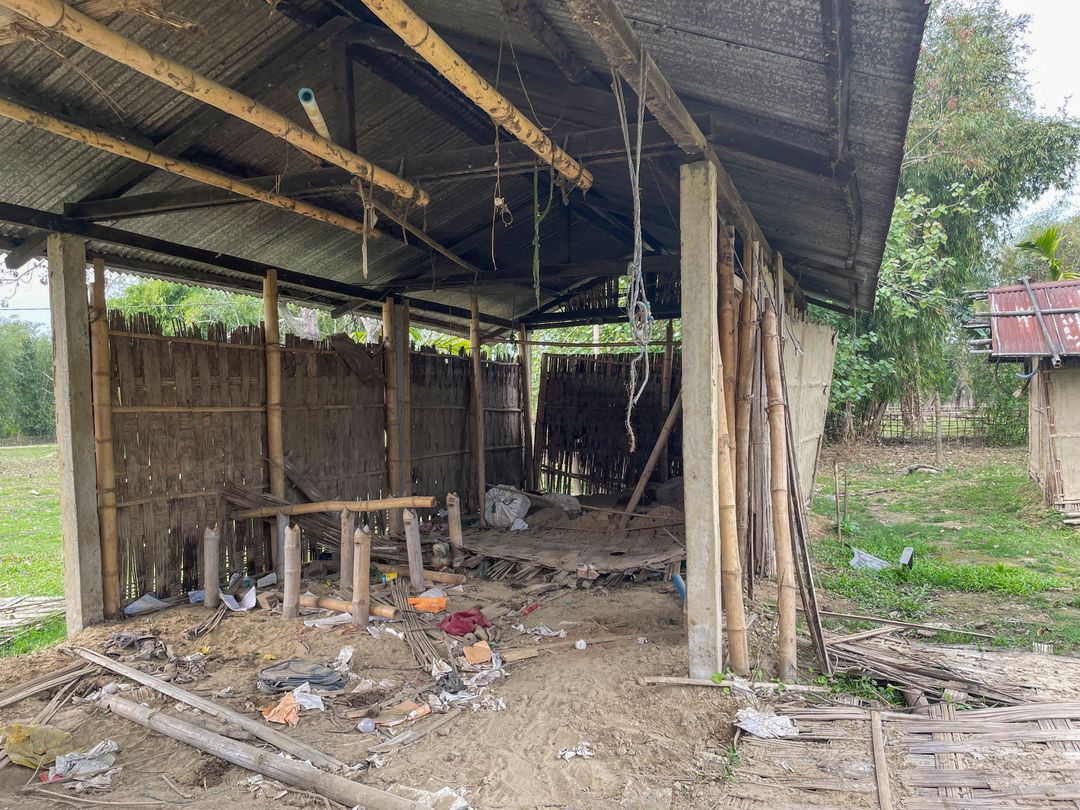
Thirty-two-year-old Roopa Baruah resides in a chang ghar — a stilt house — with her two young children while their pucca home, built under the Pradhan Mantri Awas Yojana, remains abandoned. Her husband, who has not returned in two years, works at a rubber factory in Bengaluru.
“My pucca house is too far from help if floodwaters rise suddenly. In the stilt house, I’m closer to other women and can get help quickly, especially when my children fall sick,” she said.
Women Shoulder the Workload Amid Emotional Toll
The district's reliance on chang ghars highlights the community’s attempts at climate adaptation. But survival comes at a cost. Livestock must be housed within the same shelters during floods, and women are left juggling domestic, agricultural, and community responsibilities.Twenty-six-year-old Bokul, who returned home after a workplace accident in Kerala that cost him an arm, now supports his wife and sister-in-law in daily chores. “The men who could work have all left. Only those old or unable to work are still here,” he said.
Women now perform a broad spectrum of roles: rebuilding homes and collecting firewood to weaving and managing displaced children and livestock. Their increased vulnerability and workload are reshaping Dhemaji's social fabric.
Academic and Policy Insights: Migration as a Double-Edged Sword
Researchers from the Indian Institute of Technology (IIT), Guwahati, are studying the migration patterns in Dhemaji. Professor Anamika Baruah, leading the project funded by the Indian Institute for Human Settlements and the Population Council, notes that recurrent floods disrupt livelihoods, especially agriculture, the district’s economic backbone.“Climate change worsens these issues, triggering both seasonal and permanent displacement. The socio-economic impact is deep,” she said.
Postdoctoral scholar Debarchana Biswas added that while migration offers economic relief, it carries emotional and logistical burdens. “Managing two households, staying separated during emergencies - these strain families deeply,” she noted.
The Need for Adaptive Policies and Local Solutions
Assam ranks as India’s most climate-vulnerable state according to the 2021 Climate Vulnerability Index, thanks to its fragile ecological landscape, expansive river systems, and dwindling forest cover.Environmental scientist Partha Jyoti Das of Aranyak, a regional research body, emphasized that while disaster risk reduction plans have improved, high-vulnerability groups like women and the elderly remain underserved.
“There’s a gap between policy and execution. The burden on women increases significantly when men migrate. They are left to manage not just households but also community resilience,” he said.
Luit Goswami, executive director of the Rural Volunteers Centre, echoed similar concerns. “Efforts here focus more on recovery than on building adaptive capacity. Displacement has become a default strategy for survival, but it leaves families fractured and women overwhelmed.”
A Climate Crisis Worsening Gender Inequality
As climate extremes force distress migration, women in Dhemaji are left to uphold not just their families but also the broader rights of children, from nutrition and education to protection from trafficking and child labor.“This relentless stress leads to serious physical and mental health deterioration,” Goswami warned.
In Dhemaji, the climate crisis has evolved into a gender crisis, where the responsibility of surviving the floodwaters and preserving family life rests heavily on the shoulders of women left behind.