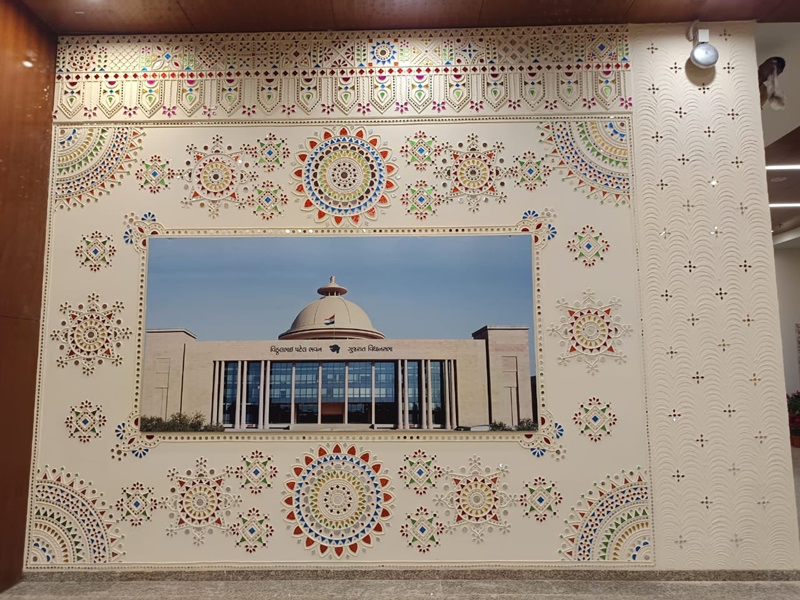
Gandhinagar, February 14 – The Gujarat Legislative Assembly has been transformed into a showcase of the state’s traditional arts in preparation for the Budget Session, which begins on February 16. Artisans from across the state have been commissioned to create and install works within the Assembly complex.
This initiative, undertaken in coordination with the state-run Gujarat State Handloom and Handicrafts Development Corporation Ltd (Garvi Gurjari), has introduced three prominent art forms into the premises: mud mirror work from Kutch, Warli art from Chhota Udepur and Ahmedabad's Mata ni Pachedi, a traditional Kalamkari style of painting.
The artworks now adorn various walls and sections of the complex and will be visible to legislators, officials, and visitors attending the session.
Officials said the effort is aimed at presenting Gujarat's cultural heritage within a key public institution that represents the people of the state.
The project was initiated under the guidance of Assembly Speaker Shankar Chaudhary, in line with the broader emphasis on combining development with the preservation of heritage articulated by Prime Minister Narendra Modi.
The state government, under Chief Minister Bhupendra Patel, has continued to promote the handicrafts and handloom sectors through institutional support.
Garvi Gurjari facilitated the selection process by identifying skilled artisans, reviewing their work presentations, and assessing craftsmanship before finalizing the installations.
According to officials associated with the corporation, the intention was to ensure that the chosen art forms reflect both the diversity and historical continuity of Gujarat's folk traditions.
Among the featured works is Warli art depicting the evolution of governance from ancient royal assemblies to the modern legislature, alongside visual representations of the transition from rural to urban development.
The Warli installation has been created by Archana Rathwa, an artisan from Chhota Udepur who has been associated with Garvi Gurjari for eight years and received a state award in 2022.
She said the opportunity to contribute to a project at the Assembly was a significant professional milestone. The mud mirror work, traditionally seen in the circular bhunga houses of Kutch and made using Multani clay and pieces of coloured glass, has been executed by artisan Girish Parmar.
He has previously worked on public installations and represented Gujarat in the Republic Day tableau parade on January 26. Parmar said exhibiting the craft in the Assembly complex, visited by people from across the country, was a matter of pride.
The Mata ni Pachedi installation has been undertaken by the Chitara family of Ahmedabad, known for preserving the centuries-old Kalamkari tradition associated with temple backdrops dedicated to the goddess.
National award-winning artist Chandrakantbhai Chitara and his daughter Mittal Chitara were involved in the project. Mittal Chitara said the response from visitors observing the work in progress had been encouraging.
With these installations in place, the Assembly complex now functions not only as the administrative centre of the state legislature but also as a venue highlighting Gujarat's living craft traditions.
Officials said the initiative provides artisans with opportunities to participate in high-profile public projects while drawing attention to the state's cultural legacy during a major legislative session.