New Delhi, February 16 – The Delhi Police celebrated its 79th Raising Day on Monday, commemorating decades of dedicated service in safeguarding the national capital and reaffirming its commitment to public security.
The ceremony featured an impressive parade by the force's top contingents, including the SWAT team, the band unit, dog squad, motorcycle riders, PCR units, and several other specialized formations, all of which demonstrated discipline and coordination during the parade.
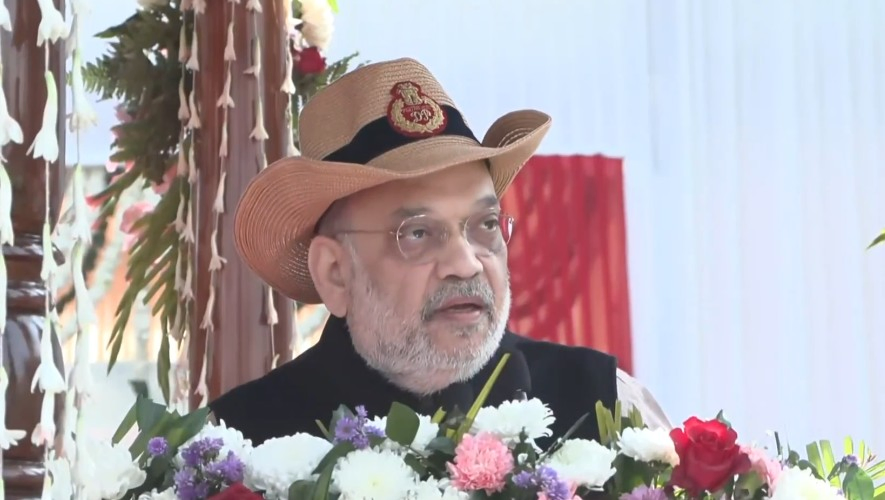
Union Home Minister Amit Shah attended the Raising Day function at the Delhi Police headquarters, where he presented honorary medals to personnel and lauded their commitment, contribution to public safety, and exemplary record of service.
Addressing the gathering, Shah congratulated the force and said, "The Delhi Police has left no stone unturned in upholding its motto of 'Peace, Service, Justice'. The responsibility, performance, and dedication of the Delhi Police, as a security force for the national capital, are of great significance. This area of Delhi is not just a city, but the heart of the country and its democracy. And that is why, as the capital, the security here should be the best."
Shah said he derives "a great deal of satisfaction, joy, and pride" from the fact that the Delhi Police has "always been at the forefront and has performed its duties with brilliance and success."
Shah announced the laying of the foundation stone for the Special Cell's Integrated Headquarters, estimated at around Rs 370 crore. He described it as the country's "most modern" center dedicated to combating narcotics trafficking and terrorism.
He also announced the laying of foundation stones for ten additional Delhi Police projects.
"The first phase of the Safe City Project has also been inaugurated. The modern Integrated Command, Control, Communication, and Computer (C4I) center, built at a cost of approximately Rs 857 crore, is being dedicated to the people of Delhi," he said, adding that eleven district-level C3I centers and seventy-five police station-level C2I units would be integrated with the system.
Shah further noted that, under the first phase of the plan to connect Delhi with 10,000 cameras, 2,100 cameras have already been made operational with live connectivity.
"I am confident that the Safe City Project will significantly advance Delhi's security in the coming days," he said.
Referring to broader national achievements, Shah stated that under the leadership of Prime Minister Narendra Modi, "the country has achieved many significant accomplishments."
"In the future, when discussions of the justice system in the country take place, the three new criminal laws and the new Nyaya Sanhita will be particularly remembered. The focus of these laws is not punishment, but justice. These three new criminal laws were passed in a Parliament elected by the people of the country, and history will surely remember them as an important chapter in judicial reforms," he said.
He added that the new laws would help ensure timely justice delivery and improve conviction rates.
The Home Minister further asserted that the period from 2014 to 2026 would be recorded as a "golden chapter" in the history of India's internal security. He said that prior to 2014, the country faced "three major challenges" – terrorism in the Kashmir region, unrest across the Northeast, and Maoist violence affecting nearly eleven states. "These three posed serious challenges to our internal security," he said.
"I am pleased to report that, following the abrogation of Article 370, we have succeeded in reducing incidents of violence in Kashmir, the Northeast, and Maoist-affected areas by approximately 80 per cent. The day is not far when these three regions will be completely free of violence," he added.
Shah described Maoist insurgency, which had spread across eleven states, as a long-standing threat to internal security.
"But today, through the people of Delhi, I want to assure the entire nation that we are very close to ending Maoist violence. I assure my countrymen that by March 31, 2026, we will succeed in freeing the entire country from Maoist violence. This is a significant success achieved by our security forces," he said.
Speaking about developments in the Northeast, Shah said that over 10,000 youth had laid down arms and returned to the mainstream. "Significant progress has been made towards establishing lasting peace there through more than 20 peace agreements," he noted.
"However, the times ahead are not without challenges. The Ministry of Home Affairs has focused on launching a robust anti-narcotics campaign in the country, establishing a comprehensive CCTV network and control room system, providing legal support, modernising border security, de-infiltration, and fully implementing the three new judicial codes. I am confident that we will be successful in effectively addressing all these challenges before 2029," he added.
Praising the force, Shah said Delhi Police has consistently demonstrated its capability in protecting both the Capital and the nation.
"Be it the attack on Parliament or the recent incident in front of the Red Fort, the Delhi Police has ensured the nation's security by solving complex cases with its efficiency and promptness. Today, on the occasion of the Foundation Day, I extend my heartfelt greetings to all the officers and personnel of the Delhi Police, and their families," he said.
The Delhi Police was initially established in 1861 during British rule as a security force. On February 16, 1948, it was officially renamed Delhi Police.