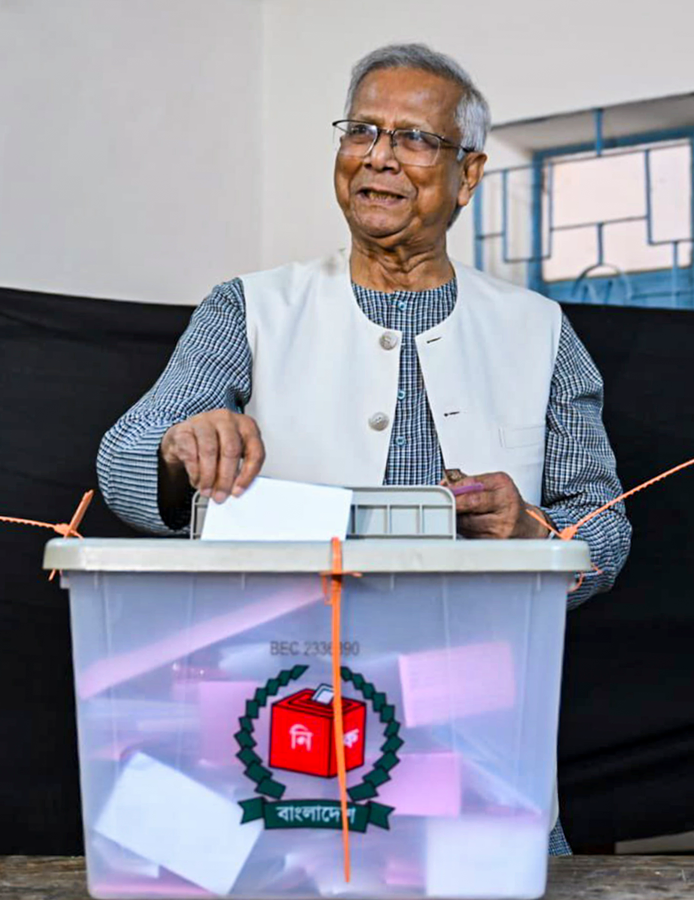
Dhaka, February 12 A referendum to seek public consent for a complex reform package proposed by Muhammad Yunus' interim government may threaten the foundational history and bring an end to the continuity of Bangladesh's 1972 Constitution, experts said on Thursday.
Voting for the 13th parliamentary elections is taking place along with a referendum on a complex 84-point reform package on Thursday.
The referendum aims to obtain public approval for the reform proposals, known as the "July National Charter 2025," which Yunus announced on October 17 following extensive consultations between political parties and the National Consensus Commission, which he leads.
The referendum ballot features a single question covering four major reform areas of the July Charter, and voters are instructed to vote "yes" if they agree more strongly with the proposals and "no" if they disagree.
"The proposals outlined in the referendum, which is being held simultaneously with Thursday's general election, appear largely complex," said Iraj Ahmed, a political analyst and playwright.
He noted that most voters are "uninformed" about the extensive 84-point reform package, which is presented in a concise manner through four questions in the referendum sheet.
"If this referendum passes, Bangladesh's almost 55 years of constitutional continuity will virtually come to an end," he said.
The 1972 Bangladesh Constitution has been amended 17 times, but critics say that this time, there are a number of proposals aimed at overturning the basic constitutional principles and "settling" issues to build Yunus' promised new Bangladesh.
Prominent lawyer and constitution expert, Tania Amir, said that the referendum and constitutional reforms threaten Bangladesh's foundational history and legal legacy, "virtually voiding our history" and largely demeaning the legal foundation of Bangladesh's 1971 independence.
"The 1972 Constitution is the legal backbone of Bangladesh. Attempts to scrap it mean questioning the very legal basis of Bangladesh as a state," said leading jurist and lawyer Swadhin Malik.
In a nationwide address, Yunus called for a "yes" vote for his proposed reform package in the February 12 referendum, which is taking place simultaneously with the general elections.
"If the 'Yes' vote wins in the referendum, Bangladesh's future will be built in a more positive way," Yunus said while addressing senior secretaries and top bureaucrats late on Monday night as electioneering ended 48 hours ahead of the polls.
Yunus had announced the charter last year, saying that it represents a move toward a "civilized society from barbarism."
However, several jurists, including senior lawyer Mohsin Rashid, also questioned the legitimacy of the referendum itself since the Bangladesh Constitution has no provision for such a plebiscite, even when the government has the proposal signed by President Mohammed Shahabuddin and subsequently issued an official gazette.
Analysts such as foreign relation expert and former ambassador Mahfuzur Rahman said that the four issues recognizing the 84-points were not elaborated enough for many voters to clearly understand what changes would occur if the people vote "Yes," and which changes would not occur if people vote "No."
Law professor Malik and other critics said "yes/no" voting in the dual election could appear difficult for voters to make their choice over the charter containing multiple complex reforms and even informed voters might support some changes but oppose others.
The referendum seeks to obligate the next government to implement the charter, thus legitimizing the interim regime, they said. Yunus took oath as the Chief Adviser three days after a student-led street protest, dubbed July Uprising, toppled the then prime minister Sheikh Hasina’s Awami League government on August 5, 2024.
"Most of the decisions taken in the July Charter, including those in the gazette, are contrary to the current Constitution," Malik said.
Since the Constitution is still in force, the President cannot legally sign this gazette, he said, adding, it could have been acceptable if the Constitution was annulled or suspended under martial law.
Another law professor SM Masum Billah said that out of the 84 reform proposals mentioned in the July Charter, 47 are constitutional amendments, while 37 are to be implemented through ordinary legislation or executive orders.
The government initially proposed that if a political party had a note of dissent on certain proposals, that party would not be obligated to implement those proposals if it came to power. But after failing to reach a resolution on this issue, the government ultimately decided to hold the referendum.
"If “yes” wins in the referendum, the next parliament will be obliged to implement the package that included establishment of a bicameral parliament instead of an existing one legislature in the unitary form of Bangladesh’s political system,” Barrister Amir said.
"How can a ‘sovereign parliament’ be obligated to implement the interim government desire when the Constitution did not have any provision of such a referendum while the government was oath bound to the Constitution," Amir questioned.
Experts said if “No” won, there would be no obligation to implement the July Charter.
The July Charter’s key-author and co-chair of the National Consensus Commission Ali Reaz said if “Yes” wins, the next parliament will serve as a constitutional reform council, virtually a Constituent Assembly, and within 180 working days, they would have to take steps to carry out constitutional reforms as proposed.