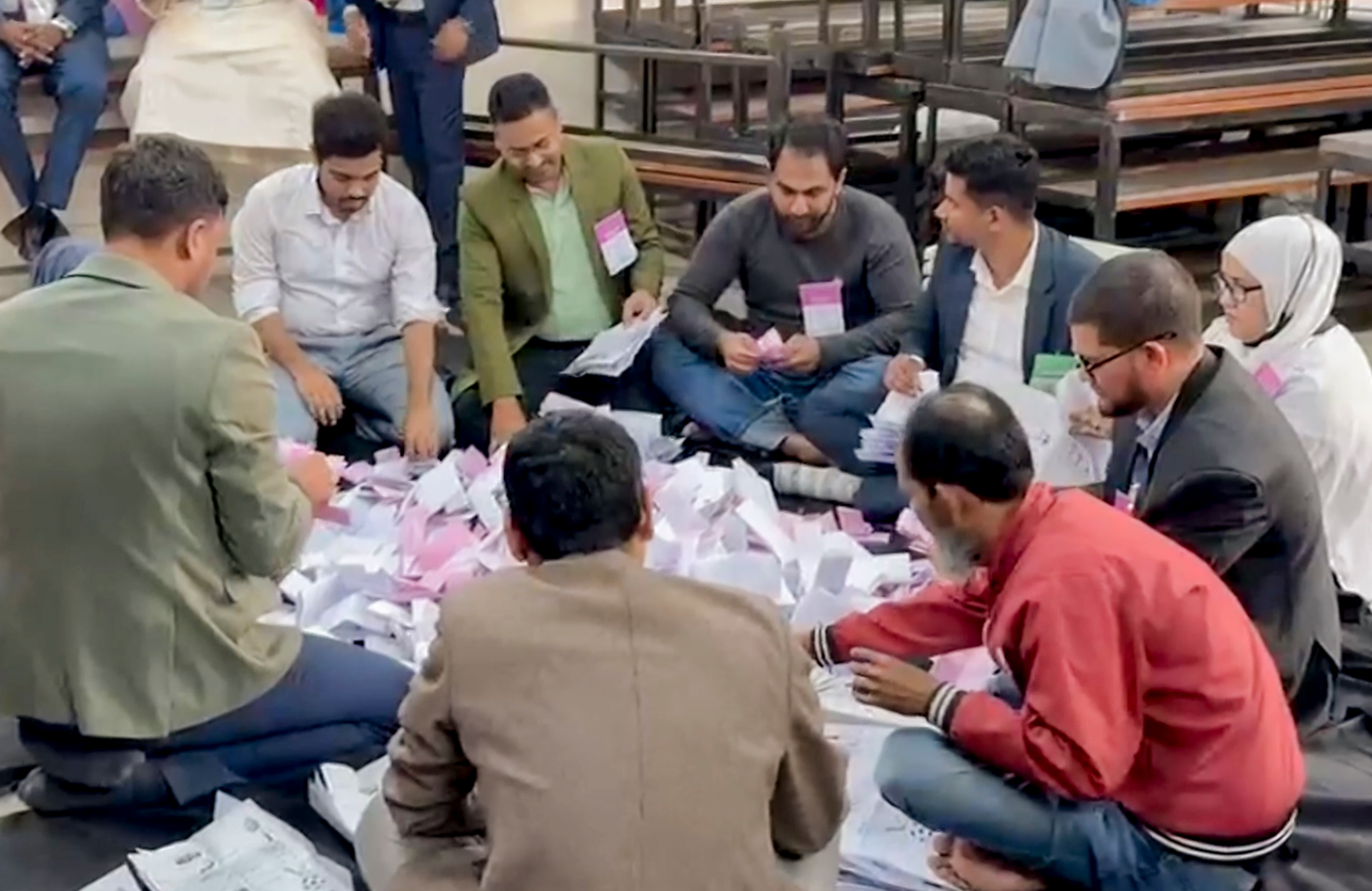
Dhaka, February 16 Four candidates from minority communities, including two Hindus, won in the recent general elections in Bangladesh, all of whom were nominated by the BNP, which is set to form the government on Tuesday.
Goyeshwar Chandra Roy and Nitai Roy Chowdhury are the two Hindu candidates who won on a Bangladesh Nationalist Party (BNP) ticket. They won from a Dhaka seat and the western Magura constituency, defeating their rivals fielded by the Jamaat-e-Islami.
Roy is a member of the BNP's highest policy-making standing committee, while Chowdhury is one of the prominent vice presidents of the party, as well as a senior advisor and strategist for its top leadership.
The third minority MP-elect is Saching Pru, a senior BNP leader and follower of Buddhism, representing the Marma ethnic community in the southeastern hill district of Bandarban, from where he was elected.
The fourth minority candidate, Dipen Dewan, belongs to the Buddhist majority Chakma ethnic minority group, who won from a constituency in the southeastern Rangamati hill district.
However, his religious identity is unclear, with many describing him as a Hindu.
Hindus make up about eight per cent of the population in the Muslim-majority country of 170 million people.
Dewan defeated an independent Chakma candidate, while Pru defeated a nominee of the National Citizen Party (NCP), which was formed last year by Students Against Discrimination, who led mass protests against ousted prime minister Sheikh Hasina in August 2024.
According to the Election Commission, 79 candidates, including 10 women from religious minority communities, mostly Hindus, contested the election on Thursday. While 67 were nominated by 22 political parties, 12 ran as independent candidates.
The Communist Party of Bangladesh (CPB) fielded the highest number of minority candidates, with 17.
This was followed by the left-leaning Bangladesh Samyabadi Dal (BSD) with eight minority candidates, the little-known Bangladesh Minority Janata Party (BMJP) with eight candidates, and the left-leaning Bangladesh Samajtantrik Dal (BASOD) with seven candidates.
The BNP fielded six candidates, and the Jatiya Party nominated four.
The Jamaat-e-Islami nominated a minority Hindu candidate for the first time in its history.
The largest Islamist party fielded veteran businessman Krishna Nandi from a southwestern Khulna constituency, who lost, but his participation as a Jamaat nominee was widely discussed. He finished as the runner-up in the Khulna-1 constituency, conceding defeat to a BNP candidate.
The number of Hindu MPs in the 2024 election was 17, and the same number of Hindus won in the 2018 election, with most of them belonging to Hasina's Awami League.
Led by Tarique Rahman, the BNP won with a two-thirds majority, securing 49.97 per cent of the votes and 209 seats in the Thursday polls, the results of which were announced on Friday.
The Jamaat-e-Islami, which opposed the country's 1971 independence from Pakistan, achieved its best-ever performance with 31.76 per cent of the votes and 68 seats. The National Citizen Party (NCP) secured the third-highest number of seats, six, and 3.05 per cent of the votes.