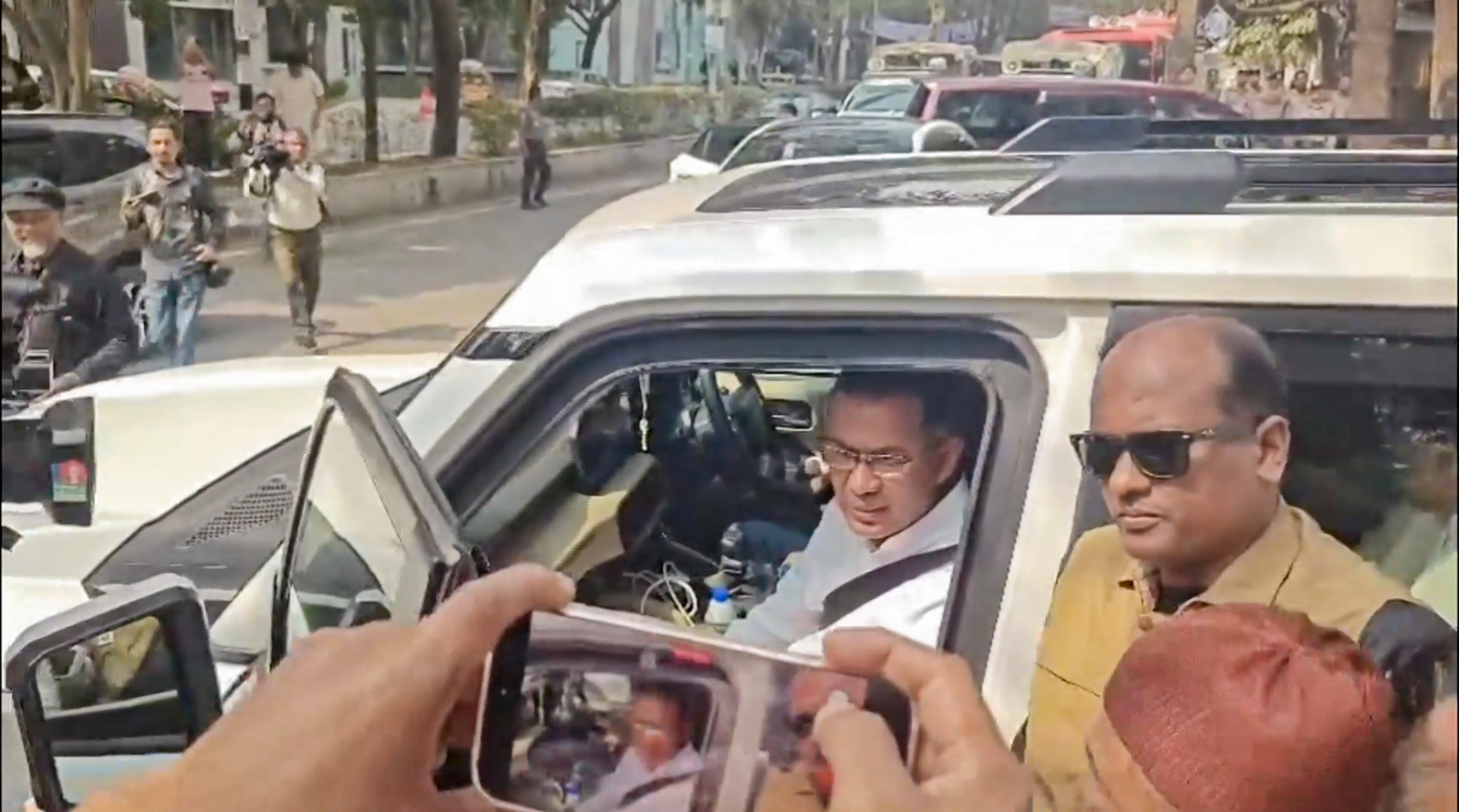
Dhaka, February 13 Tarique Rahman, who lived in London in self-exile for 17 years, has emerged as the new face of Bangladesh, with the party founded by his father set to return to power after a 20-year gap.
The 60-year-old leader's Bangladesh Nationalist Party (BNP) has won 209 out of 297 seats, while the right-wing Jamaat-e-Islami, known to be close to Pakistan, secured 68 seats. The Awami League party of Hasina was barred from contesting the elections, which saw a 59.44% voter turnout.
This result is a major turnaround for the BNP, which had been a target under the 15-year rule of Prime Minister Sheikh Hasina's Awami League government, which collapsed following nationwide student-led protests in August 2024.
The BNP was founded by Rahman's father Ziaur Rahman, a military ruler turned politician. The party was led by his mother Khaleda Zia for nearly four decades after the assassination of President Ziaur Rahman in 1981.
Five days after his return to Bangladesh amid a massive welcome in December last year, Rahman experienced a personal tragedy as Khaleda Zia died after a prolonged illness.
Rahman became the chairman of the BNP in the absence of his mother, at a time when the party was facing a period of political uncertainty ahead of the elections.
The evolving situation did not allow him to spend private time due to the rapid pace of events, making it difficult for him to reflect.
Rahman is widely seen as a product of dynastic politics, but his family's political background has given him a certain understanding. He is credited with maneuvering his party to secure a key role in the upcoming general elections.
Rahman, known for his calm demeanor, led his party's campaign effectively.
Since his return, Rahman has adopted a cautious approach, avoiding inflammatory rhetoric and instead calling for restraint and reconciliation, despite the strained relations between his family and the deposed Awami League regime. The BNP ultimately won a landslide victory, and Rahman is set to become the next prime minister.
Rahman was born on November 20, 1965, in Dhaka. He witnessed Bangladesh's liberation struggle in 1971. He was arrested along with his mother and brother, but was released on December 16, 1971, when Bangladesh gained independence from Pakistan.
He studied international relations at the University of Dhaka, but dropped out later, and started businesses in textiles and agro products. He was elected Senior Vice-Chairman of the BNP in 2009 and gradually became involved in the party's reorganization.
Under the Awami League rule, Rahman became a central target of several corruption and criminal cases. He was convicted in absentia in some of the cases. He was sentenced to life in connection with a 2004 grenade attack on Hasina's rally that killed 24 people and wounded dozens.
He has always denied these allegations, claiming they were politically motivated. He was acquitted in all cases during Muhammad Yunus' interim rule following Hasina's ouster.
In 2018, when Khaleda Zia was jailed on corruption charges, Rahman was nominated as the Acting Chairman of the party. After her death, he became the chairman.
According to analysts, the election results mark a significant turnaround for Rahman, who left the country in 2008, saying he needed medical treatment after his release from detention under a military-backed caretaker administration.
However, they pointed out that there were uneasy doubts and speculations surrounding this enthusiasm.
"I have a plan for the people of my country and for my country," Rahman said, hours after his return to Bangladesh in December, referring to US civil rights activist Martin Luther King's remark, "I have a dream."
He later gradually unfolded his plan, pledging to recalibrate Bangladesh's international partnerships to attract investment without tying the country too closely to any single power.
He aims to expand financial aid for poor families, offering "family cards," reduce reliance on garment exports by promoting industries such as toys and leather goods, and introduce a two-term or 10-year limit for prime ministers to deter autocratic tendencies.
In several interactions, Rahman acknowledged that the task ahead of him in the country of 170 million people would be challenging, with the recovery of a shattered economy being a key priority.
Several analysts and observers said the lack of discipline within the BNP poses a major challenge for him. During the past 18 months, party activists largely earned a bad reputation for extorting and seizing the businesses of political opponents.
Media reports said BNP expelled some 10,000 of its activists during the past 18 months, while they were also accused of harassing rivals by lodging false criminal cases.
In past decades, critics and opponents widely viewed Rahman as a brash operator during the BNP's 2001–2006 rule under his mother's premiership. Despite having no government position, he was accused of running a parallel power centre, a charge which, however, he denies.
But several observers said he reappeared in the political arena after spending 17 years in a country where he witnessed the governance of an advanced democracy, largely as a changed person.
"This is not the Tarique we heard of or saw before," said a minority Hindu community leader, preferring anonymity as he talked to him for over an hour two weeks ago, when he cracked sophisticated jokes and explained his vision for the country.
Rahman married cardiologist Dr Zubaida Rahman, the daughter of a former navy chief, in 1994. They have a daughter named Zaima Zarnaz Rahman.