New Delhi, May 10 — India announced on Saturday that it has effectively countered Pakistan’s widespread military escalation along the western border, which involved the use of drones, long-range weapons, and fighter jets aimed at both civilian and military targets. As tensions between the two nuclear-armed neighbours intensify, India remains on high operational alert.Pakistan Moves Troops Forward, India Maintains Readiness
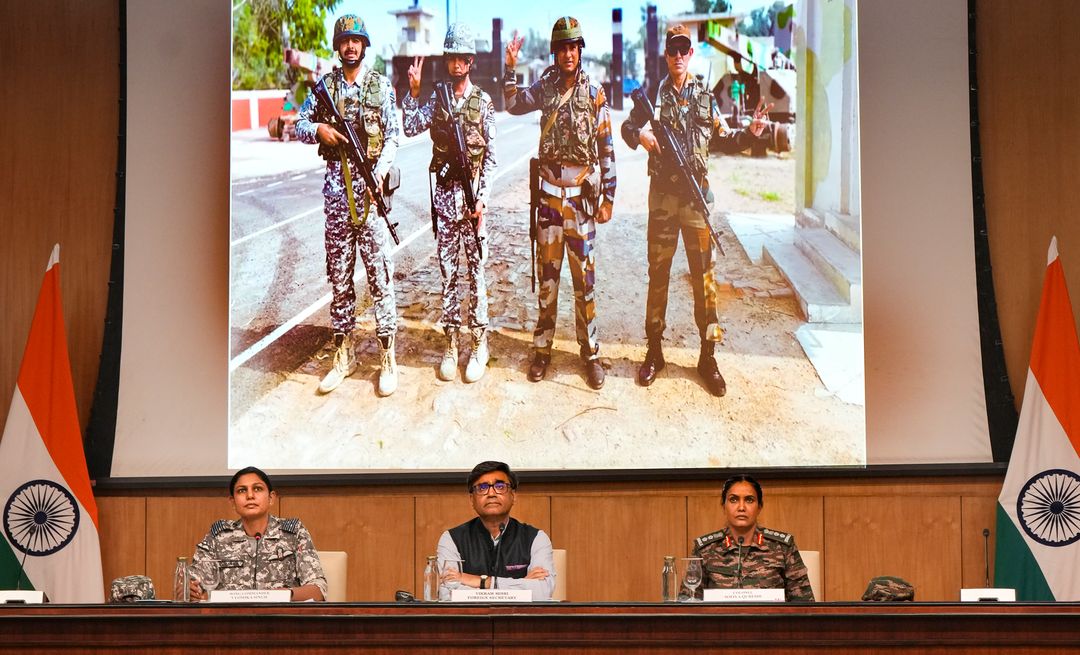
Indian military officials revealed that Pakistan is moving its forces into forward positions—an act interpreted as signaling "offensive intent." In response, the Indian Armed Forces have heightened their operational preparedness.Military spokesperson Colonel Sofiya Qureshi, speaking at a special press briefing alongside Wing Commander Vyomika Singh and Foreign Secretary Vikram Misri, emphasized that while India is committed to de-escalation, it expects the same from Pakistan.
Targeted Indian Response to Civilian and Military Attacks
Foreign Secretary Vikram Misri criticized Islamabad for launching deliberate attacks on civilian infrastructure in Jammu and Kashmir and Punjab. According to Colonel Qureshi, Pakistan carried out missile strikes after 1:40 a.m. targeting medical and educational facilities at airbases in Srinagar, Awantipora, and Udhampur.In response, India launched precision air strikes on Pakistani military installations including command-and-control centers, radar sites, and weapons storage facilities at Rafiqui, Murid, Chaklala, Rahim Yar Khan, Sukkur, and Chunian. Additional targets included radar stations at Pasrur and the Sialkot aviation base.
Qureshi stressed that these retaliatory operations were conducted with a focus on minimizing collateral damage.
Multiple Threat Vectors Neutralized
Wing Commander Vyomika Singh elaborated on Pakistan’s use of unmanned combat aerial vehicles (UCAVs), loitering munitions, and heavy artillery, noting that the provocations spanned across over 26 locations from Srinagar to Naliya. Pakistan also used drones for air intrusions and carried out shelling across the Line of Control (LoC).While India’s military successfully neutralized the majority of these threats, limited damage was reported at Indian Air Force stations in Udhampur, Pathankot, Adampur, and Bhuj.
Pakistan’s Misinformation Campaign Dismissed
India dismissed as false Pakistan’s claims of having destroyed strategic Indian military assets. These included allegations about the destruction of the S-400 system at Adampur, airfields at Suratgarh and Sirsa, and key locations like the BrahMos base at Nagrota.To counter these narratives, Indian officials shared visual evidence from airbases in Punjab and Rajasthan, showing that runways and infrastructure remained intact and fully operational.
Ongoing Conflict and Heavy Exchange of Fire
Colonel Qureshi also confirmed that Pakistan continued heavy artillery and small-arms fire across sectors including Kupwara, Baramulla, Poonch, Rajouri, and Akhnoor. The Indian Army has retaliated effectively and proportionately, reportedly causing significant damage to Pakistani forces.Despite the volatile situation, India has reiterated its intent to avoid further escalation—but made clear that it will continue to respond decisively to any threats to its sovereignty and civilian safety.