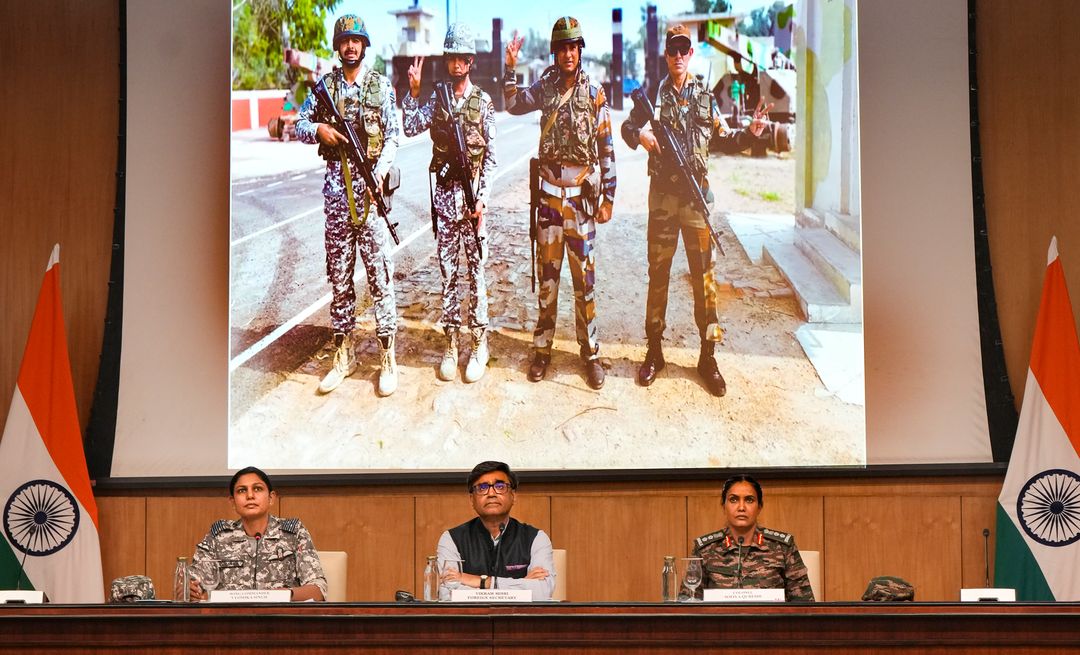
India Issues Measured Yet Forceful Response Amid Soaring Tensions
New Delhi, May 9 — In a significant escalation of hostilities, India on Saturday announced that it had conducted precision strikes on eight Pakistani military installations in response to Pakistan’s “provocative” attacks targeting Indian defence and civilian infrastructure using drones, long-range weapons, and fighter jets.The Indian military said the targets included weapons depots and command centres, indicating the seriousness of the engagement as both countries stand on the brink of a full-scale war.
Indian Forces in High Operational Readiness
Colonel Sofiya Qureshi, addressing a special press briefing alongside Wing Commander Vyomika Singh and Foreign Secretary Vikram Misri, confirmed that Pakistan is moving troops into forward areas, displaying what she described as “offensive intent.”She stressed that the Indian armed forces remain in a heightened state of operational readiness but reiterated their commitment to non-escalation — provided Pakistan reciprocates.
Precision Strikes Under Operation Sindoor
According to Colonel Qureshi, India’s calibrated military response was conducted using air-launched precision weapons. Pakistani targets at Rafiqui, Murid, Chaklala, Rahim Yar Khan, Sukkur, and Chunian were engaged, focusing on command centres, radar installations, and weapons storage areas. Radar sites at Pasrur and the Sialkot aviation base were also targeted.These retaliatory strikes follow the deadly Pahalgam terror attack on April 22, which claimed 26 lives. India had earlier launched Operation Sindoor on May 7, striking terror hubs in Pakistan and Pakistan-Occupied Kashmir.
Pakistan’s Attacks on Indian Infrastructure
Qureshi outlined how Pakistan launched attacks using drones, loitering munitions, and jets, targeting Indian airbases in Srinagar, Awantipora, and Udhampur. Around 1:40 a.m., high-speed missile attacks were reported at multiple Punjab airbases.Despite Pakistan’s use of varied threat vectors, Qureshi said, “All hostile actions have been effectively countered and responded appropriately.”
Ground Reality: Limited Damage, No Major Setbacks
Wing Commander Vyomika Singh revealed that Pakistan attempted over 26 air intrusions from Srinagar to Naliya, alongside harassment attacks and heavy shelling along the Line of Control (LoC).While India successfully neutralized most threats, limited damage was reported at Indian Air Force stations in Udhampur, Pathankot, Adampur, and Bhuj. The officer categorically dismissed Pakistani claims of having destroyed India's S-400 systems, airfields, and ammunition depots, labeling them as part of a “malicious misinformation campaign.”
Images presented at the briefing showed intact runways and operational airbases at Sirsa and Suratgarh, contradicting Pakistani propaganda.
Ongoing Shelling Along LoC
Heavy artillery exchanges continue in Kupwara, Baramulla, Poonch, Rajouri, and Akhnoor sectors. Qureshi said that Pakistan shelled civilian areas and infrastructure, leading to casualties. India’s response has caused “extensive damage” to Pakistani positions.Diplomacy in Motion: G7, US, Saudi Arabia Call for Restraint
Foreign Secretary Vikram Misri rejected Pakistan's allegations of Indian missiles hitting Afghanistan, calling them “ludicrous” and “totally frivolous.”As tensions escalated, the G7 group called for immediate de-escalation through dialogue. US Secretary of State Marco Rubio, in a phone call with External Affairs Minister S Jaishankar, emphasized the need for re-establishing communication to avoid miscalculation, even offering US support in facilitating discussions.
Meanwhile, Saudi Arabia reiterated its commitment to promoting peace, confirming efforts to mediate between the two nuclear-armed nations and encourage diplomatic resolution.