In New Delhi, February 15, politics no longer feels like politics; it feels personal, even eccentric, with rhetoric that alienates more than it persuades. The tone emphasizes grievance over governance and emotion over institutional building. The result is the impression of someone seeking power without the patience of political work, who seems to believe leadership is inherited rather than earned – a mindset perhaps shaped by the comforts of dynastic rule.
Rahul Gandhi is not just leading the opposition; he is redefining it into a spectacle. In a democracy that demands rigor, responsibility, and resilience, his politics increasingly resembles performance over purpose.
When the Leader of the Opposition treats Parliament as a platform for provocation rather than persuasion, it undermines institutional credibility.
Democracy depends not only on the strength of those in power but also on the maturity of those who challenge it.
Remaining in office consecutively in a country as vast and politically complex as India is never easy. It requires organization, discipline, effective action, and relentless political work.
Prime Minister Narendra Modi's work ethic and political discipline are often cited as reasons for the BJP's continued dominance. However, there is another factor that cannot be ignored: the nature of the opposition he faces, and Rahul Gandhi, its leader.
What Parliament witnessed between January 28 (when the Budget Session commenced) and February 13 (when the first phase concluded) raises serious concerns. Instead of sustained legislative engagement, the House saw repeated disruptions and headline-driven confrontations. The opposition benches appeared more committed to amplifying a single political narrative than to structured policy debate.
This pattern has become familiar. The Congress party has made grand allegations with dramatic branding, such as the "vote chori" campaign and the so-called "H-Files," alleging manipulation of nearly 25 lakh votes in the 2024 Haryana Assembly elections.
Earlier, serious accusations were leveled against the Election Commission of India, alleging "criminal fraud" and collusion with the BJP to steal elections, including claims that 1,00,250 "fake votes" were created in the Mahadevapura Assembly seat under the Bangalore Central Lok Sabha constituency in Karnataka to secure a BJP victory. These charges, presented with theatrical urgency, failed to produce substantive political impact.
Similarly, when the Viksit Bharat-Guarantee for Rozgar and Ajeevika Mission (Gramin) Act, 2025, popularly known as the G RAM G Law, was passed by Parliament in December 2025, the Congress party announced nationwide protests. Dates were declared for a massive mobilization.
Yet, the promised agitation failed to materialize. The protests were postponed, rescheduled, and eventually fizzled out. Apart from scattered demonstrations in Congress-ruled states such as Karnataka, there was no national momentum.
Electoral verdicts have repeatedly signalled voter expectations. In Bihar, the narrative failed to resonate. In Maharashtra's local body elections, including the prestigious BMC polls, the Congress party struggled to convert rhetoric into results. In most political formations, repeated setbacks prompt introspection – new strategies are crafted, leadership roles are recalibrated, and messaging is refined. However, Congress appears to have chosen spectacle over self-correction.
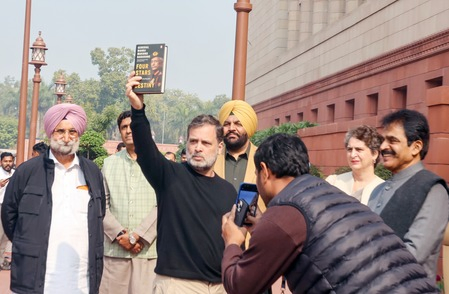
Rahul Gandhi’s conduct during the Budget Session reinforced this perception. Episodes surrounding former Army Chief M.M. Naravane's book, the public attack on Union Minister Ravneet Singh Bittu, and the "grip-and-choke" remark during the Motion of Thanks debate seemed designed more for viral visibility than parliamentary persuasion. Politics today undoubtedly operates within a digital ecosystem, but legislative seriousness cannot be replaced by social media traction.
The events of February 4 marked a particularly troubling moment. When the Speaker of the Lok Sabha advises a sitting Prime Minister to avoid entering the House due to security concerns arising from protesting Members of Parliament, something has gone profoundly wrong. Disruption has long been part of parliamentary culture in India. But there is a line between protest and institutional breakdown. Crossing that line repeatedly erodes democratic norms.
The deeper concern lies in what appears to be a recurring strategy: escalate confrontation, invite reaction, and then frame oneself as a victim of institutional suppression. This approach may energize a committed support base, but it does little to build broad national confidence.
India’s electorate has historically demonstrated political sophistication. It rewards sustained effort, organizational discipline, and credible alternatives. It does not, for long, reward perpetual grievance. When the Congress-led Opposition prioritizes spectacle over substance, it inadvertently reinforces the ruling narrative of stability versus chaos.
None of this suggests that dissent should be muted.
On the contrary, a strong democracy demands a vigilant and assertive opposition. But the dissent must be anchored in facts, preparation, and institutional respect.
There may be some who find the drama compelling. But India, by and large, remains unimpressed by spectacle unaccompanied by seriousness. In a democracy of 1.4 billion people, performance may create noise. Only responsibility creates trust.
Rahul Gandhi, who carries a miniature Constitution in his pocket, must also demonstrate the will to practice.