Defends India's Retaliatory Strikes After Pahalgam Attack, Warns Terrorists of Decisive Action
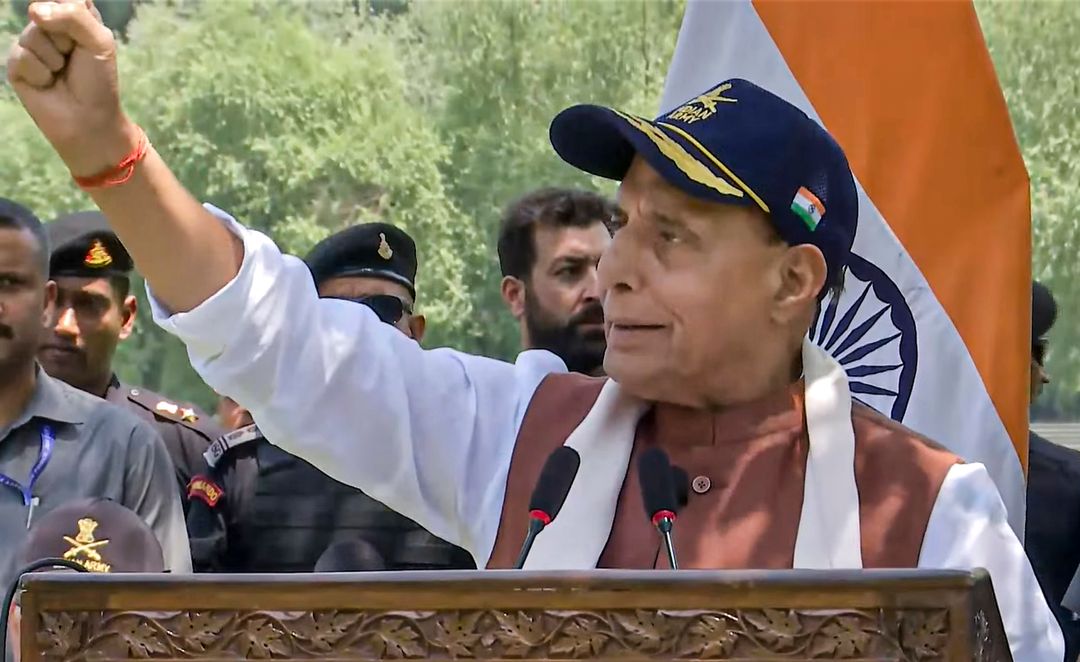
Srinagar, May 15 – Defence Minister Rajnath Singh on Thursday called for Pakistan's nuclear weapons to be placed under the supervision of the International Atomic Energy Agency (IAEA), citing serious concerns over their safety in what he termed a "rogue nation."Addressing troops in Srinagar during his first visit to Jammu and Kashmir since the conclusion of Operation Sindoor, Singh criticized Pakistan's repeated nuclear threats to India and emphasized that India had not succumbed to what he described as “nuclear blackmail.”
“The whole world has seen how irresponsibly Pakistan has issued nuclear threats to India. From the land of Srinagar, I ask the global community: Are nuclear weapons safe in the hands of such an irresponsible and rogue nation?” Singh stated.
Operation Sindoor: India’s Strongest Message Yet Against Terrorism
Calling Operation Sindoor the “biggest” anti-terror action in India’s history, Singh declared that the country is now willing to go to any extent to crush terrorism emanating from across the border.“They attacked India’s forehead in Pahalgam, we responded by targeting their chest,” he said, referring to the recent terrorist attack that aimed to disrupt national unity.
Singh reiterated that India’s policy under Prime Minister Narendra Modi had shifted significantly, making it clear that any terrorist attack on Indian soil would now be treated as an "act of war."
Pakistan’s Betrayal and the Price of Terror
Reflecting on past diplomatic efforts, Singh recalled former Prime Minister Atal Bihari Vajpayee’s visit to Pakistan 21 years ago, during which Pakistan pledged not to export terrorism.“But Pakistan betrayed us then and continues to do so. It will now have to pay a heavy price, and if terrorism continues, this price will only increase,” he warned.
He further stressed that dialogue with Pakistan is only possible if it focuses on terrorism and Pakistan-Occupied-Kashmir (PoK).
Retaliation After Pahalgam: Eight Pakistani Bases Targeted
Singh confirmed that India had conducted precision strikes on May 7, targeting terror infrastructure following the Pahalgam attack. In retaliation to Pakistan’s attempts to strike Indian military installations on May 8, 9, and 10, India launched missile and long-range weapon attacks on eight Pakistani air bases on May 10.The escalating hostilities deescalated following a conversation between the Director Generals of Military Operations (DGMOs) of both countries on May 10 afternoon, leading to a ceasefire.
Criticism of Pakistan’s Economic Condition
Taking a jibe at Pakistan’s financial troubles, Singh remarked that the country had become so dependent on foreign loans that it had become synonymous with begging.“Wherever Pakistan stands, the line of beggars starts from there,” he said. “Our country, on the other hand, is now among those that lend to the IMF to help other nations.”
Salute to the Forces
Commending the armed forces for their valor and response to the Pahalgam incident, Singh expressed pride in the military’s strategic and courageous retaliation.“I know how it feels when the blood in your veins boils with anger. But I am proud that you turned that anger into a powerful response and gave the country justice,” he concluded.
The visit underscored India’s firm stance against cross-border terrorism and conveyed a stern message to those who threaten national security.