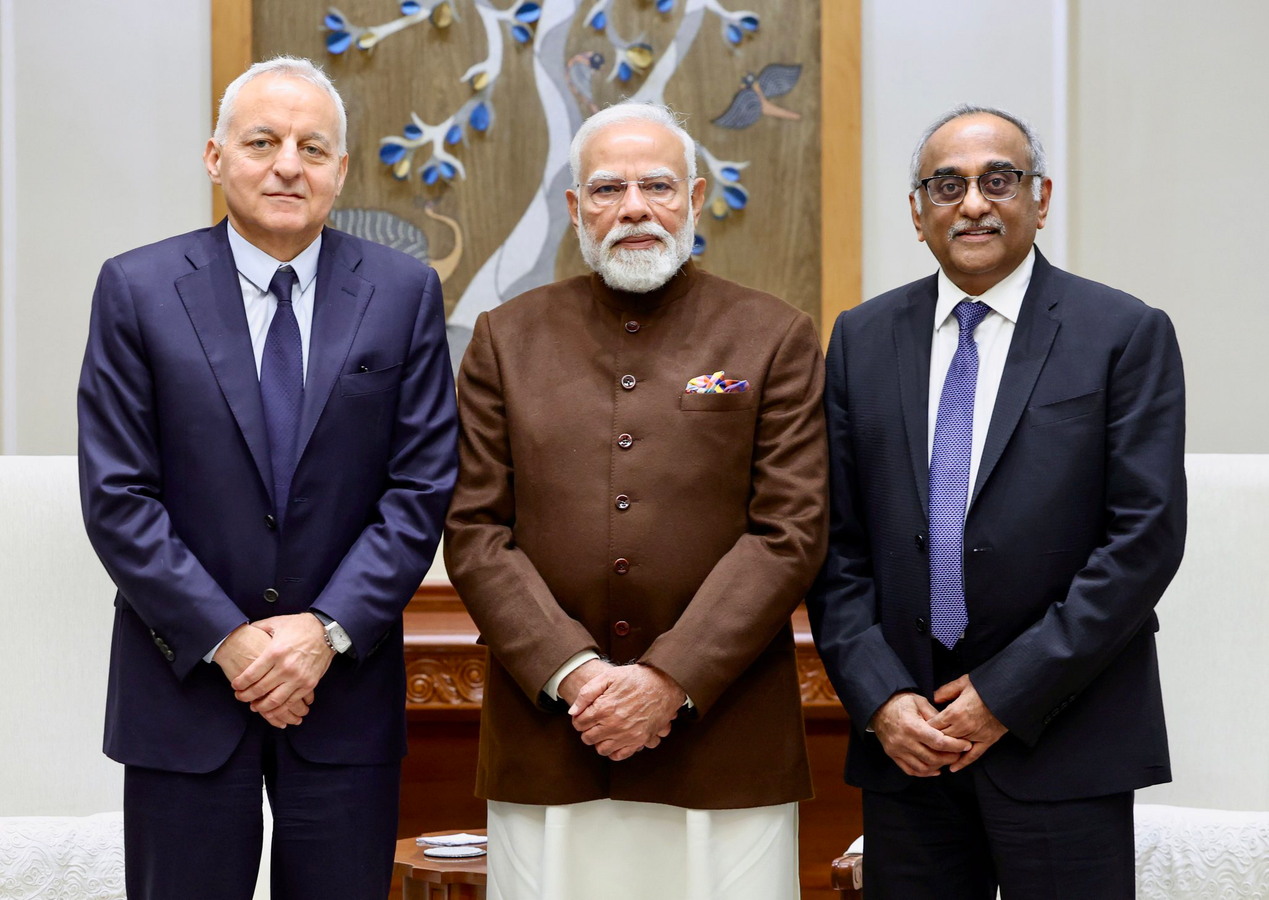
A day after meeting with Prime Minister Narendra Modi, Rolls-Royce CEO Tufan Erginbilgic unveiled a strategic roadmap on Thursday to expand the company's operations in India across defense, energy, and civil aviation, including plans to co-develop a next-generation combat jet engine for India with full intellectual property transfer.
Under this initiative, Rolls-Royce aims to more than double its workforce in India to approximately 10,000 people and increase local supply chain sourcing by 10-fold, with the long-term goal of establishing India as a global hub for its high-tech manufacturing.
"As we expand our involvement in programs across India's defense, aviation, and energy sectors, we will strengthen our presence in India, as we have successfully done in other countries," Erginbilgic said.
Besides meeting with the prime minister, Erginbilgic also held separate discussions with National Security Advisor Ajit Doval and Commerce Minister Piyush Goyal.
"We welcome Rolls-Royce's enthusiasm for scaling up its operations in India and partnering with our innovative and dynamic youth," Modi said on social media last night.
The leading aero-engine maker is focusing on making India its third "home market" outside the UK, in line with its strategy to fully leverage opportunities in jet engine, naval propulsion, land systems, and advanced engineering development.
"Our ambitions for India are built on the strong foundations of our decades-long presence in the country, our growing footprint, our deep industry partnerships, and our competitively advantaged technologies," the Rolls-Royce CEO said.
"We are committed to partnering with India on its Atmanirbhar journey, by developing indigenous propulsion capabilities, providing sustained power to critical infrastructure and industry, and expanding local manufacturing for global supply chains."
Among the major defense projects, Rolls-Royce is prioritizing the development of a next-generation aero engine in India to power the combat jets that New Delhi will produce under the Advanced Medium Combat Aircraft (AMCA) program.
Rolls-Royce, in collaboration with the UK government, is offering to co-develop a 120 kN class combat jet engine core that could be India's fastest route to an indigenous next-generation engine.
This co-development will provide full technology transfer with IP ownership for India, supported by a dedicated design complex and manufacturing capabilities that will create significant job opportunities.
"We believe our unique portfolio of advanced capabilities can help us further expand our presence and partnerships, to power, protect, and connect India for decades to come," Erginbilgic said.
British High Commissioner to India Lindy Cameron welcomed Rolls-Royce's expansion plan for the country.
"Rolls-Royce has a lot to offer India. And India has a lot to offer Rolls-Royce! Their announcement is set to boost investment and job creation in India and further contribute to India's growth story," she said.
"From powering India's civil and defense aerospace to advancing digital and engineering capabilities -- this is exactly what our shared UK-India Vision 2035 envisions," Cameron said on 'X'.
The announcement by Rolls-Royce builds on the India-UK strategic cooperation and the India-UK Vision 2035 roadmap for deeper bilateral industrial and defense collaboration.
More than 1,400 Rolls-Royce engines are currently powering various defense platforms such as the Jaguar combat aircraft and Hawk trainers of the Indian Air Force and Navy, the Arjun Main Battle Tanks of the Army, and a variety of vessels and submarines of the Indian Navy and Coast Guard, including the prestigious anti-submarine warfare shallow water crafts and the P17 Alpha frigates.
The company said it is eyeing to scale-up its business in India to support future programs and partnerships across defense, civil aviation, and energy, adding it is looking to position the country as a global hub for its most complex high-tech manufacturing.
Rolls-Royce said its ambition is to make India a strategic home market, supporting the country's Viksit Bharat vision for national security and deterrence, energy resilience, infrastructure development, and air connectivity.
"Rolls-Royce is currently exploring opportunities in India that include the potential co-development of a next-generation combat jet engine; as well as partnerships to localize and manufacture engines for the Indian Army, Navy, and Coast Guard and potentially power solutions for critical infrastructure and industry," the company said.
"These initiatives could more than double the size of the workforce that supports Rolls-Royce and its partners, to approximately 10,000 people in India," the company said in a statement.
It said Rolls-Royce believes the opportunities it is looking to secure could lead to a 10-fold increase in the company's supply chain sourcing from India, a move which it noted would nurture and benefit many small and medium-sized enterprises (SMEs).
In his meeting with Modi, Erginbilgic discussed the company's plan to be part of 'Viksit Bharat' (developed India) and how its advanced technologies can support India's growth plans and Atmanirbhar journey in critical sectors of the economy, the British firm said in a readout.
Sashi Mukundan, the executive vice president of Rolls-Royce India, accompanied Erginbilgic in the meeting with the prime minister.
At present, more than 4,000 people are working across the Rolls-Royce ecosystem in India, including 2,800 engineers who contribute to global programmes across its businesses.
The company's long-standing industrial footprint includes its manufacturing joint ventures with HAL and Force Motors as well as sourcing partnerships with over 100 different vendors including Tata, Bharat Forge, Godrej, Azad Engineering and many small and medium sized enterprises (SMEs).
Rolls-Royce recently inaugurated its newly expanded Global Capability and Innovation Centre in Bengaluru, which houses digital capabilities, enterprise services, and engineering teams supporting its civil aerospace and defence divisions.
The centre serves global corporate functions while advancing digital and engineering expertise, according to the company.