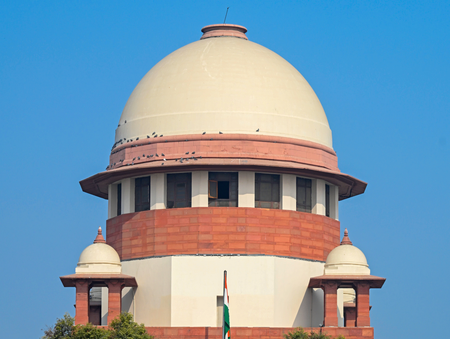
New Delhi, February 14 – A public interest litigation (PIL) has been filed in the Supreme Court seeking directions to the Centre and state authorities to install "display boards" at police stations, court complexes, and public offices, highlighting the penal provisions and punishments for filing false complaints, false charges, and providing fabricated evidence.
The plea, filed by advocate Ashwini Kumar Upadhyay through his legal representative, Ashwani Kumar Dubey, argued that such preventive measures are essential to secure the right to life, liberty, and dignity of innocent citizens guaranteed under Article 21 of the Constitution.
According to the petition, the proposed display boards should be installed at all police stations, tehsil and district court premises, panchayat buildings, municipal offices, and educational institutions, clearly stating the provisions and punishments for false complaints, false charges, false statements, false information, and false evidence.
The petitioner has also sought directions to state authorities to inform complainants about the legal consequences of filing false complaints before registering an FIR or accepting any complaint.
"The authorities must inform the complainant about the punishment for false complaints, false charges, false statements, false information, and false evidence before accepting the complaint, in order to secure the freedom of speech and expression of innocent citizens," the plea stated.
In addition, the petition has sought directions to authorities to obtain an undertaking or affidavit from complainants affirming that the statements made in the complaint, information, statement, evidence, and charges are true and correct, in order to curb frivolous litigation and malicious prosecution.
The plea cited data from the National Crime Records Bureau (NCRB) reports, claiming that there is a significant disparity between the number of cases registered and convictions under several special criminal laws, with a disproportionately high number of acquittals.
"This statistical pattern reveals a structural problem of false complaints, false charges, and fabricated evidence clogging the criminal justice system," the petition stated.
Referring to the Law Commission's 277th Report, the petitioner argued that false charges, fabricated evidence, and wrongful prosecutions have been identified as primary causes of miscarriage of justice and violation of Article 21.
The report noted that existing remedies are "episodic, uncertain, and ineffective," and that a large percentage of undertrials ultimately face acquittal after years of incarceration.
The plea further stated that despite the enactment of Chapter XIV of the Bharatiya Nyaya Sanhita, 2023, the absence of any administrative or preventive mechanism has rendered the provisions largely ineffective.
The petition claimed that unchecked misuse of criminal law creates a chilling effect on freedoms guaranteed under Article 19, including freedom of speech, movement, and the right to carry on trade and profession, as fear of malicious prosecution suppresses legitimate dissent and enterprise.
"False complaints and malicious prosecutions convert the criminal process itself into punishment, resulting in loss of liberty, social stigma, mental trauma, and irreversible damage to reputation, even in cases ending in acquittal," the plea stated, adding that speedy trial and the presumption of innocence become meaningless when false cases proliferate unchecked.
Stating that the judiciary is overburdened due to false complaints, false charges, and fabricated evidence, the petitioner submitted that neither the Centre nor the states have taken effective steps to control the menace, necessitating judicial intervention by the Supreme Court.